

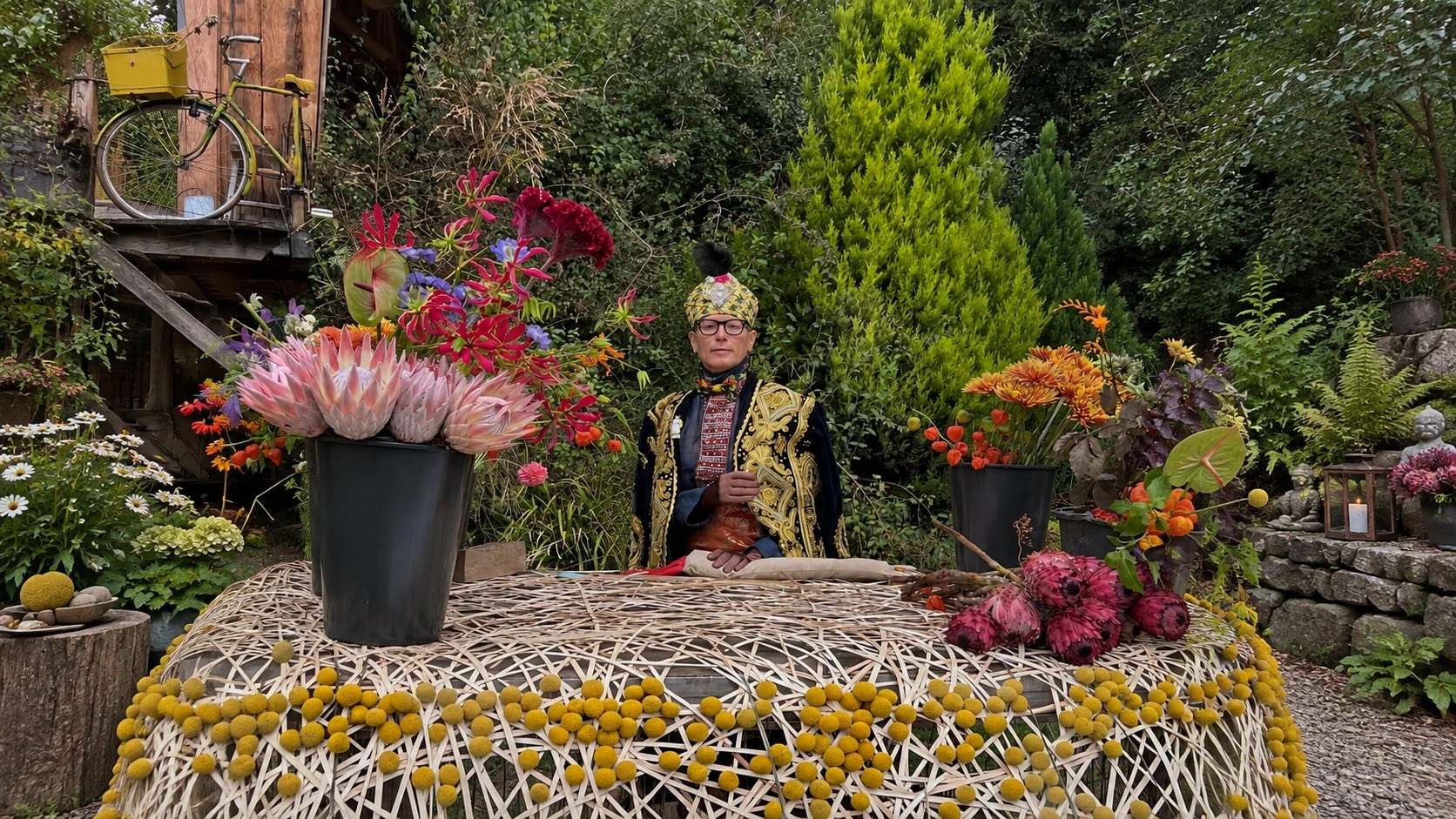

Andrey Bartenev is one of Russia’s best-known performance artists. He was born in Norilsk, above the Arctic Circle, in 1965, graduated from the theatre directing faculty in Krasnodar and worked as a director for six months, after which he left for Moscow — where, in his words, his “I do what I want” began.
His first success was the Grand Prix of 1992 for Botanical Ballet, a performance with moving paper sculptures; a year later The Snow Queen travelled to London’s Royal Festival Hall, and in 2007 he represented Russia at the Venice Biennale. His work is held in MMOMA, in the Willem de Kooning Foundation in New York and at Watermill on Long Island.

He makes enormous textile sculptures and climbs inside them himself. And for thirty years he has insisted on joy in an art world that generally prefers severity.
In September he came out onto the stage of the Open Air Theatre in Regent’s Park in London on all fours, in a crocodile costume, and took second place at Alternative Miss World.
It’s the legendary competition that the sculptor Andrew Logan invented in 1972 in a converted jigsaw factory in Hackney — as an answer to sexism, and modelled on the Crufts dog show, from which he took the judging criteria: poise, personality and originality.
The first jury included the artist David Hockney; in 1975 the director Derek Jarman won; later judges included the musician Brian Eno, the drag icon Divine, the photographer David Bailey, Pulp frontman Jarvis Cocker and Duran Duran. The competition happens not every year but whenever Logan feels the time has come: sixteen times in fifty-four years. In 2018 Bartenev won Alternative Miss World as Miss UFO.
The artist is currently occupied with a new project, Andy Barrt.
Here he talks about why contemporary art is needed at all: he considers it training for a consciousness that otherwise won’t withstand the speed at which informational progress comes at us. About how a costume changes not only the viewer but the person inside it — right down to the vector of their fate. About how the idea comes not from the artist but from the future. About the word “artist”, which in his teenage Norilsk worked as a shield. And about why comparing yourself to others means betraying your calling.
And he names the museums of contemporary art that, in his opinion, everyone should see.
“Contemporary art is training for future superheroes. Training for a future superconsciousness.”
“And Who Are You?” — “I’m an Artist”

If someone comes up to me in the street and asks who I am and what I do, the answer depends on who’s asking. If it’s a Russian speaker, then most likely I’ll say I’m Andrey Bartenev. If a foreigner asks — or if I were asked the question at an airport — I’ll say: I’m an artist. Of course I’m an artist. It’s the most unique verbal form, one that precisely defines who I am and what I do.
What irritates me is being called a fashion designer. Because I’m not a fashion designer, I never was: I have never been involved in replicating my constructive ideas in the business of building clothes. I never replicated them — they were always unique, made in a single copy, and mostly I wore them myself.
The word that protects
By the age of eleven I had already understood: if somebody starts asking me — and who are you? — I say: I draw, I’m an artist.

And something clicked in people when they heard it: ah, a holy fool of sorts, fine, let’s leave him alone. I’m explaining it trivially here, of course. It turned out that the word “artist”, in all its capacity and many-sidedness, also works as a practical method for preserving the person who carries it. The surrounding environment immediately became softer, more favourable towards a person who calls himself an artist.
It’s the same when a person says: I’m a performer, I’m a pianist. When you hear it, everyone immediately understands that one should be careful with this person, that he has some kind of calling, some heavenly kiss on the crown of the head.
And even as a teenager I understood it on my own skin: in situations where people come to smash your face in, you say “I’m an artist” — and they change their minds about smashing your face in. That’s already good help. And maybe I avoided sixty or seventy per cent of the beatings that way.
“You say ‘I’m an artist’ — and people change their minds about smashing your face in.”

But an artist is not a roll of honour
Comparing yourself with others is a big mistake. The moment you start conducting comparative, evaluative procedures, you immediately betray your calling. And you’ll immediately get a metal ruler across the nose.
Because creativity isn’t about commercialisation, it isn’t neuro-careerism. Creativity is not a roll of honour, you understand. Creativity is living energy. And the further you go from all those regulations and postulates of socialisation that all the curators, museum people and art historians sing about, the better for the artist — because he will reach the highest meanings, which nobody will ever discover or find.

And if he listens to all the curators, museum people and art historians, he will be torn apart. His soul will want to sing, and his brain will be watching how that singing fills his wallet. And that is where the personality tears. It simply tears.
Wedding-Joy: How the Future Dictates What to Cut
Wedding-Joy, or the Adventure With the Abduction of the Bride is a static opera after Stravinsky’s Les Noces, shown this summer at the TON Centre in Moscow. It was staged by the director and curator Katya Bochavar, the libretto was written by Evgenia Nekrasova and the music by Vladimir Rannev. Bartenev made twelve characters.
The main and largest character is Ivan Kupala: the principal events take place on Kupala night.
Some sketches the tailors executed exactly — there I only watched that the construction corresponded to the original drawing. But there were characters that wouldn’t fit into the given form at all. They flatly refused: no, no, no, I’m not like that.


And here you had to take a pause. To think. In that moment of reflection — it’s a kind of meditation — you send your consciousness into the future and ask: so what on earth should this character be, why isn’t it working? And the answer comes.
I understood that sometimes there is a dictation from the future. The future already knows how it looks, and it begins to dictate how you should wave your arms, how to cut, which ornaments to choose, and what this final compote should turn out to be.
Silent resistance
There were no actors in this opera. The figures were textile sculptures: the inner circle of the stage rotates clockwise, the outer anticlockwise, and transparent metal podiums added height. Like a wedding cake.
And when there’s no actor who can say “no, I don’t want to”, the resistance becomes silent — and in silent resistance the voice of the future is heard most loudly of all.
If you don’t submit, there’ll be a fracture, and everything will collapse into it. Once I understood that the greater part has been invented by the future, and that I am simply an obedient bio-robot who has to repeat it, everything began to come out perfectly.
“The future already knows how it looks, and it begins to dictate how you should wave your arms, how to cut.”
Alternative Miss World: The Crocodile That Fell Apart on Stage
In parallel I was preparing my appearances for Alternative Miss World in London — with the same tailors, in the pauses between work on the opera. There are three appearances there — day, beach and evening — and we made three crocodiles: a green one that crawls on all fours, and a white and a pink one that walked on their hind legs.

I realised that of the seventeen contestants hardly anyone would go on all fours. So the first appearance is on all fours. Alexander Khromov, director of the DR.Robot gallery in Valencia, buys giant basketball knee pads at a sports shop. And as soon as I crawled out onto the stage, those knee pads — the costume was natural green leather — rode straight up to my hips. My knees were bare. For two weeks after the performance they were a bruised blue, because I was hitting the stage at Regent’s Park with live knee meat.
But improvisational enthusiasm switches off the pain receptors: while you’re carrying out this act, all of it disappears. The pain arrives the next day.
There was no white crocodile
Backstage, I unpack my suitcases — and it turns out that of the white crocodile there is nothing at all except the tail and the jaws.

For a fraction of a second I was in shock. But fortunately we had devised with the tailors a single base onto which the elements of both the pink and the white are mounted. I combine the foam base with the white leather tail and jaws.
This was dictated by a turn of fate. There is nothing here of my will or unwillingness as an artist. Fate said: one part of one costume will be lost, and in the end the story will look like this.
And the result was a Homeric story. The tail, in movement, turned out to be very short, wound itself around my left leg and no longer looked like a tail. And the jaws, under the weight and inertia of my movement, fell off and wanted to turn into a jabot — I had to hold them up with my front right paw to preserve at least some semblance of a crocodile. People saw all of it, and it produced Homeric laughter: the idea exists, and the execution is somehow absurd — and that gives the character an inimitable satirical quality.
Turn minuses into pluses — and it has to be done instantly. You can reason about how it would have been if everything had been ideal. But then, perhaps, it wouldn’t have turned into an adventure. This way it was an adventure. And the fact that you responded to it with your wits is a good lesson for an artist.
“Turn minuses into pluses — and it has to be done instantly.”
An audience that arrived already dressed up
There were fifteen hundred people there, and all of them already in costume: air stewardesses, mermaids, mushrooms, musketeers. All already modified in one way or another — and they were looking at the examples of transformation the contestants show, and judging them. The jury sat bold and distinguished, headed by Zandra Rhodes, and was ready for unexpected jokes and sallies to come flying from the stage.
I set up my entrance like this. First the actress Kesha runs out, shouting “Crocodile”, scattering leaflets — vote for Miss Crocodile — runs up to the judges’ table, takes a wooden crocodile out of her bra and throws it onto Zandra Rhodes’s lap. And runs off. And then, under that shouting, I crawl out and start trying to bite Andrew Logan’s leg.
Analysing it afterwards, I understood that there’s a reincarnation in it of Priscilla, Queen of the Desert — there’s a song there where they crawl out onto the stage like lizards. This points to the fact that an artist’s brain is a kind of vacuum cleaner: something fell in there thirty years ago, and thirty years later it sprouts and says — let’s get it out of the storeroom, let’s realise it. And here, as with the static opera, you have to listen: it’s the future talking again, and it said — now is our time.
In the end I got second place: first place was already behind me. It was a fantastic joy. The backstage life there is astonishing — the energy and the impulses of everyone waiting in the wings, an incredibly curious game and a unique test for an artist. I have taken part since 1995 and I hope to keep taking part as long as this festival exists.
“An artist’s brain is a kind of vacuum cleaner. Something fell in there thirty years ago, and thirty years later it sprouts.”
What a Costume Does to the Person Inside It

Dressing up, colouring in your external image, is a magnificent moment of psychological influence on yourself. You press these reactive buttons. For example, if you put on all green and tie a gigantic pink bow around your neck — of course, willingly or unwillingly, you will change your manner of behaviour. Your movement changes, your voice changes, the text you will speak changes, your whole system of reactivity changes.
Thanks to dressing up you can change your fate. You can change the vector of your fate. Dressing up, I live out my multi-lives. We see it everywhere: how much people love to dress up, and how many festivals exist that give people a reason to dress up, to be someone else, to find in themselves the stories and narratives that in ordinary life are never in demand. And when you change clothes, you start to think: oh, I’m a knight, oh, I’m a horse, oh, I’m a crocodile, oh, a balloon, oh, a princess.
When I try on an infinite number of characters, heroes, costumes, I see that I’m not some frozen character. I’m only a moment of an endless flow. Because everything finds a response in me, everything awakens a new creative impulse. And that new impulse may look nothing like everything I did for the last five years. And I like that.
When you run, when you improvise, when you think reactively and respond to everyone on stage and in the hall — you have one task: to turn into a crocodile! To turn into an absurd, funny crocodile!
“I’m not some frozen character. I’m only a moment of an endless flow.”
Where Performance Went

If a person has the urge to move into socio-political actionism — then please, God grant him talent, let him find the pedals that need pressing or burning, and let his word be heard. Performance art was taken up by all the greens who rushed into museums to throw tomato paste and paint at the masterpieces of world culture: they use the forms of performance art to draw attention to their aims and objectives. And there is performance that explores the boundaries of beauty, humanism and creation, and through that discovers staircases of new visual aesthetics.
It’s like painting, you understand. In painting there are a great many talented artists, and each can paint his own. Even if a thousand talented artists take one thought and each paints it, there will be a thousand different versions of one thought. It’s exactly the same in performance: individual talent determines what that performance will be.
After social networks took over the world
When social networks took over the world — and TikTok first of all — all performance art and all actionism moved there, and in doing so they received a new evolutionary impulse, because a very large number of people on the planet began working in these genres. Musical performance, vocal, gender — it doesn’t matter. On the whole the performance art industry has undergone a fantastic evolution over the last fifteen years.
Where people used to say: “My God, what are you doing, what is this, it isn’t theatre, is it variety?” — now everyone understands that performance art is a powerful part of visual production. That’s why more serious researchers and more serious institutions are turning their attention to artists working in performance. And look: even an institution like the court is now involved in the procedures of researching and criticising performance art. And that’s astonishing.
And the best performance right now — you know it, of course: when Banksy made the painting, and the moment it was sold at auction the picture went straight through a shredder-destroyer, and strips came crawling out. Here’s another example: the banana that was bought and eaten, and then stuck back up. Or Lady Gaga in the meat dress — that’s already an old classic.