





Dzmitry Samal is a Paris-based eyewear and watch designer, founder and creative director of SAMAL DESIGN, and a SILMO d’Or winner for Best Designer of the Year. He grew up in Belarus, studied design in Minsk and Milan, and began his career designing automotive bodies at Renault and Alfa Romeo — where he specialized in front lighting, the part of the car that defines its identity.
In 2012, he launched 5DPI, a pixelated Tetris-inspired frame with lenses set from behind, and turned an experiment into a brand. Today his frames are handmade in France in the Jura, and he teaches at Créapole and LISAA Mode Paris while running the studio.
For Locals Insider, Dzmitry wrote about how 5DPI happened, what car headlight design taught him about eyewear, why every frame still starts with a freehand pencil sketch, who actually wears SAMAL DESIGN, the smaller boutiques in Paris and the Saint-Ouen flea market that inspire him, what he thinks of Meta’s smart-glasses collaborations, and the metal-chiseled Art Deco collection he’s working on right now.
Follow him on Instagram at @dzmitrysamal_officiel or explore the collection at dzmitrysamal.fr.

5DPI: The Pixelated Tetris Frames That Started Everything
5DPI — literally pixelated shape glasses — was one among many design projects I was exploring at the time, including cars, shoes, bags, jewelry, and watches. All of them shared one main inspiration: Retro Futurism. Retro mainly referred to the 80s — video games, fashion, that whole visual language — and futurism meant new materials, new technologies, new design possibilities.
5DPI was clearly a tribute to Tetris, with the originality of setting the lenses from behind. It looked like something a video-game character would wear if the video-game character were also a modernist.
When the Experiment Became a Brand
I first proposed my virtual designs on my website, as concepts. Then fashion and design blogs and magazines picked up the pictures of 5DPI and published them as a new, innovative frame. The demand and the interest were almost immediate.

That’s when I decided to look for a French manufacturer and turn the idea into a real business. I created my company and my brand in 2012.


From Belarus to Milan to Automotive Design
I began my career designing automotive bodies, with a particular fascination for front lighting and the way it defines a vehicle’s identity. Through my studies in Minsk and Milan, and later my work with automotive companies, I developed a strong command of geometry, ergonomics, comfort, and the relationship between form and function.

Milan became a turning point in my creative journey. It confirmed my passion for fashion and accessories — and it gave me the discipline that later shaped everything I would do with eyewear.
Glasses Are the Front Lights of a Face
Car headlights were often where I started when working on car bodies. They helped me define a personality for the car: sporty, aggressive, romantic, classic, retro. Headlights are the most expressive part of a car’s face — they show identity, mood, sometimes attitude.

For glasses, the principle is similar but the direction is different. My designs do not impose. They are meant to reveal the personality of their owner — to give them strength, self-confidence, and a feel-good sensation. I always think of the comfort of my frames and make them as light as possible.
“My designs do not impose. They are meant to reveal the personality of their owner.”
Where the Ideas Come From: Paris Architecture, Art Deco, and a Sketchbook
My actual main inspirations are Parisian architecture and Art Deco, urban constructivism, the intersection of geometrical shapes, 80s aesthetics, and car design. When I wander in the streets of Paris I always have a sketchbook with me. At the beginning of each of my models, there is always a freehand sketch.
As my fine arts professor once taught me, inspiration lies at the tip of the artist’s pencil. It is through drawing that ideas emerge, evolve, and ultimately take form.

“Inspiration lies at the tip of the artist’s pencil.”
The hardest part is proposing a genuinely original design that will neither be a gadget nor a disguise. Behind every design lies a rigorous process: refining proportions and shapes, selecting the right colors, and carefully developing every finish and fitting. My customer should feel comfortable wearing my frames — and be themselves.
Handmade in France: The Jura Ateliers

Every SAMAL DESIGN piece is handmade in France. I work with the best French atelier in the Jura — the historic heart of French eyewear manufacturing. They respect my designs precisely and remain open to all my suggestions, even when they transgress the common ways of the eyewear industry.
I am often at the atelier finding solutions with my supplier to make sure the final result is exactly as I dreamed it. Same language, geographical proximity, know-how, and quality — these are the reasons why all my frames are handmade in France.
All my collections have found success with my clients, though some have taken time to be fully understood. Sometimes recognition comes one or several seasons later. That’s part of working genuinely in design — the market doesn’t always meet you where you thought it would.

Who Actually Wears SAMAL DESIGN
You would be surprised — in fact, it can be any person. What our customers have in common is the desire to wear an exclusive and original product. We want to put a big smile on the face of every customer we meet, with no limitation of age, sex, or origin.

Paris Boutiques and Streets I Return To
Living in Paris, I visit different places for inspiration and shopping.
I love the independent labels around Rue de Poitou in the northern Marais — a small street that has become one of the most interesting concentrations of young fashion and design brands in Paris.
L’Eclaireur on Rue de Sévigné is another one — one of Paris’s original concept stores, still setting the standard for how a boutique can be curated as a full aesthetic experience rather than just a shop.
And the Marché aux Puces de Saint-Ouen — the Paris flea market at the northern edge of the city. It’s the place I go for objects, vintage pieces, and the unexpected details that show up later in a collection.
On Meta’s Smart Glasses and the Future of Eyewear
Meta and its partners — the Ray-Ban and Oakley smart glasses collaborations — are right to try to improve our possibilities with new technologies adapted to daily life. But they are looking for a consensual design for a mass market rather than an original one. I prefer staying creative and independent, and doing what I want.
“I prefer staying creative and independent, and doing what I want.”
Technology is evolving so rapidly that I believe, within a few years, we may have a single lens integrating all the functions of today’s smart glasses. The exciting part is that this technology could then be adapted to my own frame designs, allowing innovation to become part of the eyewear without compromising its aesthetic identity.
What’s Next: Art Deco Meets Metal Chiseling
Right now I am working on inserting metal chiseled pieces onto acetate frames for a new Art Deco–inspired collection. Handmade in France and limited edition, of course.
Where to Buy SAMAL DESIGN
Our store partners are listed on our website. You can also purchase directly from the site, with delivery worldwide. All frames can be set with prescription lenses.
- Online store: dzmitrysamal.fr — worldwide delivery
- In-person partners: listed on the site’s stockist page
- Prescription lenses: available on every frame in the collection
Three Paris Shops Dzmitry Actually Visits for Inspiration
Where SAMAL DESIGN founder Dzmitry Samal goes in Paris to find the details that end up in his next eyewear collection — a Marais concept store, an independent-label street, and the flea market at the northern edge of the city.
Rue de Poitou, 75003 Paris · runs between Rue de Turenne and Rue de Bretagne · nearest metros Filles du Calvaire (Line 8) and Saint-Sébastien–Froissart (Line 8) · See on Google Maps
The short, understated street in the northern Marais (Haut-Marais) that has become one of the most concentrated stretches of independent French fashion and design in Paris. AMI’s original store, Sézane’s flagship, Marin Montagut’s Provence-inspired atelier, and a rotating cast of smaller labels sit shoulder-to-shoulder here, with the Marché des Enfants Rouges (Paris’s oldest covered market) just around the corner on Rue de Bretagne.
Best to walk: the loop from Rue de Poitou to Rue Charlot to Rue de Turenne on a Saturday afternoon — the density of independent-label shopfronts per hundred meters is the highest in central Paris.
40 Rue de Sévigné, 75003 Paris · +33 1 48 87 10 22 · leclaireur.com · Mon–Sat 11am–7pm, Sun 2pm–7pm · nearest metro Saint-Paul (Line 1) or Chemin Vert (Line 8)
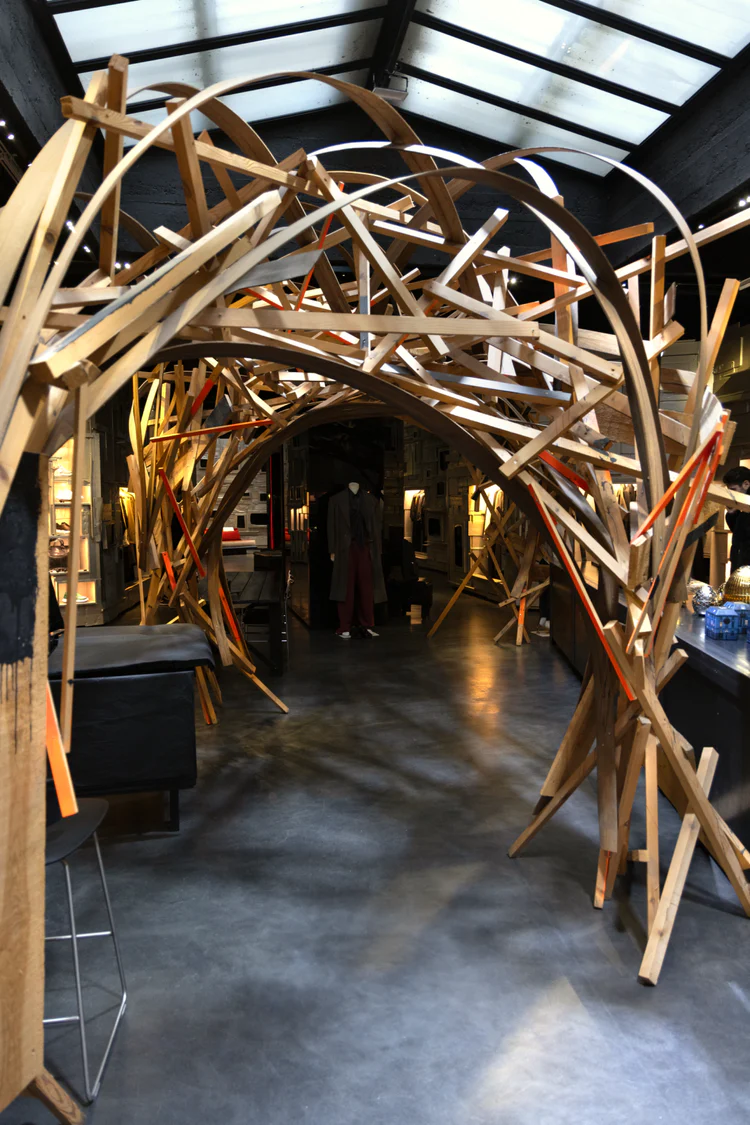
Paris’s original concept store, founded in 1980 by Armand and Martine Hadida — the boutique that first brought Prada, Helmut Lang, Dries van Noten, and Martin Margiela to France. The Rue de Sévigné location, opened in October 2009 and designed by Belgian artist Arne Quinze, is the one most worth walking into: reclaimed-wood walls, embedded video screens, and sliding panels that hide and reveal the collection. Six locations in Paris and one in Los Angeles, but this is the address.
Best to browse: the design and homewares floor as much as the fashion — L’Eclaireur has been an art-and-design curator since the 1980s and it still shows.
Main entrance: 142 Rue des Rosiers, 93400 Saint-Ouen-sur-Seine (northern edge of Paris) · metro Porte de Clignancourt (Line 4) · open Saturday, Sunday, and Monday only · Sat 9am–6pm, Sun 10am–6pm, Mon 11am–5pm · marcheauxpuces-saintouen.com
The largest antique market in the world — founded in the late 19th century, sprawling across roughly 7 hectares just outside the Paris périphérique. Fifteen distinct markets (each with its own personality) house more than 2,000 dealers selling everything from 18th-century furniture and Art Deco lighting to vintage Vuitton trunks, industrial salvage, and mid-century Scandinavian pieces. Considered protected French cultural heritage.
Best markets to start with: Marché Serpette and Marché Paul Bert for high-end 20th-century design; Marché Vernaison for vintage jewelry and objects; Marché Dauphine for books, records, and Art Deco. Go early for the best selection.
All addresses, opening days and details verified against each venue’s own site, Apple Maps, and the goop Paris guide. Saint-Ouen’s individual markets keep slightly different hours from the overall opening window — worth checking the specific market’s page before a targeted visit. Some markets are closed for renovations or private events, particularly in late summer.