
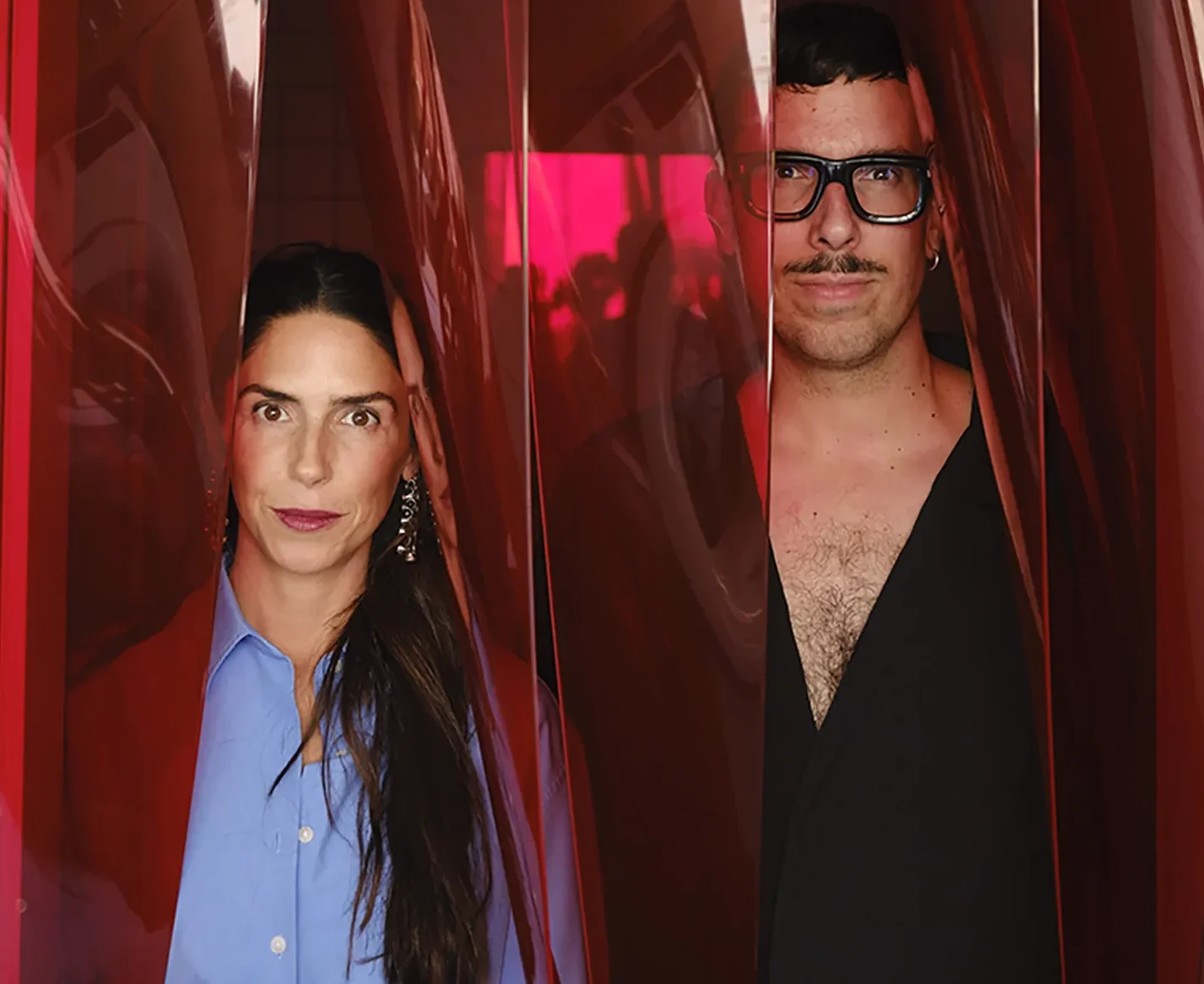

Most interior studios treat colour as the last decision: the thing chosen once the walls are up. Plutarco treats it as one of the materials you build with.
The Madrid studio was started by Ana Arana and Enrique Ventosa, who met while both were helping a mutual friend finish his architecture thesis. They began working together in 2015 and formally set up the studio in 2017, after their second showing at the Salone del Mobile in Milan. The name of their letter of introduction — EX-PER-IM-ENT-O — became the name of the building they now work from, which holds the studio, a design gallery, a coworking space and a room used for dinners.
Their work runs from furniture to whole houses. PDLL70, Arana’s own home in a three-storey Madrid villa built in 1934, was rebuilt as an argument for curves, pattern and a particular unexpected red; another recent project turned a house in La Moraleja into an explosion of colour. They are currently working on a hotel in Portugal and two in Norway, none of which they can say much about yet.

They spoke to Locals Insider about what the disciplines do for one another, which Spanish designers they watch, why complexity is coming back — and where they send people in Madrid.
“What sets us apart most is our use of colour as an additional constructive tool.”
How Plutarco Started: A Thesis, a Friend and a Competition
We studied architecture at the same university, but we met through a friend while working on the final thesis. Talking, we found out we loved design. We decided to take part in a design competition together, and we won. That was the beginning.


Architecture Is the Box. The Small Scale Makes It Habitable
Your work spans architecture, interiors, furniture and objects. What do you gain from combining them?
We always think that different disciplines complement each other. The architecture is the box that contains the rest, but the smaller scale is what reinforces the atmosphere and the human relationship with the space. The box without content and purpose loses coherence.

Where the Ideas Come From: Openings, Exhibitions, Food, Music
We find inspiration in everything. For us it is very important to always stay attuned to what is happening around us. From new venue openings and exhibitions to food and music — everything, in general, creates a vibe that helps spark the imagination.
It is essential to keep moving, to travel, to explore and to remain curious. That prompts us to reconsider and devise different solutions for our projects.

The Spanish Studios Worth Watching Right Now
There are too many! Hahah.
We could start with Paloma Cañizares, who was the boss of both of us before we started on our own. She is amazing at details and has a very particular way of exploring with material. Estudio Reciente — we share the space with them and we also share knowledge. Burr, Dirr and Plantea also have their personal ways of approaching projects. You can always tell something has been done by them, but the solutions are always good.
There are so many others. We think Spain is having a good moment in terms of interiors and architecture.

That moment is not only in Madrid — the boutique hotels of Barcelona are where a lot of the same thinking ends up in rooms you can book.
Colour as a Material, Not a Finish
What sets us apart most is our use of colour as an additional constructive tool. We employ it to imbue a space with a specific feeling or atmosphere, based on how we envision it being experienced.

We also constantly explore and combine materials to devise unique solutions tailored to each specific requirement. Our guiding principle is that every individual lives differently, and every space has its own distinct needs to function effectively — meaning the solution is almost never the same.
“Every individual lives differently, and every space has its own distinct needs. The solution is almost never the same.”
Why Southern Europe Is Winning the Argument With Scandinavia
Is Scandinavian design losing some of its appeal?
We believe Scandinavian design is profoundly aesthetic and unfailing in its apparent simplicity, use of high-quality materials and fine craftsmanship. However, we also see a growing desire for a bit more complexity within the spaces we inhabit.
Southern European cultures are more accustomed to blending elements, layering details and incorporating colour. Today this approach helps to differentiate styles and allows the unique identity of each individual to be more clearly reflected in their living space — which adds real value.

If you want the other side of that argument in its purest form, our visit to Finn Juhl’s modernist house outside Copenhagen is where Scandinavian restraint still makes its case.
Working Beyond Spain: A Hotel in Portugal, Two in Norway
We work internationally as well. Currently we are working on a hotel in Portugal and two in Norway, but we cannot tell much about it yet.
An Architectural Walk Through Madrid, Chosen by Architects
We would recommend a pleasant stroll along the Paseo del Prado, where you can visit museums such as the Prado, the Thyssen and CaixaForum, continuing on until you reach the Reina Sofía. This offers a great blend of classical and contemporary architecture.

Additionally, the Madrid of the Austrias — Hapsburg Madrid — the Royal Palace and the Museum of Royal Collections are well worth a visit.
The Design Shops They Actually Buy From
Ana’s three:
Dspacio, a mix of design and clothing in the neighbourhood of Salesas. LLop, for contemporary craft and design objects. And González & González — in this decor shop in Madrid’s Chueca neighbourhood they have everything. It is so authentic and original that it’s almost like taking a trip into the past from the heart of the city.
Enrique’s three:
Sportivo, a clothing store but with designer pieces also; the space is worth the visit on its own. Cocol — the result of artisanal craftsmanship, using wood, wicker, cotton, clay, wax and more, with the collection also including pieces reinterpreted by designers or adapted to the latest trends. It’s not for nothing that this is the go-to shop for decor and beautiful objects in La Latina.

For the same exercise in another design city, see the best design shops and boutiques in Copenhagen, chosen by the people who live with them.
Breakfast at Plaza de Olavide, Dinner at FARAH
Near our architecture studio, around Plaza de Olavide, we love having breakfast at Cuadra, grabbing a coffee at Toma Café or picking up pastries at Alma. The area is packed with great culinary spots. We’d also add Alzueta, and a Lagree fitness studio with a beautifully curated interior.

In the Palacio, Ópera and La Latina neighbourhoods, we recommend Four, a specialty coffee shop that transforms into Five, a natural wine bar, in the evening.
For dinner, FARAH is a must — not just for the food and the atmosphere, but also because of its owner, Heba, who will look after you as if you were in her own home.
As for museums, the ones we mentioned earlier — the Thyssen, the Reina Sofía and the Prado — are essential. We’d also add the galleries Alzueta and Travesía Cuatro to the list.
Locals Insider · Madrid · 15 places
Madrid Guide by Ana Arana and Enrique Ventosa: Museums, Design Shops, Bakeries and Galleries
The architects behind Plutarco share the Madrid addresses they use themselves, from the Paseo del Prado to the streets around Plaza de Olavide.

www.museodelprado.es Museum · Paseo del Prado
Museo del Prado
Classical architecture
The Prado opened in 1819 in a neoclassical building designed by Juan de Villanueva. Its collection of European painting is anchored by Velázquez, Goya and Bosch.
We would recommend a pleasant stroll along the Paseo del Prado, where you can visit museums such as the Prado, the Thyssen and CaixaForum, continuing on until you reach the Reina Sofía.
- Calle de Ruiz de Alarcón, 23, 28014 MadridMap
- Official websitemuseodelprado.es

www.museothyssen.org Museum · Paseo del Prado
Museo Thyssen-Bornemisza
Private collection
The museum occupies the Villahermosa Palace, which was adapted for it by the architect Rafael Moneo, and opened in 1992. Its collection was assembled by the Thyssen-Bornemisza family and runs from the Italian primitives to the twentieth century.
As for museums, the ones we mentioned earlier — the Thyssen, the Reina Sofía and the Prado — are essential.
- Paseo del Prado, 8, 28014 MadridMap
- Official websitemuseothyssen.org

www.facebook.com/CaixaForum Cultural centre · Paseo del Pr


