
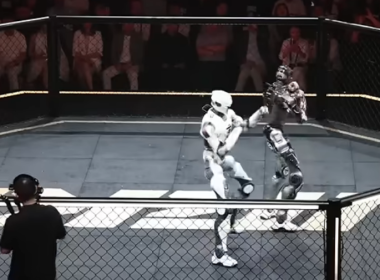




You can now visit places like a robot district in Shenzhen or watch humanoids dance to K-pop in Seoul, where travelers can get up close to this technology.
Humanoid robots can run, box and even do backflips in videos. Now you can actually travel and see them in person.
China’s World Humanoid Robot Games have taken that spectacle even further. But the more interesting development is happening away from competitions: Shenzhen has an entire district built around robots, Seoul has humanoids dancing to K-pop, and Japan is testing them for airport work.
I’m generally positive about new technology, although the speed of development is starting to feel a little I, Robot. So we looked at where travelers can actually see humanoid robots today — rather than at a trade show or in a YouTube clip — and where they might start to become part of everyday travel next.
We have focused mainly on actual humanoids. Robot dogs, robotic arms and delivery bots, which you’ll also find in many of these places, offer a different experience.
Robot Block, Shenzhen: The Best Place to See Humanoid Robots Right Now
If the main purpose is to see humanoid robots, Shenzhen is probably the best destination right now.
The place to head for is Robot Block in Longgang, centered around the intersection of Wuhe Avenue and Yanan Road in Bantian. The nearest metro stop is Yabao Station on Line 10, Exit B.
This is not a conventional museum. Robot Block places machines in more ordinary surroundings, with robots making coffee, cleaning and performing, alongside a Robot Theatre and spaces devoted to AI, healthcare, education and smart homes.
Inside the Robot 6S Store
The main stop is the four-story Robot 6S Store, which opened in July 2025.
A basic self-guided visit currently costs 49 yuan, while a full-access experience is around 570 yuan. Visitors can steer robot dogs through obstacle courses, try robot boxing and see humanoid and service robots intended for homes, restaurants, healthcare and eldercare. There are also machines preparing and serving food.
The store also functions as a commercial space where companies can sell, rent and customize robots, so this is not only a collection of prototypes brought out for visitors.
You could easily spend a few hours at Robot Block, have lunch or coffee nearby and then continue into the city. Shenzhen’s own visitor information now groups Robot Block with factory tours, drone delivery, AI stores and other high-tech experiences.
A Robot Hotel Is Coming
There is also a robot-heavy hotel planned for an artificial island on the Shenzhen–Zhongshan Link, where developers want machines to handle luggage, reception, room service, cleaning and other jobs. It is expected to open in phases from 2027, so for now it is one to watch rather than somewhere to book.
iRIC × Deep Space Robot Future World, Shanghai: Watch Humanoids Train

Shanghai’s iRIC × Deep Space Robot Future World is a little different.
It sits at 955 Liuxiang Road, Buildings 2 and 3, in Nanxiang, Jiading District, well outside the usual Bund–French Concession–Pudong tourist circuit.
The 4,000-square-meter site has nearly 100 types of robots across four indoor areas, plus an outdoor training ground. Visitors can see humanoid performances, play robot football, interact with robot dogs, fly drones and try a brain-computer interface used to control a racing car. The outdoor area is used for humanoids, quadruped robots and other machines undergoing physical training.
How to Book a Visit
Regular opening hours are Monday to Friday, 8:30 a.m. to 5:30 p.m. Individual visitors can currently reserve places on some Wednesdays and Saturdays, with reservations handled through the WeChat account of the Intelligent Manufacturing and Robotics Joint Innovation Center.
That makes it less convenient for overseas visitors than Shenzhen, especially if you don’t already use WeChat.
It’s also far enough from central Shanghai that I’d plan it as a half-day tech trip, not something to fit in between other sights.
Galaxy Robot Park, Seoul: Humanoid Robots Dance to K-pop
Seoul’s Galaxy Robot Park takes almost the opposite approach.
The roughly 16,500-square-meter park officially opened on August 21, 2026, after a pre-opening period that drew more than 20,000 visitors. Seventeen additional types of robots were added for the full opening.
The K-pop Robot Arena
The centerpiece is the K-pop Robot Arena.
Humanoid robots perform synchronized choreography to songs including Rosé’s “APT.” At the opening, human taekwondo performers appeared alongside humanoids capable of jumping side kicks. Other areas let visitors operate robot dogs, interact with drawing and hugging robots and watch robot boxing.
It sounds slightly ridiculous. It also sounds quite fun.
The park is at 103 Arisu-ro 61-gil in Godeok-dong, Gangdong-gu, in eastern Seoul. Galaxy says it intends to run the Robot Arena at least four times a day, eventually exceeding 1,000 performances a year.
Seoul Robot & AI Museum: The Serious Alternative

For something less theatrical, there is the Seoul Robot & AI Museum, or RAIM, in Chang-dong.
The museum is at 56 Madeul-ro 13-gil, Dobong-gu, about a five-minute walk from Exit 1 of Chang-dong Station on subway Lines 1 and 4.
Its exhibitions cover robotics and artificial intelligence, including a humanoid section. Visitors can interact with a generative-AI “meta-humanoid mask robot” and even play football with a humanoid robot.
RAIM is open Tuesday to Sunday from 9:30 a.m. to 5:30 p.m. Adult admission to the permanent third-floor exhibition is 2,000 won, while children, teenagers and visitors 65 and older enter free. The first-floor experience area and robot café are open to the public.
At that price, it is an easy addition to a trip to Seoul.
Miraikan, Tokyo: Fewer Humanoids Than You Might Expect
Japan is so well known for robots that I expected Tokyo to have something like Shenzhen’s Robot Block.
Right now, it doesn’t.
The easiest place to see robotics is Miraikan, the National Museum of Emerging Science and Innovation in Odaiba. Its robotics exhibits are broader than the newest generation of humanoids. Hello! Robots looks at different kinds of machines and how people might coexist with them, while other exhibitions explore AI and increasingly automated cities.
Closed for Refurbishment Until April 2027
Miraikan is at 2-3-6 Aomi, Koto-ku, around a four-minute walk from Telecom Center Station on the Yurikamome line. It normally opens from 10 a.m. to 5 p.m., with adult admission to the permanent exhibitions at ¥630 and ¥210 for visitors aged 18 and under.
One important date: the museum is closed for refurbishment from October 1, 2026, and is due to reopen on April 22, 2027, with new exhibits.
Miraikan is a good stop if you’re interested in robotics in general, and slow-paced Tokyo has plenty more to fill a trip. But it wouldn’t be fair to suggest it’s full of the latest walking humanoids.
Where You May Meet Working Humanoids Next: Hotels and Airports
The places above are destinations where you can go specifically to see robots.
But in the long run, it may matter more where travelers come across robots without planning to. Hotels and airports are already being used to test them.
Lotte Hotel Seoul
At Lotte Hotel Seoul, employees are helping teach robots how hotel work is done.
Food and beverage manager David Park has been recorded folding napkins, polishing glasses and setting tables while cameras attached to his head, chest and hands capture exactly how he moves. The data helps robotic systems learn details humans rarely think about: where to place a hand, how hard to grip something and what to do when an object is not exactly where expected.
The limitations are revealing too. The developer involved has said that a robot can currently need several hours to clean a room that a human hotel worker prepares in roughly 40 minutes.
Lotte nevertheless plans to use its Seoul flagship as a humanoid testing ground, starting with tasks such as moving supplies and room maintenance before potentially moving toward reception and concierge work.
This might be how travelers first meet working humanoids.
Not at the front desk. Maybe you’ll spot one in a service hallway carrying towels.
Haneda Airport
Japan Airlines began a humanoid trial at Haneda Airport in May 2026.
This is not something you buy a ticket to see. The project runs through 2028 and is studying whether humanoids can help with baggage and cargo loading, cabin cleaning and other ground-handling work.
JAL’s thinking is straightforward. Airports are built for people, so a human-shaped robot could use the same spaces and equipment without the airport needing to change everything for a special robot.
The same idea works for hotels too.
Why Hotels and Airports Make Sense
Hotels and airports combine repetitive physical work with relatively predictable surroundings.
The same hallways, elevators, baggage carts, storage rooms and hotel rooms are used over and over. Tasks like moving linens, loading luggage, cleaning and restocking are easier for robots to handle than the unpredictable things that happen on a busy street.
China, South Korea and Japan also have strong reasons to push the technology. China is investing heavily in a domestic humanoid industry, while South Korea and Japan face aging populations and shrinking workforces.
Each country has its own reasons, but all three want to see if these machines can do useful work, not just put on a good show.
Practical Tips for a Robot-Themed Trip to Asia
China: set up WeChat and Alipay before you travel; you’ll need them for bookings, payments and transport. Many Western apps and sites are blocked, so install a reliable VPN at home, before you arrive.
Staying connected: a travel eSIM is the easiest way to get data across China, South Korea and Japan on one trip — see our eSIM promo codes before you buy.
Check before you go: robot venues are new and their hours, prices and booking systems change often, so confirm the latest details on each venue’s own channels.
So Where Should You Go to See Humanoid Robots?
For now, Shenzhen is the clear first choice.
Robot Block offers the best mix of real humanoids, hands-on activities and a city where you can see robotics, drones and automation beyond a single museum.
Shanghai’s iRIC is more technical and harder to visit, but it could be more interesting if you want to see robots being developed and trained.
In Seoul, Galaxy Robot Park is the fun, entertainment-focused choice, while RAIM is cheaper, easier to reach and feels more like a museum.
Tokyo isn’t the best place right now if you just want to see the latest humanoids — and Miraikan is closed until April 2027.
What’s happening at Lotte Hotel and Haneda is different. They aren’t tourist attractions, but they might show us how humanoids will become part of everyday travel.
Watching a robot run a race or do a backflip is impressive.
Seeing a robot carry towels through your hotel probably isn’t as exciting.
But the second example might tell us a lot more about where things are headed.