






Rafi Mercer’s first job in music was in a Virgin shop at 100 Oxford Street, one floor above the 100 Club. He has written about turning up in the mornings and still being able to smell the night before coming up through the floorboards — beer, brass, sweat — and taking from it the idea that sound leaves something behind after it stops.
He stayed twelve years at Virgin, in the era when a record shop was a place you went to be told what to listen to by someone who cared. He now runs Tracks & Tales, a guide to rooms where sound is treated seriously — listening bars, hi-fi cafés, sound-first restaurants — assessed against a single published standard across 171 countries and 6,465 cities. He calls it the Michelin Guide to Listening, on the grounds that no such thing existed.
The guide takes no ads and no paid placements. No venue can buy a listing, a Star, or a kinder sentence. Reviews are anonymous, the criteria are public, and Stars can be lost as well as won. Alongside it he runs the Listening Club — one album a month, on vinyl, start to finish, hosted from one room to members worldwide — and has written a book, The Luxury of Listening.
For Locals Insider, Rafi wrote about what twelve years behind a counter taught him about how people actually listen, why the most expensive systems often make the worst rooms, which cities understand this best, and what happens now that listening bars have become fashionable.
“Partly what I’m trying to do with Tracks & Tales is a written version of the experience of life at the Megastores and Virgin in the nineties — people listening to each other and moving things forward, opinion mattering a lot. With a stream of listening, the real skill of listening is lost. Not in a nostalgic way. As a life skill, in some ways.
Hearing and listening are very different.”

People Rarely Listen the Way They Say They Do
Twelve years at Virgin taught me, more than anything, that people rarely listen to music in the way they say they do.
I spent years surrounded by records, customers, staff, charts, new releases and people who were completely obsessed with music, and what fascinated me was that none of it was ever simply about the music. It was about identity, discovery, belonging, memory and place. You could watch somebody walk in looking for one record and leave with four because a member of staff had played them something. You could see whole small communities forming around particular scenes.
Music traveled between people.
I also learned that discovery needs some friction. When everything isn’t immediately available you pay more attention — you ask people questions, you read sleeves, you listen to something because someone you trust tells you to.
“Streaming gave us access to almost everything, which is extraordinary. But access and discovery aren’t the same thing.”
Tracks & Tales is partly my attempt to put the human part back in.
Twenty or Thirty Years, Suddenly Joining Up
There was no moment when the idea clicked, nothing cinematic. It was more like twenty or thirty years of separate thoughts suddenly joining up.
I’d always been drawn to places where music mattered — record shops, clubs, bars, cafés, hotel lounges, hi-fi rooms. Then listening bars started appearing outside Japan and I realized nobody was documenting them properly. There were lists. There were reviews. There were Instagram photographs. But nobody was asking the question I was interested in, which was what makes a room worth listening in.
So the idea became: what if somebody treated listening places with the same seriousness Michelin applies to restaurants. Not just where they are, but why they matter.
What Makes a Room Worth Listening In
So what actually makes a listening bar great? The strange answer is that it isn’t the equipment. Obviously the sound matters enormously, but you can put £200,000 worth of gear into a room and still build somewhere completely forgettable.
What makes a great listening bar is a combination of sound, selection, room, hospitality and intent, and you feel it almost immediately — somebody cares. The volume is right. The records make sense. The lighting makes sense. The person behind the bar understands that the silence between records can matter as much as the record. Nothing in the room is fighting for your attention, and the best rooms slow time down because of it.
“Eventually you stop noticing the speakers. That’s usually when you know it’s working.”
The Equipment Becomes the Point
Can an incredible sound system still make for a bad room? Absolutely. Some of the worst listening experiences happen around very expensive systems, because the equipment has become the point. A listening bar isn’t a hi-fi demonstration; the system serves the room and the music.
What usually goes wrong is imbalance. The music is too loud, or the room hasn’t been treated and the bass swallows everything, or the DJ is performing at the audience rather than playing for the room, or the service interrupts every few minutes. And sometimes somebody has simply copied the visual language of a Japanese listening bar — vintage JBLs, McIntosh amplifiers, record shelves, low lighting — without understanding the behavior underneath it.
“You can copy the furniture. It’s much harder to copy restraint.”
Tokyo, and Then Everywhere Else
Tokyo is still very hard to beat, because listening has a depth there that goes well beyond fashion. There are rooms where the owner has spent decades with one particular genre, and you walk into a very small space and realize you’ve entered somebody’s life’s work. That’s an extraordinary thing to sit inside.
But I’m increasingly interested in everywhere else. New York has a wonderful energy around it because serious music culture, hospitality and nightlife all sit in the same place. London is working out its own interpretation. Seoul has some remarkable rooms, Mexico City has become genuinely interesting, and spaces are appearing in cities you’d never associate with listening culture at all.
The idea is traveling, and every city puts its own accent on it. That’s the part I find most exciting now.
What the World Got Right About Japan, and What It Missed
The thing people have correctly understood is that listening can be the main event. It sounds obvious, but it really isn’t — most bars have historically used music as decoration, and Japanese listening culture reversed that relationship. The room exists partly because of the music.
What gets misunderstood is the aesthetic. People see old Altec or JBL speakers, valve amplifiers, wooden shelves and thousands of records and assume that’s the formula. It isn’t.
“The real inheritance is attention.”
Someone has spent years learning how their room sounds, where the speakers should sit, which pressing they prefer, how volume behaves across an evening, how to sequence a night, when not to speak. It’s closer to craft than interior design. If the rest of the world learns that part, listening culture becomes much more interesting.
Yes, It Will Get Ruined. Partly.
Are listening bars becoming fashionable in a way that ruins what made them special? Yes, inevitably. Anything interesting gets copied. We’ll see more places described as listening bars on the strength of a turntable and a pair of expensive speakers, and we’ll see the aesthetic become a hospitality trend.
I don’t think that’s a disaster. Fashions tend to separate themselves into two groups — the places that borrowed the look and the places that understood the idea — and the second group survives.
Tracks & Tales was never really about bars or speakers anyway. It’s about recovering the act of paying attention.
And somebody will walk into one of those fashionable new rooms, hear a record properly for the first time, and go home and sit through a whole album.
What Tracks & Tales Actually Is
The guide covers listening bars, hi-fi cafés, sound-first restaurants and rooms built around a record, mapped across 171 countries and 6,465 cities, with city guides running from Tokyo and Osaka to Lisbon, Copenhagen, Hanoi, Mexico City and Dublin. Venues are assessed against one published standard and can be awarded Stars, which can also be lost as rooms change. There are no ads and no paid placements, reviews are anonymous, and the whole thing is independent and self-funded.

Running alongside the guide are monthly album charts, city charts, an essay series and a daily journal. There is a YouTube channel, and a book, The Luxury of Listening, which sets out to teach the act rather than the canon.
The Listening Club is the ritual the guide points toward: one album a month, played on vinyl from beginning to end, hosted live on a private channel so members can join from anywhere, with other records brought in between tracks to open the album out — its influences, its arguments, its echoes. Every session is archived permanently. Members get a private letter every Friday at 4pm London time, full access to the site, and a direct line to Rafi rather than a support desk. Founding membership is capped at 200 places.
“A subscription asks for your attention constantly. This asks for it once a month, for the length of one record, and then leaves you alone.”
- The Listening Club: Join here
- The book: The Luxury of Listening
- YouTube: @tracksandtalesguide
- Instagram: @tracksandtales.co
What Tracks & Tales Actually Is
The guide covers listening bars, hi-fi cafés, sound-first restaurants and rooms built around a record, mapped across 171 countries and 6,465 cities, with city guides running from Tokyo and Osaka to Lisbon, Copenhagen, Hanoi, Mexico City and Dublin. Venues are assessed against one published standard and can be awarded Stars, which can also be lost as rooms change. There are no ads and no paid placements, reviews are anonymous, and the whole thing is independent and self-funded.
Running alongside the guide are monthly album charts, city charts, an essay series and a daily journal. There is a YouTube channel, and a book, The Luxury of Listening, which sets out to teach the act rather than the canon.
The Listening Club is the ritual the guide points toward: one album a month, played on vinyl from beginning to end, hosted live on a private channel so members can join from anywhere, with other records brought in between tracks to open the album out — its influences, its arguments, its echoes. Every session is archived permanently. Members get a private letter every Friday at 4pm London time, full access to the site, and a direct line to Rafi rather than a support desk. Founding membership is capped at 200 places.
“A subscription asks for your attention constantly. This asks for it once a month, for the length of one record, and then leaves you alone.”
- Tracks & Tales: tracksandtales.co
- The Listening Club: Join here
- The book: The Luxury of Listening
- YouTube: @tracksandtalesguide
- Instagram: @tracksandtales.co
Best Listening Bars: Tokyo, London, New York and Beyond
Rafi Mercer maps listening bars for Tracks & Tales. These are ten of the rooms he points people toward — four in Tokyo, where the form began, and six that show what happens when the idea travels. Several are small, several are cash-only, and several have rules about phones and conversation, so check before you go.
Meikyoku Kissa Lion — Shibuya, Tokyo
2-19-13 Dōgenzaka, Shibuya, Tokyo 150-0043 · daily 1:00–8:00pm · cash, no reservations
Open since 1926 and the oldest surviving room of its kind — a classical-only listening café where the chairs face the speakers like pews and conversation is not the point. No phones, no photographs, no talking. You order tea or coffee, sit facing forward, and let a full work play. It is the clearest possible demonstration of the idea that the room exists because of the music, rather than the other way round.

JBS — Shibuya, Tokyo
1-17-10 Dōgenzaka, 2F, Shibuya, Tokyo 150-0043 · evenings from 7:00pm · cash only, no food
Jazz, Blues, Soul — the name is the entire filter. A single small second-floor room lined floor to ceiling with records, run single-handed by an owner who selects, pours and manages the space himself. Altec horns, an enormous collection, drinks priced for a neighborhood bar rather than a destination. Music comes first here in a way that is stated rather than implied.
Bar Martha — Ebisu, Tokyo
1-22-23 Ebisu, Shibuya, Tokyo 150-0013 · nightly 7:00pm–3:00am · cover charge, smoking permitted
The room that taught a generation of visitors what a listening bar asks of them. Phones away, voices down, and staff who will tell you if you forget. Wide-ranging selection across genre and era, played loud enough to fill the room and quiet enough to talk under — just. The rules are the reason it works, and the reason it divides people.

Bonobo — Jingūmae, Tokyo
2-23-4 Jingūmae, Shibuya, Tokyo 150-0001 · late, hours vary by event · check listings before travelling
A converted wooden house on a Jingūmae backstreet, spread over several small floors, closer to an intimate club than a seated listening room. Serious sound, careful lighting, and a crowd that comes for the DJ rather than the address. The rare place where dancing and fidelity are not treated as opposing goals.
Brilliant Corners — Dalston, London
470 Kingsland Road, London E8 4AE · from 5:00pm daily, later Friday and Saturday · booking advised
London’s answer to the question, and the room most often credited with starting the British version of it. Valve amplification, a rotary mixer and horn loudspeakers at one end; Japanese small plates and a proper drinks list at the other. It works because the food is good enough to justify the table and quiet enough not to compete with what is playing.

Eavesdrop — Greenpoint, Brooklyn
674 Manhattan Avenue, Brooklyn, NY 11222 · from 5:00pm, from 2:00pm weekends
A narrow Greenpoint room, New York’s listening bar, built around a listening system and a cocktail program that takes itself equally seriously. Vinyl all evening, low light, a kitchen doing more than bar snacks. Small enough that the sound reaches every seat, which is rarer in New York than it sounds.
Public Records — Gowanus, Brooklyn
233 Butler Street, Brooklyn, NY 11217 · Wednesday to Sunday, closed Monday and Tuesday · sound room hours differ from the café
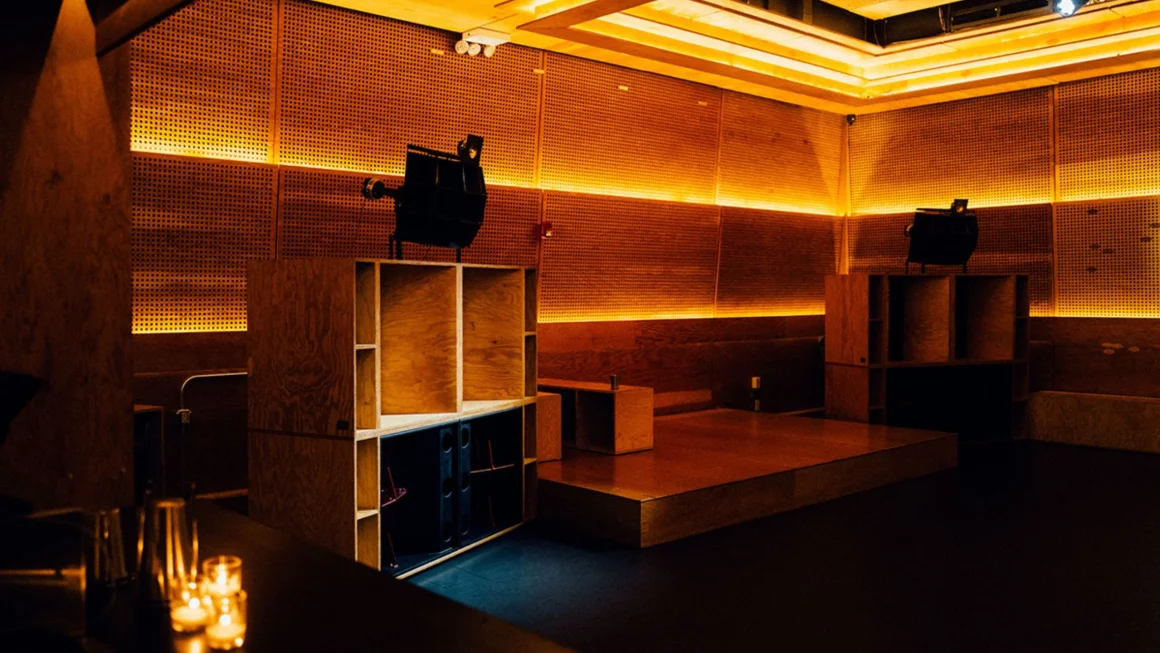
The most ambitious version of the format in New York: a plant-based restaurant, a listening café/bar, and a purpose-built sound room with a custom system, all in one converted municipal building. The sound room is the reason to come and is treated as a separate space with its own program — worth checking what is on before you commit the evening.
Café de Nadie — Roma Norte, Mexico City
Chihuahua 135, Roma Norte, Cuauhtémoc, 06700 CDMX · Wednesday to Monday, closed Tuesdays · terrace and interior
Roma Norte’s vinyl bar, named after a 1920s Mexico City avant-garde café and running the same spirit — records played properly, a menu that moves between salsa nights and slower listening, and a terrace for when the room fills. Mexico City’s scene is one of the newest and least imitative, and this is where most people start.
Lennon’s — Ploenchit, Bangkok
30th floor, Rosewood Bangkok, 1041/38 Ploenchit Road, Lumphini, Pathum Wan · nightly 6:00pm–midnight · booking essential
Thirty floors up, styled as a private home recording studio, with a vinyl library in the thousands and guests invited to choose what gets played next. The polar opposite of a back-street kissa — a hotel bar with a serious cocktail list and a city view — but the listening is real, and it shows how far the idea stretches without breaking.

33 Giri — Borgo, Rome
Via del Falco 37/38, 00193 Rome · daily 6:00–11:00pm · order at the bar
Named for the revolutions of an LP, and tucked into the streets behind the Vatican where almost nothing stays open for locals. A short seasonal menu, a good wine list, records all evening and a room small enough to hear properly. Rome’s listening scene is barely a scene yet, which is part of the appeal.