

 Argentina
 Austria
 Azerbaijan
 Belgium
 Brazil
 Canada
 Chile
 China
 Colombia
 Costa Rica
 Croatia
 Cyprus
 Czech Republic
 Denmark
 Egypt
 Estonia
 Finland
 France
 French Polynesia
 Georgia
 Germany
 Greece
 Greenland
 Hong Kong
 Hungary
 Iceland
 India
 Indonesia
 Ireland
 Italy
 Japan
 Kenya
 Lithuania
 Malta
 Mauritius
 Mexico
 Mongolia
 Montenegro
 Morocco
 Netherlands
 Norway
 Oman
 Peru
 Poland
 Portugal
 Saudi Arabia
 Serbia
 Singapore
 Slovenia
 South Africa
 South Korea
 Spain
 Sweden
 Switzerland
 Taiwan
 Thailand
 Türkiye
 USA
 United Arab Emirates
 United Kingdom
 Uruguay
 Uzbekistan
 Vietnam
Destinations › Europe › Germany
Country guide · Europe
Germany
Germany Travel Guide: Berlin, Munich, Hamburg & Where to Go in 2026
Your Germany guide, curated by Locals Insider
Germany, by Locals Insider
Germany contains a contradiction: the country of efficient trains and serious people also produced Berlin, one of the most genuinely creative cities in Europe. Marco Müller's three-Michelin-star Rutz anchors the fine dining scene; Curry 36 anchors the late-night one.
Munich is the formal counterweight (beer halls, Bavarian traditions, Tantris). Then there's the country itself — the Black Forest (Schwarzwaldstube three Michelin stars at Traube Tonbach), the Mosel wine valleys, Dresden's rebuilt Baroque core, the Bavarian Alps for skiing.
Our Germany coverage spans Berlin's neighborhoods, Munich's food scene, and the country routes that connect them.
Cities to explore
Where to go in Germany
Cities with a full guide are marked “City guide”.
Berlin
Creative capital, clubbing, art galleries, complicated history
City guide · 9 stories
Munich
Bavarian elegance, beer gardens, gateway to the Alps
City guide · 3 stories
Hamburg
Port city, music scene (Beatles + Elbphilharmonie), warehouse district
The Black Forest
Fairy-tale countryside, thermal spas, cuckoo clocks (yes really)
Stories · updated as we publish
Latest from Germany
All 8 stories


Recommended in our stories
Places in Germany our authors recommend
Bar · Berlin
Potsdamer Straße 102, 10785 Berlin, Schöneberg
Victoria Bar opened in 2001 at Potsdamer Straße 102, on a stretch of street that was not yet known for good drinks. The room is defined by hand-painted wallpaper, green leather and a very long bar, with a menu of around 200 items. A fire in December 2022 closed it for several months, and it reopened in 2023.
Open in Google Maps ↗In Britt Kanja’s story · “Your Inner Self Is Hungry”: Britt Kanja, Grande Dame of Berlin Nightlife on Eclectic Vintage, the Secret Lake and Finding People With Joy in Their Hearts
Shop · Berlin
Große Hamburger Str. 25, 10115 Berlin
The independent Berlin designer Ashley collects, in a shop that runs like a private salon — he sat with her and walked the new collection the day after his F…
Open in Google Maps ↗In Ashley Scott Muller’s story · “He Packed It in a Supermarket Bag and I Took It Home”: Ashley Scott Müller on Collecting Thierry Mugler, and Her Berlin

Shop · Munich
Prannerstraße 10, 80333 München, Germany, Munich
While most think of Berlin when considering the German fashion scene (particularly the avant-garde shops and galleries like Andreas Murkudis and Darklands),…
Open in Google Maps ↗In Nick Nomi’s story · Ethics Aesthetics: Our Favorite Independent Design Shops & Fashion Boutiques
Market
Goslar Christmas Market, Marktplatz, 38640 Goslar, Germany
Open in Google Maps ↗In Martin Eriksen (Danemaq)’s story · Europe’s Best Christmas Markets
Bar · Berlin
Stresemannstraße 76, 10963 Berlin, Kreuzberg
SOLAR is a sky restaurant and cocktail bar with a 270° panorama over the city. The entrance is in the rear courtyard, and a glass lift takes you up to the restaurant and bar, which sit on two floors.
Open in Google Maps ↗In Britt Kanja’s story · “Your Inner Self Is Hungry”: Britt Kanja, Grande Dame of Berlin Nightlife on Eclectic Vintage, the Secret Lake and Finding People With Joy in Their Hearts
Place · Berlin
Kurfürstendamm 203/205, 10719 Berlin
Her secret cave for recent archival runway pieces, 2012 to 2022, mostly Italian houses.
Open in Google Maps ↗In Ashley Scott Muller’s story · “He Packed It in a Supermarket Bag and I Took It Home”: Ashley Scott Müller on Collecting Thierry Mugler, and Her Berlin
Market
Lübeck Christmas Market, Markt, 23552 Lübeck, Germany
Open in Google Maps ↗In Martin Eriksen (Danemaq)’s story · Europe’s Best Christmas Markets

Bar · Berlin
Anton-Wilhelm-Amo-Straße 30, 10117 Berlin, Mitte
The Bellboy concept comes from Tel Aviv, where the original has long had cult status in the nightlife scene. In Berlin the interior, menu and award-winning cocktails keep alive the mood of 1920s Europe, and the kitchen serves oysters and caviar. It sits a few steps from Gendarmenmarkt.
Open in Google Maps ↗In Britt Kanja’s story · “Your Inner Self Is Hungry”: Britt Kanja, Grande Dame of Berlin Nightlife on Eclectic Vintage, the Secret Lake and Finding People With Joy in Their Hearts
Restaurant · Berlin
Morsestraße 2, 10587 Berlin
Where she buys oysters — a deep obsession, in her words, for taste and for beauty.
Open in Google Maps ↗In Ashley Scott Muller’s story · “He Packed It in a Supermarket Bag and I Took It Home”: Ashley Scott Müller on Collecting Thierry Mugler, and Her Berlin
Don’t miss
Don’t miss in Germany
Must visit · Bavaria, near Füssen
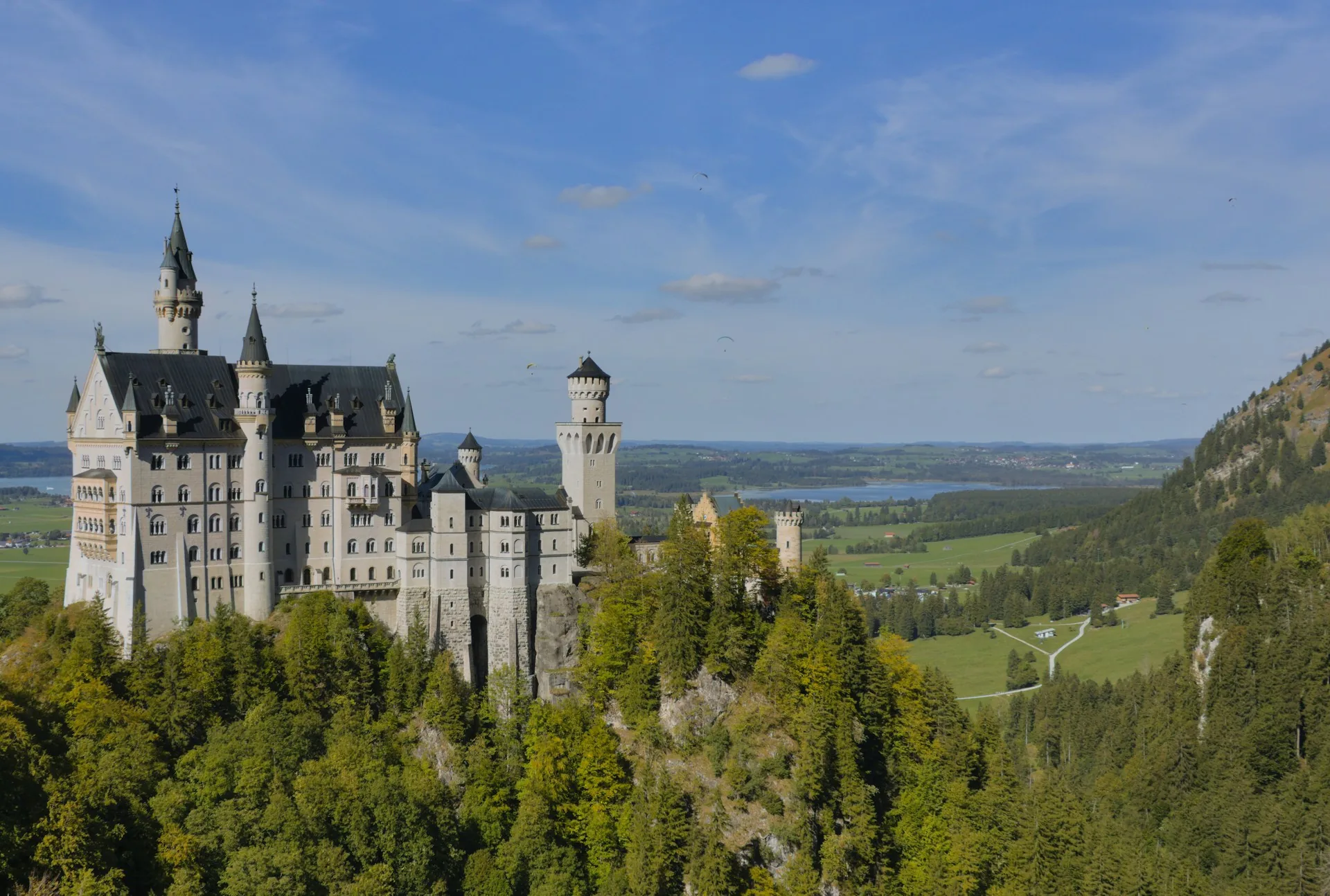
Neuschwanstein Castle from the Marienbrücke
King Ludwig II's 19th-century fairy-tale castle in the Bavarian Alps — the inspiration for Disney's Sleeping Beauty Castle. The view from the Marienbrücke (Mary's Bridge), suspended 90 meters above the Pöllat Gorge, frames the castle against the Tegelberg mountains. Take it at sunset.
2 hours train+bus from Munich. Castle interior tickets timed-entry — book online ahead.
Sandstone rock formations
Saxon Switzerland & Bastei Bridge
An hour east of Dresden, the Bastei Bridge crosses 200 meters above the Elbe river between sandstone pillars that have eroded into surreal stone needles. The hike from Rathen takes you across the bridge and through the rock labyrinth.
Train from Dresden to Kurort Rathen, then ferry across the Elbe. Free to walk, no reservation.
Experiences
Experiences in Germany locals love
- Berlin's club culture — Berghain to Sisyphos
- Oktoberfest in Munich (late September–early October)
- Romantic Road through Bavaria's medieval towns
- Christmas markets across the country (Nuremberg, Dresden, Cologne)
- Rhine Valley castles and wine tastings
Insider tips
Insider tips for Germany
- Leipzig — Berlin's cooler younger sibling, music heritage
- The Saxon Switzerland sandstone landscape near Dresden
- Heidelberg — most romantic German university town
- Sylt — North Sea island for old-money German vacation culture
- Tegernsee — Bavaria's lake-and-mountain weekend escape
- Bremen for its sci-fi-modern Beck's brewery and old town
Our picks
Germany’s best restaurants, hotels and museums
Checked against Michelin, the venue or Google.
Rutz
Michelin
$$$$ (€220+ tasting menu)
Three Michelin stars (since 2020) in Berlin's Mitte — chef Marco Müller's modern German built around regional ingredients, with the Rutz Weinbar wine focus below.
Chausseestraße 8, 10115 BerlinWebsite ↗
Tantris
Michelin
$$$$ (€280+ tasting menu)
Two-Michelin-star Munich institution since 1971 — the 1970s interior is iconic, the cuisine modernized continuously. Currently chef Benjamin Chmura.
Johann-Fichte-Straße 7, 80805 MünchenWebsite ↗
Schwarzwaldstube
Michelin
$$$$ (€280+ tasting menu)
Three Michelin stars in the Black Forest at Hotel Traube Tonbach — chef Torsten Michel. Tragically the original burned down in 2020; the rebuilt restaurant reopened 2022.
Tonbachstraße 237, 72270 Baiersbronn (Black Forest)Website ↗
Curry 36
Traditional
$ (€3-8 per person)
The Berlin currywurst institution since 1981, open 24 hours — across from Kreuzberg's Mehringdamm U-Bahn. The signature: currywurst ohne Darm (without skin), with chips and curry sauce.
Mehringdamm 36, 10961 BerlinWebsite ↗
Hotel Adlon Kempinski
Luxury
€500-1,500
Berlin's grande dame next to the Brandenburg Gate — rebuilt after WWII reduced it to rubble. Lobby bar where journalists and politicians actually meet, Lorenz Adlon Esszimmer Michelin-starred restaurant.
Unter den Linden 77, 10117 BerlinWebsite ↗
Bayerischer Hof
Luxury
€450-1,200
Munich's 19th-century grand hotel — Volkstheater, Atelier Michelin-starred restaurant, the rooftop pool and spa added in the 2010 modernization. Annual venue of the Munich Security Conference.
Promenadeplatz 2-6, 80333 MünchenWebsite ↗
SO/ Berlin Das Stue
Boutique
€350-700
1930s Danish embassy converted to boutique hotel beside the Berlin Zoo — Patricia Urquiola interiors, the famous zebra-print lobby, Cinco by Paco Pérez Michelin-starred restaurant.
Drakestraße 1, 10787 BerlinWebsite ↗
Schloss Elmau
New 2026
€700-1,800
Bavarian Alps retreat — hosted the G7 Summit 2015 and 2022. Six restaurants (one with two Michelin stars), seven spas, concert hall with year-round chamber music programming. Recently refreshed wellness wings.
In Elmau 2, 82493 Krün, BavariaWebsite ↗
Pergamon Museum
Ancient civilizations
Houses the Pergamon Altar and Ishtar Gate of Babylon — entire reconstructed ancient monuments. Closed for major renovation; some collections moved to Pergamon Museum: The Panorama nearby.
Bodestraße 1-3, 10178 Berlin (Museum Island)Website ↗
Hamburger Bahnhof
Contemporary art
Berlin's contemporary art museum in a former railway station — major Joseph Beuys collection, Anselm Kiefer, Robert Rauschenberg. The lit corridor by Dan Flavin is one of Berlin's signature interior moments.
Invalidenstraße 50-51, 10557 BerlinWebsite ↗
Pinakothek der Moderne
Modern art & design
Munich's hub of 20th-century art, design, architecture, and works on paper — Picasso, Beckmann, Klee, plus a Design Museum with the legendary Ettore Sottsass and Dieter Rams collections.
Barer Str. 40, 80333 MünchenWebsite ↗
On the world lists
Editor’s picks for Germany
A few additions for travelers heading beyond Berlin and Munich:
Château Royal, Berlin
A 2022 opening in three Mitte townhouses with an extraordinary contemporary art collection (Wolfgang Tillmans, Isa Genzken) curated by the owner.Schloss Elmau, Bavarian Alps
A literary-and-music retreat near Garmisch-Partenkirchen — two G7 summits have been held here.Restaurant Tim Raue, Berlin
Two Michelin stars — Asian-influenced Berlin cuisine in a stripped-back Kreuzberg setting.Documenta in Kassel (next: 2027)
Every five years, the world's most serious contemporary art exhibition takes over an industrial German town — the next is 2027 and worth planning ahead.Hamburger Bahnhof / Museum für Gegenwart, Berlin
A converted train station with the best post-1960 collection in Germany — Beuys, Warhol, Kiefer.
Through the year
Germany festivals and what’s on
Late September-Early October
Oktoberfest
Munich's 16-day beer festival — six million attendees, the world's largest
February
Berlinale Film Festival
One of the world's big three film festivals
November-December
Christmas Markets
Every major city has one — Nuremberg and Dresden the most historic
Questions
Germany FAQ
Do I need a visa to visit Germany?
Germany is in the Schengen Area and the EU. EU, EEA, and Swiss citizens enter freely. Citizens of the US, UK, Canada, Australia, Japan, and around 60 other visa-exempt countries can stay up to 90 days within any 180-day period across the Schengen Area.
From late 2026, those travelers will need an ETIAS online authorization (around €7, valid three years) before flying. Russian and Chinese passport holders need a Schengen short-stay visa via VFS Global or the German consulate.
Travel insurance should cover at least €30,000 medical across the Schengen area. Germany uses the euro. Passport must be valid for at least 3 months beyond your intended departure.
Major airports (Frankfurt, Munich, Berlin Brandenburg) can have slow non-Schengen passport queues — allow 60–90 minutes for connections.
When is the best time to visit Germany?
May and September are the universal sweet spots — pleasant 18–24°C, hotel rates 30–40% lower than peak summer, lighter crowds, and the major attractions all fully operational. July–August are peak (warmer 20–28°C, longer days, but crowded UNESCO sites and occasional heat waves). September 20 – October 5, 2026 is Oktoberfest in Munich — accommodation books out 6–9 months ahead and prices triple. November 24 – December 24 brings Christmas markets across the country — Nuremberg's Christkindlesmarkt, Dresden's Striezelmarkt (the oldest, since 1434), Cologne's seven separate markets, and the Tollwood Winterfestival in Munich.
Book Christmas-market-city hotels 4–6 months ahead for December weekends. January–March delivers the lowest prices but cold weather (0–8°C) and shorter days.
What's a good 10-day Germany itinerary?
Three different trips depending on your interest. The classic culture loop: Berlin (3 nights — Brandenburg Gate, Museum Island, the East Side Gallery, Kreuzberg/Neukölln food), Dresden (1 night — the rebuilt baroque old town), Nuremberg (1 night), Munich (3 nights — Marienplatz, beer halls, day trip to Neuschwanstein Castle), with two nights elsewhere (Hamburg or Cologne). The Rhine + Bavaria route: Frankfurt (1) → Rhine Valley (2 — castle cruises, Bacharach or Bingen base) → Heidelberg (1) → Black Forest (2) → Munich (3) → Berlin (1 for departure). The fast trains (ICE — Deutsche Bahn) make hops easy: Berlin–Munich in 4 hours, Frankfurt–Berlin in 4 hours, Munich–Salzburg in 90 minutes if extending into Austria.
Book ICE Sparpreis tickets 60–90 days ahead for the best fares (€20–50 vs €120 walk-up).
Is Oktoberfest worth planning a trip around?
Yes, if you go in with the right expectations. Oktoberfest 2026 runs September 20 – October 5 on the Theresienwiese fairgrounds in Munich.
Important to understand: tent reservations require group bookings made 6–9 months in advance through the individual tent operators (Hofbräu, Augustiner, Paulaner — direct websites only), but tables also hold walk-in seats — arrive at 9am on weekdays or 7am on weekends to claim a table.
Expect €13–15 per liter of beer, €12–18 for traditional meals, and serious crowds (6+ million visitors). Munich accommodation triples for those weeks — book by March 2026 for any reasonable price.
Alternatives if Oktoberfest is full: Cannstatter Volksfest in Stuttgart (overlaps dates, half the crowds, locals' favorite), or Erlanger Bergkirchweih in Erlangen, Germany's second-largest beer festival, every June.
Where do locals eat in Berlin and Munich?
Berlin is one of Europe's best food cities and far cheaper than Munich.
Skip the central tourist spots and head to Kreuzberg (Mustafa's Gemüse Kebap, the iconic queue), Neukölln for the modern bistro scene (Lode & Stijn, Hallmann & Klee), and Mitte for the döner kebab originals (Imren and Konnopke's Imbiss for the city's defining currywurst, in business since 1930). Mustafa's, Burgermeister under the U-Bahn, and Markthalle Neun on Thursday Street Food evenings cover the modern Berlin food experience. Munich is more traditional.
Don't only do the Hofbräuhaus (it's beautiful but heavily tourist-focused) — try Augustiner-Keller (a true Bavarian beer garden, locals all summer), Schneider Bräuhaus for the city's best Schweinshaxe, and Viktualienmarkt for fresh weisswurst (eaten before noon, peeled with the skin removed).
Tip 5–10%, rounded up.
Capital BerlinTime CET (UTC+1)Plugs Type C/F (230V)
Locals Insider
Spotted a mistake? Know a better place?
We check every guide against official sources, but places change. Tell us what’s out of date, or the spot you’d send a friend to.
Tell us about itMore countries
Is Germany for you?
You want efficient infrastructure, world-class museums, distinct regional cultures (Berlin vs. Bavaria are different countries), and a music + nightlife scene that anchors Europe. Germany rewards both city breaks and rural retreats.
You’re
The Curious Cosmopolitan
Cultural travelers
Music lovers
Couples
Beer culture
Nightlife
Walkability9
Getting around9
Safety9
Weather5
Value for money6
LGBTQ+ friendly9
Crowds6
Digital nomads8
When to go
Best time to visit Germany
From a local
Locals in GermanyLocals here
All authors
Nadezhda Stiazhkina
Nadezhda Stiazhkina is the co-founder of SchubKI, a Berlin platform that introduces Germany’s family-owned Mittelstand to young AI startups.
After 18 years in executive search, she moved via Moscow, Istanbul and Munich to Prenzlauer Berg.
She lives there with her family and spends her free time at the opera, on Saturday market strolls and in the woods hunting for mushrooms.

Britt Kanja
Britt Kanja is a Berlin style icon and the Grande Dame of the city's nightlife.
Born in West Berlin, she danced professionally across Europe before co-initiated the legendary 90 Grad club in Schöneberg in 1989, where she ran a themed party every month for sixteen years.
She dresses in what she calls Eclectic Vintage, owns more hats than she can count, and is still out most nights.