Hiša Franko
Two Michelin stars + Green Star — chef Ana Roš (Chef's Table season 2) cooks modernist Slovenian in a remote Soča Valley farmhouse. World's 50 Best Female Chef 2017. Cars only access.
Pavel Matějíček
Slovenia
Slovenia is the country that gets quietly recommended by every well-traveled European, and which most American travelers haven't put on the map yet.
Ljubljana is one of the most walkable, livable small capitals in Europe — riverside cafés, bridges by Plecnik, the kind of city you can fully understand in two days and still want to return to.
Then the country opens up: Lake Bled (the obvious one), the Soca Valley (the better one), the Julian Alps, the small slice of Adriatic coastline that includes Piran. The food scene punches well above its weight, anchored by Ana Ros's Hisa Franko.
Our Slovenia coverage is small but growing — Ljubljana neighborhood walks and Alpine valley routes. Scroll for the archive.
Riverside capital, café culture, dragon bridge, compact and walkable
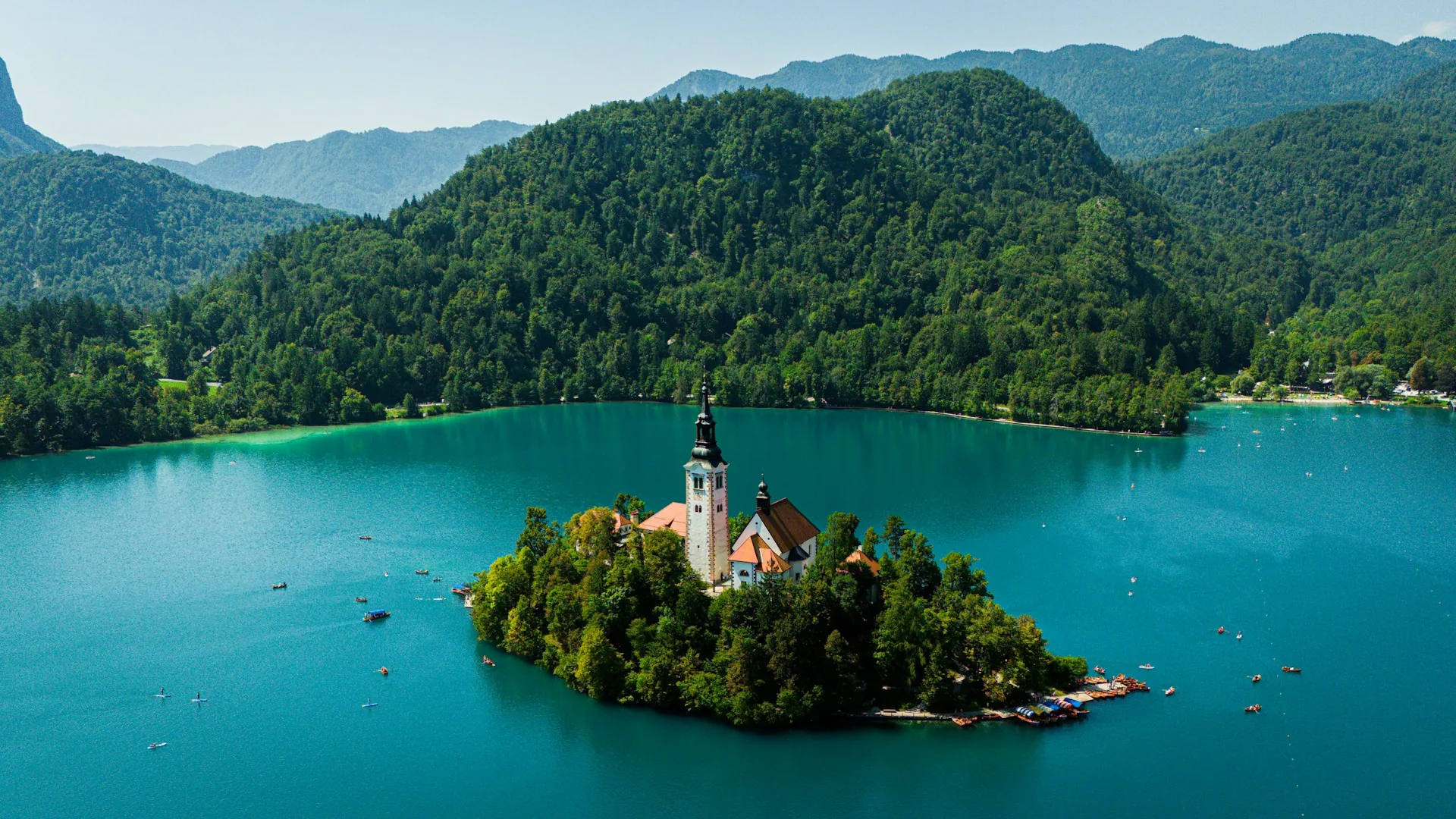
Iconic island church, castle, alpine views
Emerald river, white-water rafting, WWI history
Venetian-architecture coastal town, Adriatic seafood
Slovenia's most photographed lake — a small church on a tiny island in the middle, ringed by Alpine mountains, with an 11th-century castle on a cliff above. Take a pletna (handmade wooden boat) out to the island; ring the wishing bell.
45 minutes from Ljubljana airport. Visit autumn (October) for fall colors reflecting on the water.
21km of cave passages explored on a small electric train that takes you 5km deep into the karst limestone — stalactites and stalagmites, an underground river, the rare olm salamander (the 'human fish'). 90 minutes underground.
40 minutes from Ljubljana. Combine with nearby Predjama Castle (built into a cliff face).
Sprawdzone w Michelin, u źródła lub w Google.
Two Michelin stars + Green Star — chef Ana Roš (Chef's Table season 2) cooks modernist Slovenian in a remote Soča Valley farmhouse. World's 50 Best Female Chef 2017. Cars only access.
One Michelin star in central Ljubljana — chef Jorg Zupan's modern Slovenian, 12 courses in 12 seats. Karst chef-table experience.
Family-run Slovenian gostilna (inn) in rural Dolenjska — traditional dishes from regional grandmothers' recipes, the cured-meat platter is essential.
Tito's former residence overlooking Lake Bled, converted to a 31-room hotel — Relais & Châteaux, original Yugoslav-era interiors preserved, private lakeshore.
Boutique in central Ljubljana — minimalist contemporary design, walking distance to everything, the rooftop terrace overlooks Tivoli Park.
Only 4 wooden chalets on a Soča Valley ridge — private sauna, Julian Alps panorama, restaurant in the main lodge. Among Slovenia's most architecturally interesting new escapes.
Relais & Châteaux country manor in western Slovenia — only 11 rooms, the renowned Idrijska čipka lacework heritage, restaurant uses ingredients from the surrounding hills.
Slovenia's national modern art collection — Jakopič, Grohar, plus 20th-century Eastern European artists. The MSUM contemporary annex is in the Metelkova cultural quarter.
Surprisingly clever — vortex tunnel, anti-gravity room, head-on-a-platter exhibit. Original Ljubljana location of the chain that's now spread worldwide. Best with kids or hangover.
A few additions for travelers planning Slovenia at the high end:
Major summer festival of classical music, ballet and opera
Ptuj's ancient pre-Lent festival, costumed Kurent figures
Bled lake festival — candles floating on the lake at night
Slovenia is an EU member, Schengen Area country (since 2007), and eurozone country (since 2007), so the standard Schengen rules apply. EU/EEA/Swiss citizens travel freely with passport or national ID. UK, US, Canada, Australia, Japan, South Korea, Brazil, Argentina, Mexico, and around 60 other Schengen-visa-exempt countries: visa-free 90 days in any 180-day period across the entire Schengen Area. ETIAS pre-authorisation (€7) is required for these nationalities as of the 2026 rollout — apply online before travel. Russian passport holders need a Schengen visa, with significantly reduced availability since 2022 (Hungary, Italy, and France remain the main practical channels).
Passport valid 3 months beyond exit. Crossing from Croatia, Italy, Austria, or Hungary is Schengen-internal (no passport check usually). Note on Schengen reintroduction: Slovenia briefly reintroduced spot checks on its borders with Croatia and Hungary in 2023–24 over migration concerns — generally a 1-minute formality, but allow buffer on overland routes. From Ljubljana: it's a 2-hour drive to Venice, 4 hours to Vienna, 1.5 hours to Zagreb.
Mid-May to mid-June and September are the two universal sweet spots — 18–25°C, dry, wildflowers or autumn colors in the Julian Alps, Lake Bled and Lake Bohinj at their cinematic best, hiking trails open, Ljubljana's terraces alive but not overwhelmed. July–August is high tourist season — temperatures comfortable (22–28°C), but Bled and Bohinj parking is rationed and tour-bus heavy, prices peak. Late September into mid-October brings the autumn colors to the Soča Valley and Triglav National Park — among Europe's most spectacular foliage. December: Ljubljana's Festive Fair is one of central Europe's prettiest Christmas markets, the Old Town strings of lights are extraordinary. January–March: ski season at Kranjska Gora, Vogel (above Lake Bohinj), and Krvavec — small Alpine resorts with good value compared to Austria/Switzerland. Avoid mid-November and early March — grey, wet, in-between everything. The Slovenian coast (Piran, Portorož): best mid-May–September, swimming pleasant June–early October.
Slovenia is small (the country is 4 hours' drive end-to-end), so 5–7 days is enough to cover the highlights with a rental car. Ljubljana (2 nights): the small, walkable, Plečnik-designed capital — the river embankments, Triple Bridge, Dragon Bridge, the castle (funicular up), Tivoli Park, Metelkova alternative cultural complex.
The Central Market (Saturdays best). Lake Bled (2 nights, or 1 with Bohinj): the picture-postcard alpine lake with the island church (rowing-boat pletna ride 30 min, ring the bell and make a wish) and the cliffside castle.
Walk the 6 km lake path. Lake Bohinj (1–2 nights, the locals' lake): 30 min from Bled — larger, wilder, less Instagram, deeper into Triglav National Park.
Hike Savica Waterfall and Vogel cable car. Soča Valley (1–2 nights): the turquoise Soča River — Kobarid, Bovec, rafting, the Triglav road, the WWI Isonzo Front history. Postojna Cave + Predjama Castle (half-day): the most-visited cave in Europe (electric train through huge chambers) + the medieval castle built INTO a cave mouth. Piran (1 night): the Venetian-influenced coastal town. Or wine: Goriška Brda (next to Italy) for orange wine and Movia.
Yes, but they're different lakes and you can't really substitute one for the other. Lake Bled: 2 km long, 1 km wide, with the church-on-the-island and the cliff-perched castle — the postcard Slovenia image, visited by 1.5 million people a year.
It's genuinely beautiful, but it's also the country's busiest tourist spot — go at sunrise (6–8am the lake mist with the castle visible is the photo) or after 6pm to escape the day-trip buses.
Stay 2 nights, not 1 — gives you time to walk the lake path (6 km, mostly flat), take a pletna rowing boat to the island (€18 return), eat the kremšnita custard cake at Park Café (the original 1953 recipe), hike to Mala Osojnica viewpoint (45 min steep up, the iconic high-angle photo). Lake Bohinj: 4 km long, 30 minutes' drive south of Bled — deeper into Triglav National Park, wilder, no central village, fewer hotels, much less Instagram.
Activities: swim in the cold alpine water (16–22°C in summer), hike to Savica Waterfall (40 min walk in), Vogel cable car for Triglav views, kayak the lake. If choosing one: Bled for the icon, Bohinj for the nature. Most travelers do both, basing 1 night in each.
Slovenia is a culinary crossroads — Italian, Austrian, Hungarian, and Balkan influences in equal measure across 24 distinct gastronomic regions. Must-try dishes: potica (the rolled walnut nut-cake — the most-loved Slovenian dessert, every grandmother makes it differently), kranjska klobasa (the protected Carniolan sausage), štruklji (rolled dough dumplings, savory or sweet), idrijski žlikrofi (the only PDO-protected Slovenian pasta — small filled pasta from the mercury-mining town of Idrija), jota (Italian-Slovenian bean and sauerkraut stew), žganci (buckwheat or corn polenta-equivalent), kremšnita (the Bled custard-cream cake). Wine: Slovenia has three wine regions — Primorska (coastal, Italian-influenced, the home of orange wine in Goriška Brda — Movia, Edi Simčič, Burja), Posavje (south, lighter reds), Podravje (north-east, similar to Austrian Styria — excellent dry Rieslings and Furmint, especially around Maribor and Ptuj). Restaurants worth seeking: Hiša Franko (Kobarid — Ana Roš, 3-Michelin-starred, properly transformative), Atelje (Ljubljana), Dvor Jezeršek (Brnik). Ljubljana's Open Kitchen (Odprta Kuhna) Friday street food market March–October is the country's culinary showcase.
Każdy przewodnik sprawdzamy w oficjalnych źródłach, ale miejsca się zmieniają. Napisz, co jest nieaktualne albo dokąd wysłałbyś przyjaciela.
Napisz do nasYou want Alpine lakes and mountains, Mediterranean coastline, and Italian-quality food — all in a country smaller than New Jersey and refreshingly uncrowded. Slovenia is Europe's most underrated travel secret.
Kierunki
Kierunki