



Living in Europe, you don’t think about earthquakes much. I’m based in Denmark now, where the strongest tremors top out around magnitude 4 and arrive maybe once every five years — enough to rattle a coffee cup, not enough to remember. But during my three years in Malta, I felt something closer to a magnitude 6: strong enough that we ran out of the building without discussing it.
The unsettling part isn’t the shaking itself, it’s the suddenness — it always seems to happen mid-movie, or worse, while you’re asleep. And every time I travel somewhere genuinely seismic — Japan, Taiwan — I find myself wondering the same thing: can we actually predict when one is coming?
The honest answer is no. The U.S. Geological Survey is unequivocal that no scientist has ever predicted a major earthquake, and they don’t expect that to change anytime soon. What does exist is the next best thing: detection systems that catch a quake the moment it begins and race the seismic waves to your phone, giving you seconds to take cover.
That’s the niche My Earthquake Alerts fills — a free global tracker that pings your phone whenever the ground shifts. This Locals Insider review covers how it works, what its main features actually deliver, and whether the $2.99 Pro upgrade is worth paying for.
What is My Earthquake Alerts
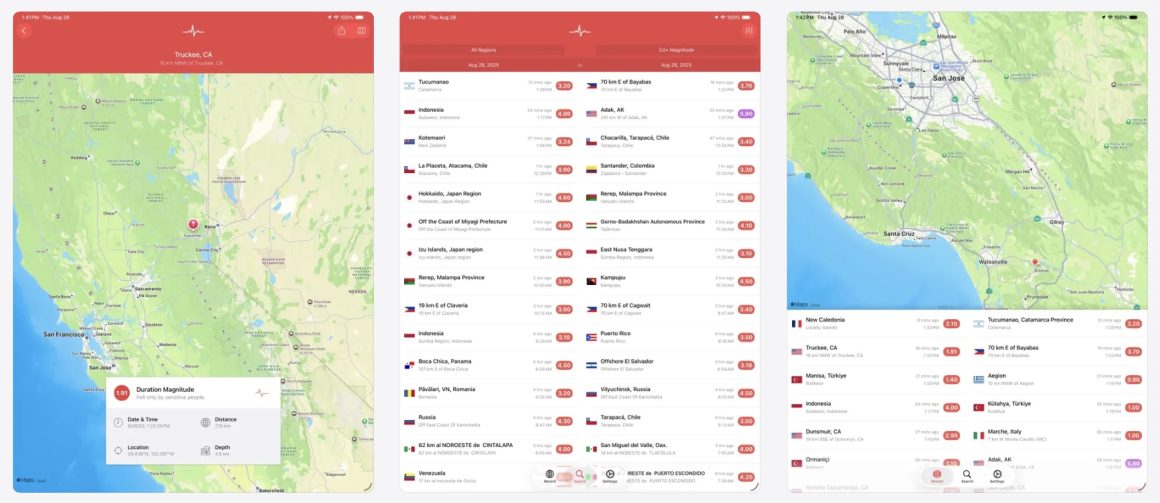
My Earthquake Alerts is a free iOS and Android app offering live seismic activity updates from around the world. It’s useful if you live in — or are traveling to — a region prone to frequent or potentially serious earthquakes, with data drawn from established networks including the U.S. Geological Survey (USGS) and the European-Mediterranean Seismological Centre (EMSC).
Around 90% of the world’s earthquakes occur along the Pacific “Ring of Fire,” according to the USGS, a horseshoe-shaped belt running from New Zealand up through Japan, across to Alaska, and down the western coasts of North and South America. Indonesia, Japan, the Philippines, Chile, and Mexico all sit on this ring, while Turkey and parts of China fall along the next-most-active zone, the Alpide belt. If you’re traveling to any of these places, the app earns its space on your home screen.
How My Earthquake Alerts Works, Can It Really Predict Things
When you open the app, the homepage shows recent earthquakes from around the world. Each entry provides:
- Location
- Time
- Magnitude
The feed automatically refreshes every time a quake is recorded. Given that the Earth experiences tremors every few minutes, it makes sense to adjust your settings early to avoid constant notifications.
You can choose your notification type (nearby, within a specific distance, within your state, within your country, on your continent, or worldwide). You can also set a minimum magnitude, ranging from 1.0+ up to 7.0+. This is a useful filter — many smaller earthquakes, especially below 2.5, are barely perceptible and cause minimal disruption.
If you live somewhere with frequent seismic activity, the notification feature is genuinely valuable, providing real-time alerts the moment a quake is detected. Alongside the live feed, the search bar lets you look up historical earthquakes dating back to 1970, filtered by date, location, or magnitude — handy for research, curiosity, or tracking patterns in a particular region.
Pricing & Plans: How Much Does My Earthquake Alerts Cost?
The base app is free to download and use on both the App Store and Google Play. It’s supported by banner ads on the home screen, with video ads appearing when you run searches — and yes, these get tedious quickly if you’re a frequent user.
You can upgrade to My Earthquake Alerts Pro for a one-time payment of $2.99 (no recurring subscription). The upgrade removes all ads and adds Apple Watch support, letting you receive alerts directly on your wrist. Beyond those two additions, Pro is functionally identical to the free version — same data, same feeds, same customization.
For anyone using the app daily, the $2.99 is an easy call. For occasional checks during travel, the free tier does the job.
My Earthquake Alerts Bonuses & Offers
My Earthquake Alerts doesn’t run formal promotional programs — no referral codes, free trials, or seasonal discounts. The value proposition is straightforward: the core app is free, and the Pro upgrade is a flat $2.99 one-time payment with no subscription strings attached. That’s effectively the best “offer” on the table.
If you’re price-sensitive, the free version covers 100% of the safety functionality. The Pro upgrade is essentially a small thank-you to the developer in exchange for an ad-free experience and Apple Watch compatibility. There are no hidden tiers, no add-ons, and no upsells once you’ve paid.
For region-specific U.S. users wanting an entirely free alternative with early warning capability, MyShake (covered above) costs nothing and never will — it’s publicly funded through the California Governor’s Office of Emergency Services.
My Earthquake Alerts Ratings & Reviews: Is It Legit?
My Earthquake Alerts App is highly rated across both major app stores:
- App Store: 4.7/5.0 (125,000+ reviews)
- Google Play: 4.6/5.0 (230,000+ reviews)
Reviewers consistently highlight the notification customization as one of the app’s strongest features — being able to control exactly which quakes you hear about, at what magnitude, and how often, makes it equally useful whether you’re tracking the data casually or relying on it for safety.
The most common complaint, predictably, concerns ads in the free version. Reviewers describe them as intrusive and often irrelevant. Given that $2.99 removes them permanently, it’s a minor gripe with an easy fix.
One Google Play reviewer, Sherman Jonathan, wrote: “Very accurate. It even reports small earthquakes. It has a map to show exactly where the earthquake was. A must if you live in California.”
Insider tip: If you’re traveling between regions, switch your notification radius based on where you are rather than your home location. The “Within Distance” setting is the most flexible — set it to 100 miles and you’ll get useful alerts without being woken up by tremors halfway across the continent.
Alternative Apps to My Earthquake Alerts: U.S. Users Should Check Out MyShake
If you live on the U.S. West Coast, MyShake is a strong complementary option to My Earthquake Alerts. Developed by UC Berkeley’s Seismology Lab in partnership with the USGS and California’s Office of Emergency Services, it provides early warning alerts in California, Oregon, and Washington using the federal ShakeAlert system.
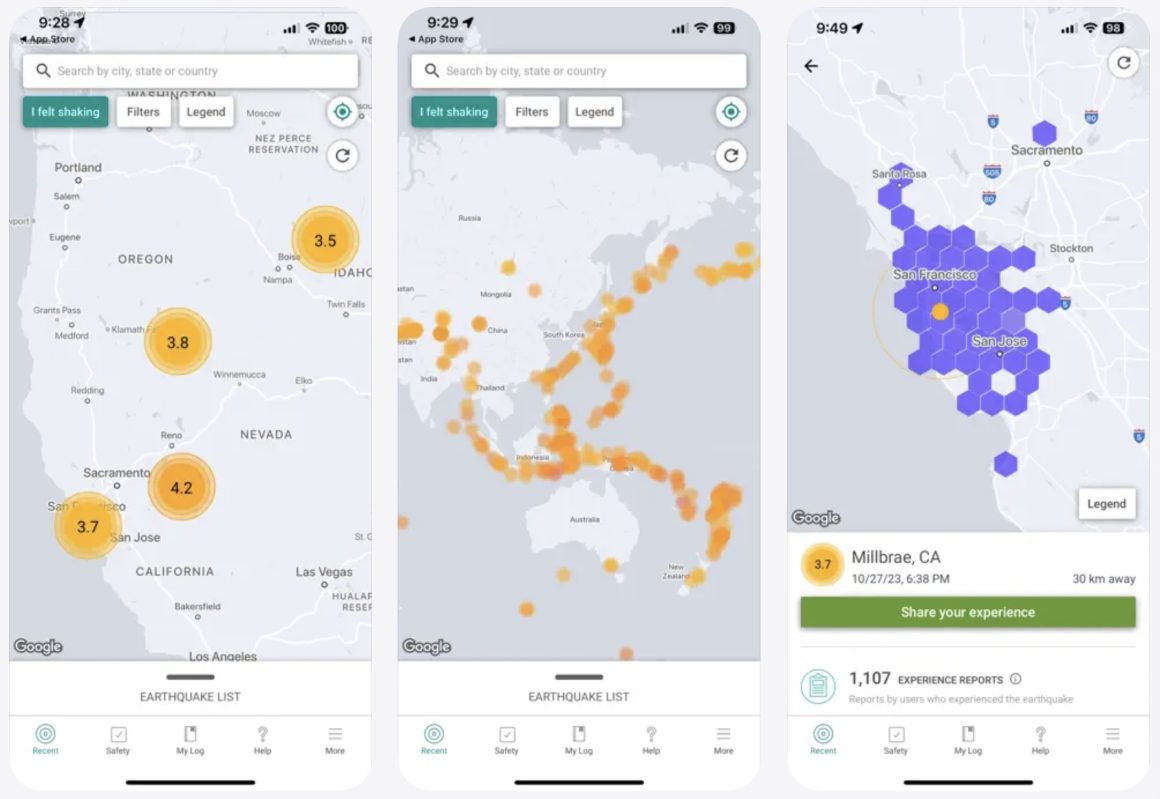
MyShake’s distinctive value is timing: it can deliver warnings several seconds before shaking arrives for earthquakes of magnitude 4.5 or greater — precious seconds that allow you to drop, cover, and hold on. The app also includes a community reporting feature, letting users share their experience after a quake, and safety tips for preparedness.
It’s completely free, runs without ads or subscriptions, and has surpassed 3.7 million downloads. For travelers and residents on the West Coast, running MyShake alongside My Earthquake Alerts gives you both early warning for serious quakes and broader global tracking.
If you’re broadening your mobile travel toolkit beyond safety apps, our overview of travel apps for tours, attractions, and unique experiences and our guide to the best portable Wi-Fi hotspots for Europe travel are good places to start.