


Belgrade sits where the Sava runs into the Danube, which is why it has been fought over for two thousand years. The Celts founded Singidunum on the ridge above the confluence; Rome took it, and Legio IV Flavia Felix was stationed there from AD 86 until the middle of the fifth century. After that: Goths, Huns, Byzantines, Bulgarians, Hungarians, Serbs, Ottomans from 1521, Austrians for twenty-two years in the eighteenth century, Ottomans again, then Serbia from 1867. The fortress above the rivers was besieged in 1440, 1456, 1521, 1688, 1690, 1717, 1739, 1789 and 1806.
Zemun, which is now a Belgrade municipality twenty minutes from the center, spent that same period on the other side of the border, in Habsburg territory — which is why the tower on the hill at Gardoš was built in 1896 to mark a thousand years of Hungarian settlement, and why the streets beneath it look nothing like the rest of the city.
Egor Zvezdin, an artist and art producer, moved from St Petersburg to Belgrade in 2023 and produces the Serbian program for an international travel company — walking and driving routes, food and cultural itineraries, and a cocktail tour. He talked to Locals Insider about what the city’s neighborhoods each explain, the place everyone goes that he would skip, where to find quiet, and the view that makes the whole thing make sense.
“Belgrade is a city with a strain running through it. Its entire history, it has been trying to prove to the world that it exists.”

From St Petersburg to Producing Trips That Explain a City
I’m from St Petersburg and I’ve lived in Belgrade since 2023. I work as a producer for the Serbian destination at an international travel company. What I do is invent and develop travel products: walking and driving routes, gastronomic and cultural programs.
Broadly, I try to make it so that a person doesn’t just arrive in Serbia, look at the sights and leave, but actually understands where they’ve ended up and what kind of place this is.
A City That Keeps Contradicting Itself
My relationship with Belgrade is complicated. For me it’s a city with a strain running through it. Its entire history, it has been trying to prove to the world that it exists, that it has the right to be itself, and that it has to be reckoned with.
I come from St Petersburg, which over three hundred years, through every catastrophe and upheaval, has become a fairly organic whole. There, you understand how the city is put together even if you never took any particular interest in it.
Belgrade doesn’t have that. It constantly contradicts itself and breaks your usual picture of the world. You can be walking down a street and within a few minutes move between eras that, in your mind, shouldn’t be anywhere near each other.

At first this irritates you. Then it starts to fascinate you. And then you realize that this is exactly what its character consists of. It makes you look differently at history, and at how the world is arranged in general. It’s a great experience.
How History and Architecture Turned Into a Job
I was lucky to be born in St Petersburg, where the history of architecture is literally part of the urban environment. You can take no special interest in history and still run into it constantly.
I was lucky with history itself too: I had a great teacher at school, and then lecturers at university who taught me to look not so much at dates and names as at the substance of what happened. Why did people act the way they did? What influenced them? Why did society change? How did political decisions show up in everyday life?
That seems to me far more interesting than memorizing who was born when and died when. At some point history and architecture became my way of understanding the world around me. And then it naturally grew into work.
No Single Neighborhood Explains Belgrade. It Takes Four
I wouldn’t pick one district. Here each one is responsible for its own historical period, and only together do they add up to the whole picture.
Stari Grad is an enormous historical layer cake, from ancient settlements and Roman Singidunum through to the Ottoman period.

Vračar and Dorćol let you see different sides of bourgeois Belgrade and its development in the era of royal Yugoslavia.

Novi Beograd is a completely different story: socialist modernism, large-scale urban planning experiments, an attempt to build the city of the future.
And Belgrade Waterfront is how the city wants to see itself today.

The most interesting thing is that these eras don’t replace one another neatly, like pages in a textbook. They exist simultaneously, sometimes peacefully, sometimes in conflict with each other.
So Belgrade has to be examined in detail first, and then you step back a few paces and try to see the mosaic as a whole.
“The eras don’t replace one another neatly, like pages in a textbook. They exist simultaneously, sometimes peacefully, sometimes in conflict.”
Building a Route: Fewer Sights, More Connections
For me the main thing is not the number of sights you manage to show in two or three hours. You can walk half the city, list dates, name names, and in the end say nothing about the city itself.
I’m more interested in finding the story that connects a place, people and a period. Why did exactly this architecture appear here? How did the Ottomans, the Habsburgs, Yugoslavia shape the city? Why do neighboring streets show completely different ideas of what a city should be?

I like it when history stops being something abstract and starts to explain what a person can see around them. That’s why architecture, politics, religion, everyday life and food can all sit side by side in our routes. Because in reality they don’t exist separately from one another.
And it’s important to leave room for the city itself. A route shouldn’t turn into a dash between checkpoints. Sometimes the most interesting things happen in between.
Why Cocktail Bars Belong on a History Program

Belgrade is sometimes called the Berlin of the Balkans. I can’t say how accurate that comparison is, but in terms of nightlife and bar culture the city really does have something to surprise you with.
Belgrade is one of the food and bar capitals of the region, and I want guests to see that side of it too. Because Serbia is rakija, of course. But if a person thinks the local drinking culture ends there, they’re missing a lot.
There are excellent cocktail bars here, interesting original interpretations, people experimenting with flavors and local products. That’s a different story about the city — contemporary, alive, not directly connected to the usual tourist routes.
That’s why we have a separate cocktail tour. I like showing guests Belgrade from different angles: during the day we can work through two thousand years of history, and in the evening get to know what the city lives on now.
The Fact That Surprises Visitors Most: Rome Was Here

Probably that the Roman Empire was here. And not just that its border ran somewhere nearby — there was a full Roman city, Singidunum.
People often perceive Belgrade as the capital of Serbia with a fairly complicated recent history. They don’t always imagine how deep the city’s roots go.
And then you start telling them about the Romans, the Byzantines, the Ottomans, the Austrians, and it turns out that Belgrade has spent its life at the intersection of the interests of an enormous number of states and civilizations.
It immediately becomes clearer why it looks the way it does, why there are so many contradictions here, and why history literally sticks out from under the asphalt.
“Why history literally sticks out from under the asphalt.”
Overrated: Skadarlija. Underrated: Zemun
Of the places, I’d call Skadarlija overrated. Not because it’s bad, but because it’s often treated as the compulsory stage set of old Belgrade: cobbled street, traditional kafanas, music, national cuisine.

All of that is there, and it’s definitely worth going once. But if you want to understand the city, Skadarlija alone is nowhere near enough. Belgrade is far more varied, more complicated and more interesting than that slightly postcard image.
Zemun, in my opinion, is underrated. It creates a striking contrast with the rest of Belgrade. Different architecture, a different historical fate, a different feeling of space.

That’s especially interesting if you remember that today Zemun is part of a single city, although historically it developed in a completely different political and cultural context. I like places that let you see that the urban map we’re used to isn’t a given — it’s the result of historical circumstances.
Belgrade’s Cultural Life Is Going Digital, Fast
I find it interesting to watch the digitalization of cultural life. In St Petersburg and Moscow we went through similar processes about fifteen years ago, and here a lot is now developing in the same direction, but much faster.
The ways of interacting with an audience, promoting cultural projects and organizing events are changing. Digital tools are gradually becoming part of the everyday work of cultural institutions, and I’m curious to watch how that happens.
At the same time, Belgrade is a city with a very lively independent cultural scene. Something is always going on: exhibitions, performances, music events, small projects that exist thanks to the enthusiasm of particular people.
The most interesting thing right now is watching how all that develops, and how the city finds its own balance between tradition, the European cultural context and new technology.
Choosing by Mood, Not by Calendar

It all depends on the mood. Belgrade is convenient in that sense: almost everything I’m interested in is here, from classic cultural institutions to small independent venues.
Sometimes I want theater or an exhibition, sometimes music, sometimes to end up at an event I knew nothing about the day before. I don’t much like drawing up a compulsory cultural program a month in advance. I like it when there’s constantly something new in the city and you can choose by mood.
Where to Find Quiet: Zemun and Topčider
Zemun is good because the feeling of the city there is completely different. You can walk along the Danube, disappear into the small streets, climb up to Gardoš. You’re still in Belgrade, but for a while you can forget its frantic rhythm.
Topčider is a different story — a park, trees, the chance to simply be in nature without leaving town.
I like that places like this exist inside the urban fabric in Belgrade. You don’t have to plan a separate trip to exhale a little.
Meeting Friends: It Depends on the Company

It depends on the company and the mood. Sometimes it’s a bar or a restaurant, sometimes a walk through the city, sometimes theater or some other cultural event.
I’m not one of those people who has one place for every occasion. That doesn’t seem very Belgrade to me: there are too many different spaces and scenarios for spending time here. Meeting friends for a cocktail is one thing, going somewhere for dinner is another, walking along the rivers and talking for a few hours is a third.
So first you decide on the company, then on the place.
Coffee, Breakfast and the Market He Means to Get To
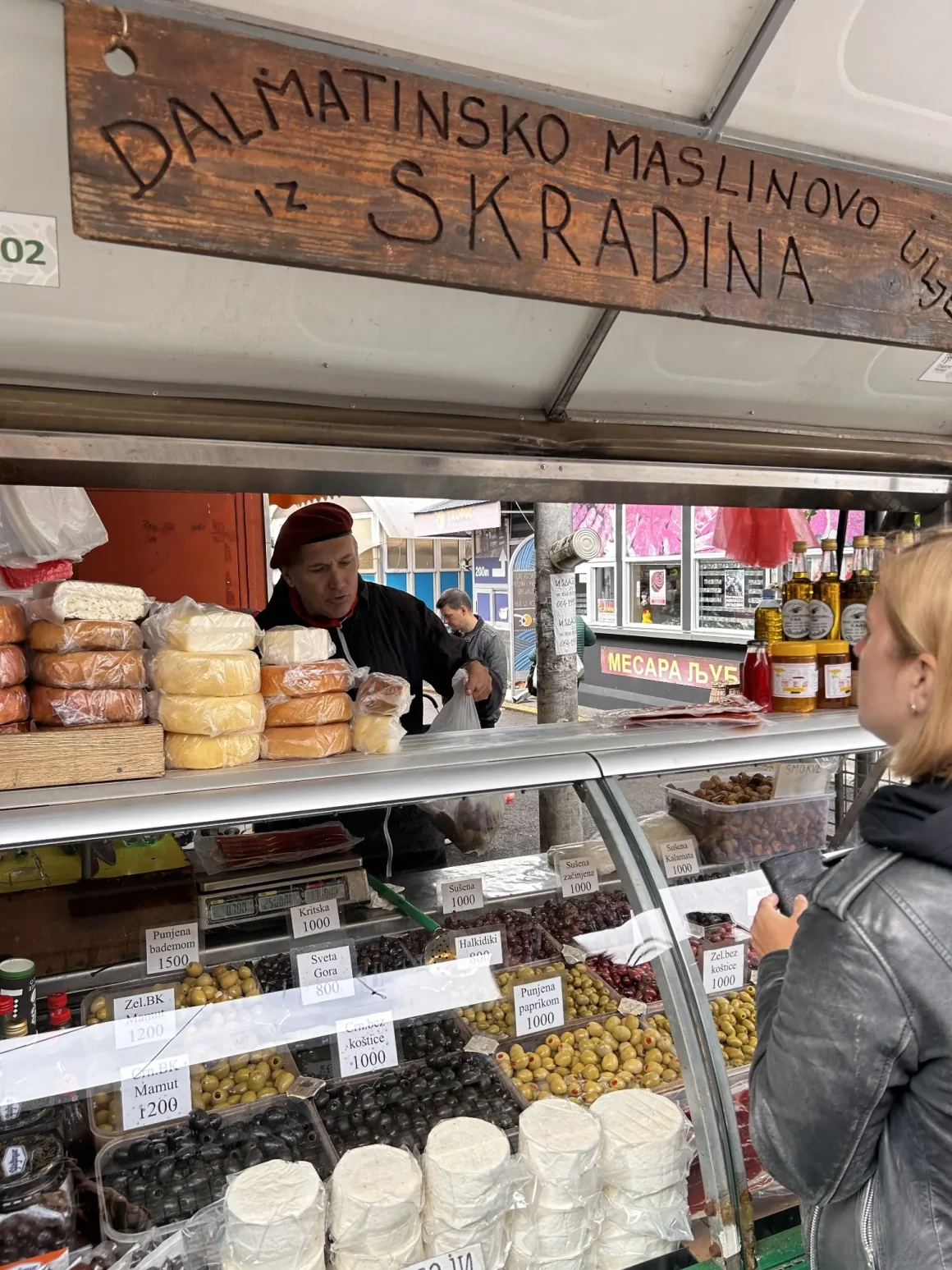
With my fairly intense schedule, breakfast most often happens at home. That’s less a question of habit than of how life is organized: sometimes there simply isn’t time for beautiful morning rituals.
Coffee I’m happy to drink in the new chains and specialty places. What matters to me is that the basic quality is predictable: I roughly know what coffee I’ll get, and I don’t waste time on experiments when I have a pile of things to do. I like good places, but I don’t think every trip out for coffee has to turn into a separate gastronomic adventure.
As for food shopping, honestly, with my schedule it’s usually supermarkets. It’s convenient and quick, and it doesn’t correspond at all to that Serbian vibe people usually show in nice stories about local life.
Because properly you should go to the market with a string bag, buy seasonal vegetables, talk to the sellers, choose your produce and then cook something good out of it. That really is a pleasure. I like the idea of that kind of interaction with a city, where you aren’t just buying food but becoming part of everyday life. But it takes time. And as usual, there isn’t enough of it.
The First Bar to Recommend

I’d say Ćilim. But this is a case where a lot depends on what exactly a person is looking for: a quiet evening, interesting cocktails, or a place with a particular atmosphere.
We also have a separate cocktail tour where we introduce guests to Belgrade’s bar culture. That seems to me far more interesting than just handing over a list of five venues. You can talk for a long time about where to go, or you can turn up, try different drinks, get to know the places and the people, and form your own impression.
Day One: Start at the Fortress
If friends come to visit, I usually take them to Belgrade Fortress.

For me it’s the ideal place to begin an acquaintance with the city. First, the position is extraordinary: the confluence of the Sava and the Danube, from where it becomes literally clear why a city arose exactly here and what this place has meant over the centuries.
Second, the fortress is a multi-layered cake of history. You can talk about the Romans, the Byzantines, medieval Serbia, the Ottomans, the Austrians — and none of it looks like an abstract account from a textbook. You’re standing in a specific place and you can see the traces of different eras.
I like starting there because the fortress lets you feel the scale of the history and see the city at the same time. And after that you can go and work through the details.
The Best View in the City: Gardoš
For me, it’s from Gardoš in Zemun.

I like not only the view itself but what stands behind it. Looking at Belgrade from that point, you can see a city that took shape over roughly fifteen hundred to two thousand years. Different eras, different architectural languages, different ideas of what a city should be.
And all of it exists simultaneously, without any attempt to finally reconcile one with another.
From Gardoš you understand particularly well that Belgrade is not one city in the usual sense, but several historical spaces that have gradually grown together into a single whole.
That’s probably why I love this place. It lets you see not just a beautiful panorama but the essence and the beauty of the city, with all its contradictions.
“Belgrade is not one city in the usual sense, but several historical spaces that have gradually grown together into one.”
If you’re planning the trip, our guide to the best things to do in Belgrade, recommended by locals covers the rest of the city, and Belgrade’s boutique hotels with charm is where to sleep.
If you need a transfer from Nikola Tesla Airport into town, our KiwiTaxi promo code LOCALS takes 7% off your first pre-booked car, and the best eSIMs for Europe covers getting data the moment you land — Serbia is outside the EU, so your roaming bundle probably doesn’t cover it.
Heading on afterwards, see Montenegro through a local’s eyes and the quiet islands of Croatia.