Cyprus Travel Guide: Paphos, Limassol, Nicosia & Where to Go 2026
Discover Cyprus with LocalsInsider’s travel guide. Explore boutique stays, Mediterranean-inspired dining, scenic hikes, and rich cultural heritage in this island paradise.
Cyprus is the Mediterranean island that sits at the crossroads of three continents and tastes like all of them. Paphos has the Hellenistic mosaics and the mythological Aphrodite's beach; Limassol has the marina, the food scene, and the wine industry quietly making moves; Nicosia is Europe's last divided capital where you can walk through a UN checkpoint into the Turkish-Cypriot north and have lunch in Kyrenia. Plus the Troodos mountains for cooler village stays and a coastline that runs in any direction you point a car.
Our Cyprus coverage focuses on the divided capital, the southern wine country, and the meze halls that take Cypriot food seriously.
The travel personality: The Mediterranean Wanderer
Quick facts
Live right now
Best time to visit
| Season | Why go |
|---|---|
| March-May | Spring wildflowers, mild, perfect for hiking and ruins |
| October-November | Sea still warm, fewer tourists, wine harvest season |
| June-September | Peak beach season but punishingly hot inland |
Top cities to visit
Experiences you'll probably love
- Tomb of the Kings at Paphos — Hellenistic underground tombs, less crowded than Greek mainland sites
- Wine tasting in the Troodos foothills — Commandaria is one of the oldest wines still produced
- Walking the Green Line in Nicosia — the divided city border with UN checkpoints
- Snorkeling at Konnos Bay or Blue Lagoon, Akamas Peninsula
- Mountain village stay in Omodos or Lefkara for traditional Cypriot food
Not many tourists know about…
- Stay in Paphos old town rather than tourist Kato Paphos — locals' Cyprus
- Meze at To Petradi (Limassol) or Mousikos (Nicosia) — 20+ small plates is the way
- Halloumi is everywhere but the best is from village dairies in Pano Lefkara
- Avoid Ayia Napa unless clubbing is your goal — neighboring Protaras is the calmer alternative
- Cross to the north for a day in Kyrenia (Girne) — the harbor is one of the Mediterranean's prettiest
If you visit only once, make it this
Hellenistic underground tombs cut into solid rock in the 3rd century BC — UNESCO-listed, less crowded than mainland Greek sites. Despite the name, no kings are buried here; the name reflects the grandeur. Walk the eroded coastal cliff path to the sea afterward.
€2.50 entry, open year-round. Best in early morning before the heat.
Where to walk & breathe
Cyprus's last undeveloped peninsula — turtle-nesting beaches, the Aphrodite Trail through gorges, the Blue Lagoon's clear shallows reached only by 4×4 or boat. National park status protects 230 plant species.
Rent a 4×4 from Paphos or take a boat from Latchi marina. 1-day trip minimum.
Museums worth your time
Cyprus's national archaeological collection — Bronze Age through Roman period. The Aphrodite statues, the famous 2nd-century Aphrodite of Soli.
Visit website →11,000 years of Nicosia history compressed into one building — Bronze Age, medieval, Ottoman, British colonial, modern. Free entry.
Visit website →The Insider's Edit
A few additions for the Cyprus traveler beyond the Limassol coast:
A Mediterranean village-style resort on the unspoiled Akamas Peninsula — regularly on the world's best-hotels lists. Pyrgos is its fine-dining option.
Stylish, design-forward beachfront — one of Cyprus's first genuinely contemporary hotels.
A polished modern beachfront escape with a Nobu Matsuhisa restaurant — only the second Nobu outpost in Europe.
Hellenistic underground tombs carved into the rock — quietest at sunset.
Where to eat
Traditional Cypriot meze — 20+ small plates including halloumi, kleftiko (slow-cooked lamb), and grilled octopus. Marina-front location.
Old Nicosia institution — the Cypriot meze taken seriously, often with live bouzouki music. Cash-friendly, family-run since the 1980s.
Limassol seafood institution — fresh Mediterranean fish, the seafood meze platter, harbor location. Booking essential in summer.
Modern Cypriot fine dining at Limassol Marina — playful takes on traditional dishes, the deconstructed kleftiko is the signature. Opened 2022, refreshed 2025.
Where to stay
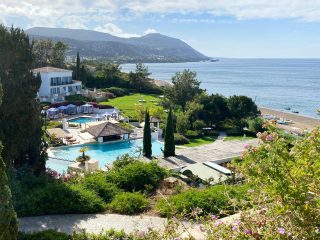
Cyprus's most acclaimed luxury resort on the Akamas Peninsula — Byzantine-village-style architecture, three pools, the Thalassa Spa, beachfront access. Leading Hotels of the World.
Adults-only beachfront hotel in Paphos — sleek modern Mediterranean design, the rooftop restaurant Tomé, infinity pool overlooking the sea.
Marriott Luxury Collection, opened 2018, refreshed 2025 — beachfront resort with the Caractère Michelin-starred restaurant (Cyprus's first Michelin star, 2024), seven pools.
Design Hotels member in Paphos — Mediterranean modernist, rooftop suites, beachfront pool, family-friendly without compromising the design language.
Realistic daily budget
Per person, per day. Excludes flights. Peak season can run 20-40% higher.
Travel safety & inclusivity
Safety scores reflect UK FCDO & US State Department travel advisories. LGBTQ+ scores reflect Equaldex and ILGA-Europe rankings. Both refreshed quarterly.
Major festivals
Need a visa for Cyprus?
Many travelers can enter Cyprus visa-free, but it depends on your passport. Check your specific requirements:
Powered by evisas.com · We'll open your nationality-specific requirements page in a new tab.
Partner link — Locals Insider may receive a small commission at no extra cost to you. Always confirm the latest requirements with the official embassy.
Not sure if Cyprus is right for your next trip? We'll compare 53 destinations against your travel style. Take our country matcher quiz →
Frequently asked questions about Cyprus
Do I need a visa to visit Cyprus?
Cyprus is an EU member and eurozone country, but as of May 2026 not yet a full Schengen member — Schengen accession was approved at EU level in late 2025 and is expected to take effect during 2026 (technical implementation pending). Practical implications: EU/EEA/Swiss citizens travel freely with passport or national ID. UK, US, Canada, Australia, Japan, South Korea, Brazil, Argentina, Mexico, and around 60 other countries: visa-free 90 days in any 180-day period (currently calculated separately from Schengen days, until full accession — after which it merges into the Schengen 90/180 clock). Holders of a valid double/multi-entry Schengen visa (Category C) can enter Cyprus on it (used as a national visa equivalent). Russian, Belarusian, Chinese, Indian passport holders can apply for a Cyprus pro-visa online — free, 24-hour processing, single entry, 90 days. Northern Cyprus (Turkish-occupied since 1974) operates a separate border regime — you can cross the Green Line at official checkpoints in Nicosia and at Pergamos/Strovilia from the Republic side; technically entering from Turkey directly (Ercan Airport) is considered "illegal entry" by the Republic and can complicate later visits. Passport valid 3 months beyond exit.
When is the best time to visit Cyprus?
Cyprus has a classic Mediterranean climate — long hot summers and mild winters. April–June is the universal sweet spot — 20–28°C, wildflowers blooming across the Akamas Peninsula and the Troodos foothills, warm enough to swim by mid-May, manageable for hiking. September–October is the secondary great window — sea still 24–26°C (warmer than the air for swimming), grape harvest, festival season (Limassol Wine Festival end of August). Avoid mid-July to mid-August — Limassol and Paphos hit 35–40°C and the package-holiday crowds peak; northern Europe's beach holiday hotspot. The Troodos Mountains stay 5–10°C cooler than the coast in summer (ideal escape) and get snow from December to March (Mount Olympus 1,952m has Cyprus's only ski resort). Winter (November–March) is mild on the coast — 12–18°C, restaurants quieter and pricing soft, walking and hiking ideal in Akamas and the Troodos. Ramadan doesn't affect tourist services in the Greek-Cypriot south but is observed in Northern Cyprus. Easter (Orthodox calendar, usually April or May) is a major event — atmospheric in the Troodos villages.
What's the classic Cyprus itinerary and where should I stay?
7–10 days for the full Cyprus loop, with a rental car (the island is small but spread out and public transport is limited). Paphos (3 nights): Western Cyprus — the Paphos Archaeological Park (UNESCO — Roman villa mosaics, the House of Dionysos), Tombs of the Kings, Aphrodite's Rock (Petra tou Romiou) at sunset, the Akamas Peninsula wild coastline (jeep tour to the Blue Lagoon at Latchi). Troodos Mountains (1–2 nights): the painted Byzantine churches (10 of them UNESCO-listed — Asinou, Panagia tou Araka, Stavros tou Agiasmati), Kykkos Monastery, the wine villages (Omodos, Vouni). Limassol (2 nights): the lively beach-and-promenade city — the Marina, the medieval castle, the Old Town's renovated quarters, day trip to Kourion archaeological site. Larnaca (1 night, often via the airport): Finikoudes promenade, the Salt Lake (flamingos November–March), the Hala Sultan Tekke mosque. Nicosia (1 night): the world's last divided capital — walk through the Green Line at Ledra Street to Northern Cyprus for the day. Skip Ayia Napa unless you're 20–25 and there for the clubs.
What about the divided island — North vs South Cyprus?
Since 1974, Cyprus has been divided by a UN-patrolled buffer zone (the Green Line) — the Republic of Cyprus (the EU member, Greek-Cypriot, southern two-thirds of the island) and the Turkish Republic of Northern Cyprus (TRNC), which is recognized only by Turkey. As a tourist, you can cross between them, but the rules matter. Crossing from the Republic to Northern Cyprus: use one of the 9 checkpoints (the easiest is Ledra Street in central Nicosia — walk through 200m of UN buffer zone, two passport stamps). Day trip easy, return in the evening. What to see in Northern Cyprus: Bellapais Abbey near Kyrenia/Girne, St. Hilarion Castle (Walt Disney's reference for Snow White), Famagusta (Othello's Tower, the ghost town of Varosha now partly accessible), Karpaz Peninsula wild beaches and turtles. Important entry rule: entering Cyprus directly via Ercan (the Northern Cyprus airport) is officially considered "illegal entry" by the Republic of Cyprus and the EU — it can complicate future EU travel. Always enter via the Republic (Paphos, Larnaca airports), then cross over. Practical: the North uses Turkish lira (TRY) but euros are accepted everywhere; you may need a separate basic car-insurance policy at the border.
What food, drink, and money should I know about?
Cypriot cuisine sits between Greek and Levantine — mezze culture, lamb-and-pork-heavy grilling, olive oil and lemon everywhere, halloumi as a national identity. Must-try: halloumi (PDO-protected Cypriot halloumi, grilled directly on the embers — not the rubber supermarket version), souvlakia and sheftalia (charcoal-grilled pork skewers and minced-pork patties wrapped in caul fat), kleftiko (slow-roasted lamb traditionally cooked in a clay oven — order a day ahead at proper tavernas), moussaka, stifado (red wine and onion lamb stew), louvi me lahana (black-eyed peas with chard), flaouna Easter pastries, loukoumi (Cyprus's version of Turkish delight, made in Geroskipou). Mezze culture: order "a meze for two" at a proper taverna and 15–25 small plates arrive over an hour. Drinks: Commandaria is the world's oldest named wine, recorded since the 12th century — a sweet fortified dessert wine. Local table wines from the Troodos foothills are improving fast (Vlassides, Tsiakkas, Kyperounda). Zivania is the local grappa-equivalent. Coffee: Cypriot coffee (cinnamon and cardamom variant of Turkish coffee). Money: euros (€) in the south, Turkish lira accepted in the north; cards work universally.
Locals Insider's Articles About Cyprus
Articles in this section are written by Locals Insider editorial team. Want to share your experience about Cyprus? Email us at hello@localsinsider.com.