

Oman Travel Guide: Muscat, Nizwa, Wahiba Sands in 2026
Den arabiske halvøs stilleste hemmelighed — wadis, ørken, Hajar-bjergene, lange hvide kyster og en kultur, der har bevaret den arabiske eleganz, der andre steder er overdøvet af moderne metropoler. Muscat er den mest civiliserede mellemøstlige hovedstad.
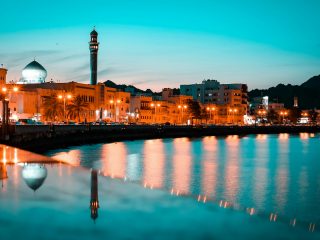
Oman is the Arabian Peninsula's quieter, more authentic alternative to its Gulf neighbors — no oil-fueled mega-development, traditional culture intact, dramatic landscapes ranging from the Hajar Mountains to the Wahiba Sands to the Dhofar coast. Muscat is the calm capital — the Royal Opera House, the Mutrah Souq, the Chedi's 103-meter pool. Beyond Muscat: Nizwa's Friday goat market, the Jebel Akhdar mountain plateau, the Musandam Peninsula's fjord-like inlets.
Our Oman coverage focuses on the luxury resort scene that's quietly become world-class, the desert and mountain experiences worth pairing, and the cultural quietness that distinguishes Oman from Dubai and Doha.
The travel personality: The Quiet Arabian Adventurer
Quick facts
Live right now
Best time to visit
| Season | Why go |
|---|---|
| October–April | October–March is the prime window for the whole country. Salalah and high-altitude Jebel Akhdar work in summer when the rest of Oman doesn't. |
| May, September | Shoulder season — fewer tourists, often cheaper, weather still good |
| June–August (45°C+ except in Salalah/Jebel Akhdar) | Off-season — quiet, best deals, plan around weather |
Top cities to visit
Experiences you'll probably love
- Overnight in the Wahiba Sands with a Bedouin family at a desert camp
- Dhow cruise through the Musandam fjords for dolphin spotting and snorkeling
- Wadi Shab — clear turquoise pools requiring a hike and short swim through a cave
- Rose harvest in Jebel Akhdar (April–May) when the mountain villages produce rosewater
- Turtle watching at Ras al-Jinz beach reserve — one of the world's most important nesting sites
Not many tourists know about…
- Rent a 4×4 if going beyond Muscat — most of Oman's best places require off-tarmac driving
- Salalah in the south transforms June–September into green tropical landscape (the khareef monsoon)
- Bait Al Luban in Muscat — the only proper traditional Omani restaurant most visitors miss
- Eat shuwa if locals invite you — meat slow-cooked underground for a day, a celebration dish
- Friday is the quiet day (weekend), Saturday is the loud one — plan accordingly
If you visit only once, make it this
12,500 square kilometers of orange dunes in central Oman — Bedouin desert in its iconic form. Stay overnight at Desert Nights Camp or Magic Camps for the dune drives at sunset and the silence at 3am. The Milky Way is genuinely visible.
3 hours from Muscat. 4WD essential — book through a camp or tour operator.
Where to walk & breathe
A 30-minute hike up a coastal canyon south of Muscat, ending in a hidden chamber pool reached by swimming through a low gap — once inside, a waterfall pours into a turquoise pool surrounded by cliffs.
2 hours from Muscat. Bring waterproof bag for the swim. Free entry.
Museums worth your time
Oman's flagship museum — opened 2016 across from the Royal Palace. 14 galleries covering Omani history, the country's maritime tradition.
Visit website →The Zubair family's private heritage museum — traditional Omani household objects, weapons, jewelry, the recreated village.
Visit website →The Insider's Edit
A few additions for travelers planning Oman at the top end:
A spring 2026 opening above an 18-hole golf course — Tivoli's debut in Oman.
Sultan Qaboos's late-life cultural gift — Muscat's serious music venue, with a season of opera and ballet.
A private museum of Omani heritage (silverwork, weapons, traditional dress) in a heritage Omani house.
With Cookson Adventures or Black Tomato — Bedouin guides, private tents, a stretch of dune that takes an hour to climb.
Where to eat
The Shangri-La's seafood restaurant on the bay — Omani lobster, hammour, the local kingfish biryani.
Refined Omani cuisine inside the Royal Opera House — kebabs, harees, shuwa (24-hour pit-roasted lamb).
Outdoor majlis-style dining under shisha lamps — Arabic mezze, grilled meats. Where Muscat locals actually go for casual dinners.
Traditional Omani majlis-style restaurant — eat on cushions on the floor. The shuwa, the maqbous rice.
Where to stay
Reached by 4WD over the Hajar Mountains or paraglider from the cliff above — pool villas on a remote crescent beach in the Musandam Peninsula.
GHM's Muscat property — Yasuhiro Koichi-designed minimalist Omani architecture, the 103-meter pool (longest in the Middle East).
Two kilometers above sea level on the Green Mountain plateau — the highest 5-star in the Middle East. Pool villas on the canyon edge.
Opened 2024 in southern Oman's Dhofar region — pool villas on a private beach. Newest luxury property in Oman.
Realistic daily budget
Per person, per day. Excludes flights. Peak season can run 20-40% higher.
Travel safety & inclusivity
Safety scores reflect UK FCDO & US State Department travel advisories. LGBTQ+ scores reflect Equaldex and ILGA-Europe rankings. Both refreshed quarterly.
Major festivals
Need a visa for Oman?
Most travelers need an eVisa or travel authorization to enter Oman. Apply online in minutes through our trusted partner:
Apply for your Oman eVisa →Powered by evisas.com · We'll open your nationality-specific requirements page in a new tab.
Partner link — Locals Insider may receive a small commission at no extra cost to you. Always confirm the latest requirements with the official embassy.
Not sure if Oman is right for your next trip? We'll compare 53 destinations against your travel style. Take our country matcher quiz →
Frequently asked questions about Oman
Do I need a visa to visit Oman?
Oman has one of the simplest visa policies in the Gulf. Citizens of more than 100 countries — including all EU/Nordic countries, the UK, US, Canada, Australia, Japan, and most of Asia — can enter Oman visa-free for up to 14 days, as long as they have a passport valid for 6 months and proof of onward travel. For stays longer than 14 days (up to 30 days), apply for the e-Visa at evisa.rop.gov.om (the Royal Oman Police portal) — OMR 5 for 10 days, OMR 20 for 30 days (around €12 and €48). Russian and Chinese passport holders apply for the e-Visa or via the Omani consulate. GCC citizens (UAE, Saudi, Qatar, Bahrain, Kuwait) enter visa-free on national ID. Holders of valid UK, US, Schengen, Canadian, Australian, or Japanese visas (with at least one prior entry used) qualify for a fast-track e-Visa via the same portal. The Omani Rial (OMR) is one of the world's highest-valued currencies — €1 ≈ 0.42 OMR. Cards work in cities; carry cash for souqs and rural areas.
When is the best time to visit Oman?
October to March is the universal answer for most of the country — mild 22–30°C in Muscat and the interior, ideal for wadis, the Wahiba Sands, and Jebel Akhdar. November to February is peak — cool nights in the desert mean you can actually sleep at a Bedouin camp. Avoid June to August — Muscat hits 40–48°C, the wadis lose water, and most things outside an air-conditioned car become miserable. The Salalah exception: southern Oman (Dhofar region) is the world's only spot where the Khareef monsoon (June–September) transforms a Gulf country into rolling green hills, waterfalls, and 22–27°C weather — Gulf families flock here for what they call "the green season." The Salalah Tourism Festival peaks in August. Jebel Akhdar ("Green Mountain," 2,000m altitude) at the same time is in rose harvest season (April–May) — terraces of Damask roses for rosewater. Ramadan (2026: Feb 17–Mar 18): respectful daytime dining in private; restaurants reopen at iftar around 6pm.
What's the best Oman itinerary?
8–10 days minimum for the classic loop, rented 4x4 strongly recommended. Muscat (2 nights): the Sultan Qaboos Grand Mosque (women cover head, shoulders, ankles — black abaya for sale at the entrance), Mutrah Souq (the old port souq — frankincense, silver khanjar daggers, pashminas), the Royal Opera House, sunset at the Corniche. Nizwa (1 night): 1.5h drive inland — the historic capital, the round Nizwa Fort, the Friday morning goat market (livestock auction by 7am, a genuine cultural rarity), the souq for silverwork. Stop at Jabrin Fort and Bahla (UNESCO walled town) on the way. Jebel Akhdar (1 night): mountain road up to 2,000m, terrace villages, the Saiq Plateau, Anantara/Alila resorts overlooking the canyon. Wahiba Sands (1–2 nights): Bedouin camps in the dunes, sunset 4x4 "dune bashing," Bedouin dinner under the stars. Wadi Bani Khalid / Wadi Shab (1 day): turquoise pools, the hidden swimming cave at Wadi Shab. Optional: add Salalah (1.5h flight south) for the Khareef season, or the Musandam Fjords in the far north.
What makes Oman different from Dubai or Abu Dhabi?
Oman is the Gulf country that feels genuinely Arabian — there's almost no Manhattan skyline, no Burj Khalifa, no Las Vegas-meets-Arabia spectacle. What you get instead is older, slower, and more visually beautiful. Architecture rule: by royal decree, buildings in Muscat are limited to a few floors and must be white, sand, or limestone — the city feels Mediterranean rather than skyscraper-Gulf. Cultural authenticity: Omanis still wear the traditional dishdasha (white robe) and kuma (embroidered cap) or massar (turban) — not as a tourist costume but as everyday dress. The souqs sell genuine frankincense from the southern Dhofar region (the world's best), Bedouin silver, and Omani halwa. Nature is the main attraction: turquoise wadis between dramatic mountains, classic dune deserts (Wahiba Sands), 2,000m mountain plateaus, fjords in the Musandam, the Khareef green-monsoon coast in Salalah, sea turtles nesting at Ras Al Jinz. Crime is essentially nonexistent. Alcohol is available at hotels and licensed restaurants but not in public.
Should I rent a car in Oman or hire a driver?
Rent a 4x4 SUV if you're going outside Muscat — Oman is built for road trips. Roads are excellent, well-signed in English and Arabic, very low traffic, fuel cheap (around €0.50/litre). A 4x4 is essential for the Wahiba Sands dunes, the Jebel Akhdar mountain road (where checkpoints turn back 2WD vehicles), and Jebel Shams. Daily rates: 30–50 OMR (€70–120) for a basic 4x4 like a Pajero or Land Cruiser Prado. Most EU/UK/US driving licenses are valid for 6 weeks; an international permit is safer for longer. Driver-led tours are the right choice if: you have only 4–5 days, you don't want the desert driving stress, or you're focused on cultural experiences (the Bedouin desert camps almost always include the 4x4 transfer from the highway). Cost: 200–400 OMR/day for a private driver-guide. Public transport is minimal — Mwasalat buses link the main cities but are infrequent. Tap water: Muscat's desalinated water is technically safe but bottled is universally preferred for taste.
Locals Insider's Articles About Oman
Articles in this section are written by Locals Insider editorial team. Want to share your experience about Oman? Email us at hello@localsinsider.com.