




Reims: A First-Timer's Guide to Champagne's Capital City
Reims is the small French city — population 180,000 — that punches in three weight classes: the 13th-century coronation cathedral where every French king from 1223 to 1825 was crowned, the centre of the Champagne wine region (Veuve Clicquot, Ruinart, Pommery, Taittinger), and the Champagne crayères UNESCO chalk cellars beneath the city.
The second weight class is Champagne. Reims is the centre of the region — within 10 minutes of the cathedral, you can tour the centuries-old chalk-cellar 'crayères' of Veuve Clicquot, Ruinart (the oldest Champagne house, founded 1729), Pommery, Taittinger, and Mumm. The third weight class is dining — anchored by Domaine Les Crayères, the Belle Époque mansion-hotel-restaurant on the city's southern edge with two Michelin stars under Philippe Mille. Reims as a stylish weekend rather than a day-trip from Paris.
Quick facts
Live right now
Where to base yourself
First-time visitor? Pick a neighborhood that matches your vibe and stay there.
Cathedral District (Place du Forum / Place Royale)
The royal medieval core
Around the cathedral — the Place du Parvis with its café terraces facing the west portal, the small medieval lanes of Place du Forum (where Caesar's Roman forum once stood), the Place Royale with its statue of Louis XV. Walkable, pedestrianised, properly atmospheric.
Champagne House District (south of centre)
Where the great houses cluster
A short walk or taxi south from the cathedral — Veuve Clicquot, Pommery, Taittinger, Vranken-Pommery all sit in this stretch, with the chalk-pit cellars below ground and the grand 19th-century surface buildings above. Most visitors do 2-3 tours over a long weekend.
Saint-Remi & Les Crayères
The southern edge with the basilica and grand hotel
South of the centre — the Saint-Remi basilica (where Clovis was baptised and France was effectively founded), the surrounding Saint-Remi park, and the famous Belle Époque Domaine Les Crayères a few minutes away. Quieter, residential, properly grand.
Place Drouet d'Erlon & Belle Époque centre
The shopping and bar street
Reims' main pedestrianised shopping and bar street, between the cathedral and the train station — restaurants, café terraces, the city's everyday social heart. Less postcard than the cathedral district, more useful.
Where to stay
The iconic Reims address — a Belle Époque château built by the Pommery family, set in 7 hectares of formal park, with 20 rooms (no two alike) and two restaurants including the two-Michelin-starred Le Parc. Relais & Châteaux.
“The Champagne-region grande dame.”
A Belle Époque manor hotel with chef Arnaud Lallement's three Michelin-star restaurant — 33 rooms, indoor pool, the most exciting fine-dining in the region.
“The serious-food luxury alternative to Les Crayères.”
A Belle Époque townhouse hotel in the heart of central Reims, recently renovated — 168 rooms, properly central location two streets from the cathedral.
“The reliable mid-luxury central option.”
On the Place Drouet d'Erlon — 168 rooms, indoor pool, the most reliable central business-friendly stay.
“Walking distance to all the cathedral and Champagne sights.”
A converted 19th-century military barracks one block from the cathedral — 88 rooms, indoor pool, modern industrial-luxury interior.
“Among the most architecturally distinctive new Reims openings of recent years.”
A long-standing family-run 3-star on Place Drouet d'Erlon — 50 rooms, classical interiors, the most affordable central Reims option that still feels properly French.
Where to eat
Two Michelin stars. Chef Philippe Mille's grand classical dining room inside Domaine Les Crayères — Champagne pairings, intricate sauces, terrine de gibier in season.
“The defining Reims fine-dining experience.”
Three Michelin stars. Chef Arnaud Lallement cooks a deeply technical modern French tasting menu — his blue lobster signature dish is widely cited as one of the most perfect single dishes in French dining.
“The Champagne region's most exciting kitchen.”
One Michelin star. Chef Jacky Louazé's modern French in a calm Boulevard Foch dining room — properly seasonal, properly classical, with a Champagne list serious enough to be a destination in itself.
Reims' iconic 1925 Art Deco brasserie next to the central market — choucroute, plateaux de fruits de mer, andouillette, all served in white tablecloth surroundings under the original stained-glass ceiling.
“The everyday lunch institution.”
A young chef's modern French bistro near Place Royale — short menu, careful pairings (Champagne by the glass is the obvious move), properly young Reims energy.
“Booking essential.”
Museums worth your time
Built between 1211 and 1311 — where 25 French kings were crowned over 600 years. UNESCO World Heritage since 1991. The 13th-century stained glass (much restored after WWI damage) and the smiling angel sculpture on the west portal are the masterpieces.
“Free entry; €8 for the towers.”
Visit website →The 17th-century palace adjacent to the cathedral — where French kings dressed for their coronations and held the coronation banquet. Now houses the cathedral treasury (including the Charlemagne talisman) and original Gothic sculptures from the cathedral exterior.
“UNESCO.”
Visit website →Where Clovis, first king of the Franks, was baptised in 496 (essentially the founding moment of Catholic France). The 11th-12th century Romanesque basilica is monumental; the adjacent abbey is now the city's medieval art and archaeology museum.
“UNESCO.”
Visit website →The Champagne house most ambitious about contemporary art — every year the cellars host new commissioned art installations. The 18 km of chalk-pit cellars are UNESCO World Heritage.
“Tour and tasting from €25.”
Visit website →Founded 1729 — the oldest established Champagne house in the world. The medieval-style chalk cellars below the Belle Époque office building. Tours by reservation, properly serious tastings.
“UNESCO World Heritage cellars.”
Visit website →The Champagne house Barbe-Nicole Clicquot took over in 1805 as a 27-year-old widow and built into a global brand — invented the riddling table (still used everywhere).
“Tours from €30.”
Visit website →Only-here places
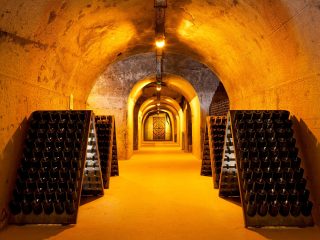
Reims' Champagne cellars sit in chalk pits originally dug by the Romans — kilometres of underground galleries at perfect Champagne-aging temperature (10°C, 80% humidity). UNESCO World Heritage Site since 2015.
“Most major houses run tours.”
The schoolroom where Germany signed the WWII surrender to the Western Allies on 7 May 1945 — preserved exactly as it was, with the original maps still on the walls.
“A free, properly sobering 30-minute visit.”
Visit website →A 1928 Art Deco library funded by Andrew Carnegie after WWI as part of the rebuilding effort — beautiful Art Deco interior, free to walk in.
“Often missed by visitors.”
Visit website →A 3rd-century Roman triumphal arch — the largest surviving from the Roman Empire (32m wide, 13m high), still standing where it was built.
“Walk through it on the way from the train station to the centre.”
An 18th-century neoclassical square with a statue of Louis XV at its centre — Belle Époque cafés and small shops under the arcades.
“The most photogenic small square in Reims.”
Tours & things to do in Reims
In partnership with GetYourGuide, Locals Insider recommends these tours and things to do in Reims.
Nature & quiet
A 22-hectare municipal park south of the centre — wooded paths, formal gardens, walking trails.
“Properly green, properly quiet.”
The small park surrounding the Saint-Remi basilica — formal lawns, benches, the basilica's flying buttresses as backdrop.
“Best after a basilica visit.”
A protected regional park covering the Champagne-vineyard hills between Reims and Épernay — walking and cycling routes through villages like Verzy (the iconic twisted beech trees) and through Premier Cru vineyards.
“Half a day with a rental car.”
City festivals
-
June (every 1st weekend)Les Sacres du Folklore (Fêtes Johanniques)
Reims' annual medieval festival — a procession of Joan of Arc with the dauphin Charles VII recreating the 1429 coronation, plus medieval markets and tournaments. The first weekend of June.
-
OctoberVendanges (Champagne harvest)
The annual Champagne harvest runs through September into October — most houses run vineyard-and-cellar visit packages during this period. The most evocative time to do a serious Champagne visit.
-
SeptemberHeritage Days (Journées du Patrimoine)
Mid-September — Champagne houses normally closed to the public open for the weekend, plus free entry to all the major monuments. Reims at its most generous.
-
November–DecemberReims Christmas Market
Late November to late December — one of France's largest Christmas markets, in front of the cathedral with the floodlit Gothic facade as backdrop. Properly civilised.
Travel safety & inclusivity
Reims is one of the safer larger French cities. Standard urban awareness applies for pickpocketing around the train station and the main pedestrianised streets. The central tourist zone (cathedral, Place Royale, Place Drouet d'Erlon, Champagne house district) is genuinely fine day and night. Solo travel, including for women in central areas, is fine.
France has comprehensive LGBTQ+ legal protections, including same-sex marriage since 2013. Reims is a small provincial city without a dedicated LGBTQ+ scene, but visible same-sex affection in central tourist zones is normal. The wine-tourism crowd is properly international.
Safety scores reflect UK FCDO & US State Department travel advisories. LGBTQ+ scores reflect Equaldex and ILGA-Europe rankings. Both refreshed quarterly.
Frequently asked about Reims
Where do locals eat in Reims?
Three picks across the spectrum of how Rémois actually eat in the iconic Champagne capital.
For the iconic Champenois institution: Brasserie Le Jardin at the Domaine Les Crayères, 64 Boulevard Henry Vasnier, 51100 Reims. The iconic brasserie of Reims's most famous gastronomic property — properly serious Champagne-regional cuisine (the iconic Champagne-region cooking with serious local Reims sourcing) at brasserie prices, alongside the three-Michelin-star Le Parc (covered below).
For the iconic Reims café institution: Café du Palais, at 14 Place Myron T. Herrick, 51100 Reims. The 1930-opened iconic Reims café — properly atmospheric Art Deco interior with the iconic stained-glass ceiling, a serious wine list emphasizing local Champagne house pours, and traditional French brasserie dining. Among Reims's most-cited heritage cafés. The walls are properly covered with vintage photographs of decades of Champagne-region celebrities.
For the affordable, locals' standard: Halles du Boulingrin, at Rue de Mars, 51100 Reims. The 1929-built Art Deco covered market hall — among France's most architecturally significant interwar market buildings, with the iconic Eugène Freyssinet-designed reinforced concrete vaulted roof. Open Wednesday, Friday, and Saturday mornings. Proper Champenois counter food and produce, including the iconic Reims pink biscuits (biscuits roses de Reims — the traditional sponge-finger biscuits served with Champagne).
Where can I get the best seafood with champagne in Reims?
Reims is the iconic global Champagne capital — every restaurant in Reims has a serious Champagne programme. For Reims seafood with the most serious Champagne pairings, the destination is Le Parc Les Crayères, at Domaine Les Crayères, 64 Boulevard Henry Vasnier, 51100 Reims.
Chef Philippe Mille's three-Michelin-star restaurant at Domaine Les Crayères — properly serious modern French cuisine with daily fresh seafood preparations (the iconic Brittany lobster, oysters from Cancale, the famous Champagne-poached white fish), and a Champagne list that runs to several hundred Champagne references including grower-producer rarities and museum-grade Champagne back-vintages from the surrounding Reims cellars. Among France's most consistently top-rated fine-dining destinations. Reservations 2-3 months ahead.
For a more accessible iconic alternative with serious Champagne service, L'Assiette Champenoise in nearby Tinqueux (chef Arnaud Lallement's three-Michelin-star restaurant — the iconic Reims-region fine-dining alternative) is the comparable destination. For something more casual, the cellar restaurants at Domaine Pommery and the iconic Mumm houses offer proper Champagne tasting menus with serious food pairings during the cellar tours.
Which historical boutique hotel should I stay at in Reims?
For an old-world historical stay in Reims, the reference is Domaine Les Crayères, Relais & Châteaux, at 64 Boulevard Henry Vasnier, 51100 Reims.
Originally built in 1904 as the private mansion of the Pommery Champagne family on the iconic Crayères chalk-cellar hillside (where Roman-era chalk-quarry tunnels still extend under the property and are used by the Pommery Champagne house for ageing the wine). Converted to a 20-room Relais & Châteaux luxury hotel in 1988. 5.5 hectares of formal French gardens designed by Edouard André (a contemporary of the Crayères period). Among France's most iconic luxury-hotel-and-restaurant complexes — the iconic three-Michelin-star Le Parc Les Crayères is the in-house dining destination.
Pricing from around €450/night. Bookings via the official site. For a more contemporary boutique alternative in central Reims, Best Western Premier Hôtel de la Paix at 9 Rue Buirette (a heritage building near the Cathedral) is the central heritage choice. For a smaller modern boutique, La Caserne Chanzy at 18 Rue Tronsson Ducoudray (a converted 1894 military barracks restored to an Autograph Collection boutique in 2019, just steps from Reims Cathedral) is the design-led heritage choice.
What is the LGBTQ+ scene like in Reims?
France legalised same-sex marriage in 2013. Reims is widely LGBTQ+-friendly as a tourist destination, but the city's small population (around 180,000) and its provincial-French character mean the dedicated LGBTQ+ scene is very limited — most LGBTQ+ Champenois travel to Paris (45 minutes by TGV) for serious queer nightlife.
The neighborhood: There is no defined gay quarter in Reims. The central area around Place Drouet-d'Erlon (the iconic pedestrian central square with the highest concentration of bars and restaurants) has the most LGBTQ+-friendly venues mixed in with the general nightlife scene.
The bars: Reims has only one or two dedicated LGBTQ+ bars at any given time (the scene is small enough that establishments come and go); Le Pull-In on Rue de Tambour has been a long-running mixed-but-LGBTQ+-friendly cocktail bar in the central area. Most LGBTQ+ travellers visiting the Champagne region take the 45-minute TGV to Paris for the iconic Marais quarter (covered in the Paris FAQ) for queer nightlife.
Pride: Marche des Fiertés Reims takes place annually in early summer — a small but growing Pride event.
What unique small museum, new 2024-2026 landmark, or 1-3 day itinerary should I plan for Reims?
The famous-person small museum: Musée Saint-Remi, at 53 Rue Simon, 51100 Reims. The contained museum housed in the iconic former Saint-Remi Royal Abbey buildings — dedicated to Saint Remigius (the 5th-century Bishop of Reims who baptised the Frankish King Clovis I in 496 CE, an event widely cited as the foundation of Christian France). The iconic Saint-Remi Basilica next door (UNESCO World Heritage) houses Saint Remigius's tomb. The museum collection covers 1,000+ years of Reims religious art and the Champenois military history. Closed Mondays.
The recent landmark: Reims Cathedral (Notre-Dame de Reims) at Place du Cardinal Luçon, 51100 Reims — the iconic 13th-century Gothic cathedral where 33 French kings were crowned (from Louis VIII in 1223 to Charles X in 1825). UNESCO World Heritage (1991). The iconic stained-glass programme includes Marc Chagall's 1974 windows in the axial chapel. The ongoing 800-year restoration programme has been active continuously since the cathedral's WWI bombing damage in 1914-1918; the most recent phase completed major facade restoration in 2024. For a Champagne-region landmark, the iconic Ruinart cellars at 4 Rue des Crayères (the world's oldest Champagne house, founded 1729, with the iconic Roman-era chalk-quarry tunnels used for cellar ageing) is among the iconic Reims experiences.
1-3 day itinerary: Day 1 — Reims city centre (Cathedral with Chagall windows, Palace of Tau coronation palace museum, Saint-Remi Basilica, lunch at Café du Palais, evening at Domaine Les Crayères). Day 2 — Champagne house cellar tours (Ruinart morning — the iconic oldest house, Veuve Clicquot or Pommery afternoon — both with iconic Roman-era chalk-tunnel cellars, evening tasting). Day 3 — Day trip via the iconic Route du Champagne to Épernay (40km south — the iconic Avenue de Champagne with Moët & Chandon, Mercier, Perrier-Jouët) and the Côte des Blancs villages (Cramant, Le Mesnil-sur-Oger for grower-producer tastings).
Planning more than just Reims? Our France travel guide covers the whole country — weather and currency live, hotels and restaurants across regions, must-visit experiences and where else to go.
Articles in this section are written by the Locals Insider editorial team. Got a Reims tip we missed? Email us at hello@localsinsider.com — we read every one.