


Osaka Travel Guide: Dōtonbori, Namba, and Japan's Unofficial Food Capital
Osaka is the Kansai-region city that the Japanese themselves consistently call the country's food capital — the home of okonomiyaki, takoyaki, kushikatsu, and the kuidaore ('eat until you drop') culture, with the iconic Dōtonbori neon canal, Osaka Castle, and the Universal Studios Japan theme park as supporting acts to the food.
This guide is built for first-timers but holds up on the return trip. We've started with picking the right area (Umeda's high-rises vs Namba's neon vs the Bay) and worked through the hotels (Tadao Ando's W Osaka, the 2026 Patina Osaka opening overlooking Osaka Castle), the restaurants from Hajime's three-Michelin-star 'synesthesia cuisine' to La Cime at #13 on Asia's 50 Best 2026, the museums beyond the obvious, and the unique places that make Osaka Japan's best food city.
Quick facts
Live right now
Where to base yourself
First-time visitor? Pick a neighborhood that matches your vibe and stay there.
Umeda / Kita
The Northern Osaka
Osaka's high-rise business district — vast underground shopping malls (Whity Umeda is the country's biggest), the Umeda Sky Building, the Hankyu and Hanshin department stores. The most connected hub.
Namba / Minami
The Vibrant Osaka
The southern entertainment district — Dotonbori canal with the famous Glico sign and Kani Doraku crab, Shinsaibashi shopping, the Kuromon Ichiba market. The most photographed Osaka.
Tennoji
The Old Osaka
South of Namba — Shitenno-ji (Japan's oldest officially-founded Buddhist temple, 593 AD), Tennoji Park, the Abeno Harukas (Japan's tallest building, 300m). Less touristed, more local.
Nakanoshima
The Cultural Osaka
An island in the middle of central Osaka — major museums (NMAO, Nakanoshima Museum), the rose garden, civic-architecture corridor. Quiet, refined, properly cultural.
Tenma / Nakazakicho
The Hipster Osaka
Just north of Umeda — Japan's longest covered shopping arcade (Tenjinbashisuji), Nakazakicho's indie cafés in restored pre-war shophouses. Where Osaka's creative class actually drinks.
Osaka Bay / Cosmosquare
The Modern Osaka
The waterfront — Universal Studios Japan, the Tempozan Ferris Wheel, Osaka Aquarium Kaiyukan (one of the world's largest). The newer hotels (W Osaka, Patina) are oriented this way.
The Insider's Edit
Three picks Osaka regulars send their friends to — curated from Tatler 2026, the World's 50 Best lists, and verified hospitality reporting.
On Honmachi-dori; the city's institutional luxury.
Asia's 50 Best Restaurants 2026 #13 (Japan's #1); chef Yusuke Takada's modern French.
Three Michelin stars; chef Hajime Yoneda's "synesthesia cuisine."
Where to stay
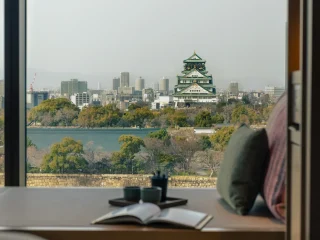
2026 opening overlooking Osaka Castle — Capella Hotels' wellness-focused sister brand's first Japan property.
“Strong wellness focus, signature spa programs.”
Tadao Ando-designed — the boldest design hotel in Osaka. 337 rooms in a concrete monolith, fashion-industry-favorite.
“The W aesthetic translated to Osaka.”
On Honmachi-dori — the city's institutional luxury. 160 rooms, the legendary St. Regis butler service. The Rural restaurant.
“Quiet, deeply refined.”
On the 33rd-40th floors of the Nakanoshima Festival Tower West — panoramic views across the city.
“The 40 Sky Bar & Lounge.”
The Umeda Ritz-Carlton — English-country-house-style interiors, the most traditional luxury in Osaka.
“Hanagatami (Japanese restaurant), La Baie (French).”
Directly above Osaka Station — among the most convenient hotels in Japan. Multiple restaurants, the panoramic Sky Lounge.
“Best business-luxury at fair price.”
Riverside boutique in the financial district — quietly stylish, well-priced for the location.
“Best mid-budget design in central Osaka.”
Major business hotel in Umeda — across from Osaka Station. The Folk Kitchen restaurant.
“Reliable, well-located, fair Hilton-status earnings.”
Affordable, central, well-connected — best non-design budget option in central Osaka.
The design-minded capsule hotel chain — sleek minimalist pods.
“Best for solo travelers on one-night stays.”
Where to eat
Three Michelin stars. Chef Hajime Yoneda's 'synesthesia cuisine' — multi-course tasting menu that triggers emotional responses through plating, scent and texture.
“The most theatrical Japanese fine dining outside Tokyo.”
Three Michelin stars. Chef Tetsuya Fujiwara's contemporary cuisine — Spanish technique meets Japanese ingredients.
“The interior in a converted 1935 town house is the most architecturally elegant fine-dining setting in Osaka.”
Three Michelin stars (Kyoto, but Osaka-accessible). The most exclusive kaiseki in Japan — booking through an introduction only.
“Pristine traditional Japanese dining.”
Tsuruhashi (Osaka's Koreatown) yakiniku — A5 wagyu cuts at restrained prices. The owner sources directly from Tajima farmers.
“Among Japan's best yakiniku experiences.”
The giant moving crab sign on Dotonbori — Kani Doraku's flagship. Multi-course crab kaiseki. Touristy but the crab is properly Hokkaido-sourced.
“The most photographed restaurant front in Osaka.”
Open since 1945 — Osaka's most famous okonomiyaki (savory pancake) institution. The yamaimo-yaki (mountain yam version) is the signature.
“Queue from 11am.”
Where to have breakfast
The Doromi Roll Cake institution — Osaka's most famous Western-style cake.
“Multiple cafés serve it for breakfast.”
Osaka's most respected specialty coffee roaster — single-origin pour-overs, properly serious about technique.
Osaka's other specialty coffee anchor — multiple locations across the city.
Japan's convenience stores — the egg sandwich, the onigiri, the freshly-pulled machine coffee.
“The standard Japanese quick breakfast.”
The 'Osaka's kitchen' market — 580m of food stalls. Open from 9am.
“Eat takoyaki, sashimi, fresh oysters for breakfast.”
Museums worth your time
César Pelli-designed building in Nakanoshima — entirely underground, with sculptural roof structures emerging from the ground.
“Serious modern Japanese collection plus international rotating shows.”
Visit website →Opened 2022 — a new Osaka contemporary art museum, Tadao Ando-influenced architecture.
“Strong on 20th-century Japanese art and international rotating shows.”
Visit website →City-history museum opposite Osaka Castle — covers prehistoric to modern.
“The full-scale reconstruction of the ancient Naniwa Palace's main hall is the centerpiece.”
Visit website →TeamLab's outdoor digital-art installation in Nagai Botanical Garden — illuminations through the trees and water at night.
“Open evening only.”
Visit website →One of the world's largest aquariums — the central 9m-deep Pacific tank with whale sharks.
“The most family-friendly major attraction in Osaka.”
Visit website →Inside the rebuilt Osaka Castle keep (1931) — eight floors of Toyotomi Hideyoshi-era history.
“The 8th-floor observation deck has panoramic views of central Osaka.”
Visit website →Only-here places
Toyotomi Hideyoshi's 1583 castle — burned and rebuilt multiple times, current keep is 1931.
“The surrounding 105-hectare park is one of Japan's most beautiful cherry-blossom spots.”
Visit website →The Glico Running Man sign, Kani Doraku's moving crab, the neon signs. Osaka's most photographed area.
“Best at night when all the signs are lit; walk the canal length.”
'Osaka's kitchen' — 580m of covered food market. Fresh fish, vegetables, the takoyaki and oyster stalls.
“Best 9am-11am.”
Visit website →One of Japan's oldest Shinto shrines (211 AD) — the four main halls were rebuilt every 20 years until 1810.
“The Sorihashi arch bridge is the icon.”
Visit website →Japan's oldest officially-founded Buddhist temple (593 AD). The five-story pagoda has been rebuilt many times.
“Quieter than Kyoto's famous temples.”
Visit website →Hiroshi Hara's 1993 twin-tower building connected by a rooftop ring — the open-air observation deck 173m above the ground.
“Most spectacular at sunset.”
Visit website →15 minutes by Shinkansen — Kyoto's 1,200+ temples, the Fushimi Inari shrine's vermilion gates, Kinkaku-ji golden pavilion, Gion geisha district.
“Even on a day trip, see one of Japan's most cultural cities.”
Tours & things to do in Osaka
In partnership with GetYourGuide, Locals Insider recommends these tours and things to do in Osaka.
Nature & quiet
The 105-hectare park around Osaka Castle — locals walking, joggers, Cherry blossoms in early April.
“Free.”
The island in the middle of central Osaka — riverside park, rose garden, civic-architecture corridor.
“Where central Osaka takes a quiet walk.”
1.5 hours south by train + cable car — UNESCO World Heritage Buddhist temple-town founded 819 AD.
“Stay overnight at a temple lodging (shukubo).”
30 minutes from central Osaka — a 33m waterfall reached by an easy forest walk. The most accessible nature escape from Osaka.
“Autumn leaves in November.”
30 minutes from Osaka — Japan's first capital (710-784). The tame deer in Nara Park, the giant Buddha at Todai-ji, the most ancient surviving Japanese architecture.
“Half-day trip.”
City festivals
-
Late March - early AprilCherry Blossom Season (Sakura)
Osaka Castle Park is the prime hanami spot — the moats surrounded by hundreds of cherry trees. The most magical week of the Osaka year.
-
July 24-25Tenjin Matsuri
Osaka's biggest annual festival — one of Japan's three great festivals. Boat procession on the Okawa River, fireworks, drumming parades. Properly Osaka.
-
AugustNaniwa Yodogawa Fireworks Festival
The biggest summer fireworks display in Osaka — 10,000 fireworks over the Yodo River. Among Japan's most spectacular hanabi.
-
October-NovemberAutumn leaves (Koyo)
Osaka Castle Park, Mino-o, Hokoji Temple. Less internationally famous than Kyoto's autumn — and far less crowded.
-
December 31Joya no Kane (New Year's Bell)
Buddhist temples across Osaka ring their bells 108 times at midnight on December 31 — Shitenno-ji is the main central event. Among Japan's most peaceful New Year traditions.
Travel safety & inclusivity
Among the safest major cities in the world. Lost wallets typically returned. Pickpocketing rare. Real risks: getting lost in train stations, earthquake preparedness.
Japan has no anti-discrimination laws and no same-sex marriage. Osaka is socially tolerant — Doyama-cho is the gay district. Less politically progressive than Tokyo; comparable in tolerance day-to-day.
Safety scores reflect UK FCDO & US State Department travel advisories. LGBTQ+ scores reflect Equaldex and ILGA-Europe rankings. Both refreshed quarterly.
Frequently asked about Osaka
Where do locals eat in Osaka?
Three picks across the spectrum of how Osakans actually eat — and Osaka is famously known as the "Tenka no Daidokoro" (the Kitchen of Japan), so eating well here is a cultural imperative.
For the iconic Osaka konamon (flour-foods) institution: Mizuno, at 1-4-15 Dotonbori, Chuo Ward, Osaka 542-0071. The most-cited okonomiyaki specialist in Osaka — the savory cabbage-and-batter pancake cooked on the tabletop griddle, with the iconic mountain-yam Yamaimoyaki version that's lighter than the standard Yamaimoyaki. Walk-in only; the queue is fast-moving.
For another iconic konamon pick: Honke Daiko, at 1-7-21 Sennichimae, Chuo Ward, Osaka 542-0074. The most famous takoyaki (octopus-ball) shop in Osaka — the spherical pancake batter balls with octopus inside, cooked on a special hot grill, topped with mayonnaise, takoyaki sauce, and bonito flakes. Around ¥600 for 8 balls. The iconic Dotonbori-area street-food experience.
For the iconic kushiage standard: The Hozenji-Yokocho alley — the iconic atmospheric alley behind Hozen-ji Temple, full of small kushiage (deep-fried skewers) shops, sushi counters, and udon stands. Hozenji Yokocho Yokoyama and the smaller traditional shops along the alley are the classic Osaka kushiage experience — paper lanterns, tatami floors, properly small format.
Where can I get the best seafood with champagne or sparkling wine in Osaka?
Osaka is Japan's iconic seafood city (the city's famous Kuromon Market has supplied chefs and home cooks for over 100 years). For Osaka seafood with serious Champagne and Japanese sparkling wine, the destination is Endo Sushi, at the Osaka Central Wholesale Market, 1-1-86 Noda, Fukushima Ward, Osaka 553-0007.
The legendary fish-market sushi shop — operating since 1907 inside the wholesale market itself, with morning sushi service starting at 5am for the market workers. The five-piece sushi sets (gozen) at ¥3,000-5,000 are the orders. The Champagne and Japanese sparkling-wine selection (Suntory's Tomi Sparkling, Grace Wines from Yamanashi) provides the contemporary pairing. Cash only; closed Sundays.
For a more refined evening alternative, Hajime at 1-9-11 Edobori, Nishi Ward, Osaka 550-0002 (chef Hajime Yoneda's three-Michelin-star restaurant — Asia's youngest chef ever to receive three stars, in 2009 at age 35) has the city's most progressive seafood-and-Champagne tasting menus.
Which historical boutique hotel should I stay at in Osaka?
For an old-world historical stay in Osaka, the reference is The Imperial Hotel, Osaka, at 1-8-50 Tenmabashi, Kita Ward, Osaka 530-0042.
Opened in 1996 as the Osaka outpost of the iconic Tokyo Imperial Hotel chain (whose original 1923 Frank Lloyd Wright-designed building in Tokyo was relocated to the Meiji-Mura outdoor museum in Nagoya), built on the historic Hyobu River bend with views over the Yodogawa river. 357 rooms in proper Japanese luxury-traditional style. The iconic Old Imperial Bar replicates the original Frank Lloyd Wright bar from the 1923 Tokyo building. The Beaux-Arts Restaurant has serious modern Japanese-French credentials.
Pricing from around ¥45,000/night. For a smaller, more architectural alternative with deep Osaka heritage, Hotel New Hankyu Osaka at 1-1-35 Shibata, Kita Ward, Osaka 530-8310 (the 1964 Osaka Olympics-era flagship hotel directly connected to Osaka-Umeda station, fully renovated 2020) is the iconic Showa-period heritage alternative. For a contemporary boutique experience, The Boly Osaka at 4-3-1 Tenjinbashi, Kita Ward is the design-led modern choice.
What is the LGBTQ+ scene like in Osaka?
Japan does not yet legally recognise same-sex marriage at the national level, but the Osaka Prefectural Government has been progressive — Osaka City began issuing same-sex partnership certificates in 2018. Osaka has the second-largest LGBTQ+ scene in Japan after Tokyo's Shinjuku Ni-chome. Kansai Rainbow Parade takes place annually in October (the iconic Kansai-region Pride event covering Osaka, Kyoto, and Kobe).
The neighborhood: Doyama-cho (堂山町) — the area just north of Osaka-Umeda station in the Kita ward — is the central Osaka gay neighborhood. Densely concentrated, properly walkable, with the highest concentration of gay bars in Western Japan.
The bars: Frenz Frenzy at 3-2-15 Doyama-cho, Kita Ward, Osaka 530-0027 is one of the iconic central gay bars in Doyama-cho — English-friendly, mixed crowd, the standard first stop. Village at 2-7-22 Doyama-cho is the contemporary cocktail-bar alternative. Most Doyama-cho bars are tiny (8-15 seats); the strategy is bar-hopping rather than settling in.
Saunas: 24 Kaikan Osaka at 2-2-9 Doyamacho, Kita-ku, Osaka is the central men's sauna and capsule hotel — sister property to the iconic 24 Kaikan Shinjuku in Tokyo.
What unique small museum, new 2024-2026 landmark, or 1-3 day itinerary should I plan for Osaka?
The famous-person small museum: Tezuka Osamu Memorial Museum, at 7-65 Mukogawa, Takarazuka, Hyogo 665-0844 (a 20-minute train ride from Osaka). The 1994 museum dedicated to Osamu Tezuka (1928-1989), the "God of Manga" — creator of Astro Boy, Black Jack, Kimba the White Lion, and over 700 other manga series. The Atom dome and the Animation Workshop where visitors can create their own short animation make this among Japan's most engaging single-creator museums. Closed Wednesdays.
The recent landmark: Nakanoshima Museum of Art (中之島美術館) at 4-3-1 Nakanoshima, Kita Ward, Osaka 530-0005 — opened in 2022 after decades of planning, the Endo Architecture-designed black-cube building on Osaka's Nakanoshima island houses 6,000+ works of 19th-21st century modern Japanese and international art (Modigliani, Magritte, Yayoi Kusama). Free admission to the public-access ground-floor spaces. Among the most architecturally and intellectually serious museum openings in Western Japan. Pair with the iconic Osaka Aquarium Kaiyukan for a family-friendly half-day cluster on the same Bay area.
1-3 day itinerary: Day 1 — Osaka Castle and Park morning (the iconic 1583 castle, fully reconstructed and one of Japan's most beautiful castle settings), Umeda evening (HEP FIVE Ferris wheel, Doyama-cho dinner). Day 2 — Minami / Namba (Dotonbori canal walk, Glico Running Man photo, Hozenji Yokocho, Kuromon Market lunch, dinner at Mizuno for okonomiyaki). Day 3 — Day trip to Nara (45 minutes by train; the iconic 1,200-year-old Todai-ji Daibutsu temple, the deer in Nara Park, Kasuga Taisha shrine) or to Kobe (1 hour; beef, harborside walking, Kitano-cho European-style mansions).
Planning more than just Osaka? Our Japan travel guide covers the whole country — weather and currency live, hotels and restaurants across regions, must-visit experiences and where else to go.
Articles in this section are written by the Locals Insider editorial team. Got a Osaka tip we missed? Email us at hello@localsinsider.com — we read every one.