


Trains are probably the most convenient way to cross Europe — center to center, no security theater, real legroom, a window that actually shows you the place you’re traveling to. The catch, until recently, was the booking: a different operator in every country, half a dozen websites in different languages, and the slow realization that the cheap fare you saw an hour ago has just vanished.
Trainline, one of the apps that we use almost all the time we travel in the EU, was built to make that mess go away. It’s a single app that pulls in rail timetables and tickets across the UK and continental Europe, lets you book in your own language and currency, and stores every ticket in one place.
But how does it actually work, and is the booking fee worth paying? Below: how Trainline works, what it really costs, the discounts most users miss, why Europe’s rail network is suddenly the most interesting it’s been in decades, and where it’s worth going direct to the operator instead.
What is Trainline?
Trainline launched in 1997 and is now a London-listed company (LSE: TRN), with reported revenue of £442 million in 2025. According to its own data, the platform helps customers across Europe make more than 172,000 journeys every day, which makes it the largest independent rail and coach booking platform in Europe.
The pitch is straightforward: there are dozens of train operators across the UK and Europe, each with their own website, app, and quirks. Trainline aggregates them into one place. You search a route once, see options across every operator that runs it, and book the cheapest. For European travel in particular — say, a London-Paris-Amsterdam-Berlin loop using Eurostar, SNCF, NS, and Deutsche Bahn — the alternative is juggling four bookings on four sites. Trainline puts them in one cart.
Why Europe’s Rail Network Is Having Its Moment
It’s worth zooming out for a moment, because the case for buying a train ticket in 2026 is stronger than it has been in a generation. Europe is in the middle of what rail commentators have started calling a “rail renaissance” — a deliberate, EU-backed effort to build out cross-border rail as a viable alternative to short-haul flights.
Flying has become more expensive and slower (fuel costs, airport delays, climate-driven taxes), and a 2025 Hitachi Rail survey found that 62% of travelers across the US, UK, and EU said they’d skip short-haul flights if a train alternative existed.
That alternative is now arriving. The new flagship route is the Prague–Berlin–Copenhagen direct service, launched on 1 May 2026 by Czech Railways (ČD), Deutsche Bahn (DB), and Danish Railways (DSB), with full service running from 14 June 2026.
CNN Travel named it one of the most exciting new train journeys in the world for 2026. It uses ČD’s brand-new ComfortJet trains (top speed 230 km/h, on-board restaurant, Wi-Fi, bicycle storage, a children’s cinema), taking about 7 hours between Berlin and Copenhagen and roughly 11 hours between Prague and Copenhagen. A summer overnight service on the same route is also running. It’s the first of 10 EU pilot projects designed to ease cross-border rail bottlenecks.
Other 2026 launches worth knowing about: the Paris–Berlin night train revived by European Sleeper on 26 March 2026 (three nights a week, via Brussels); a new Brussels–Milan sleeper starting 9 September 2026; the upcoming Ostend–Bratislava overnight service in December; and faster Austrian connections from Vienna to Venice, Trieste, and Ljubljana.
Bottom line: a trip that used to need a connecting flight can now often be done overnight in a real bed, watching the Alps go past in the morning. Trainline is the easiest single point to book most of these. And if you want to push further into the romantic end of European rail, our guide to the best luxury travel trains covers the experiences worth saving up for.
Booking & Buying Train Tickets Online Across the UK and Europe. How Does Trainline Work?
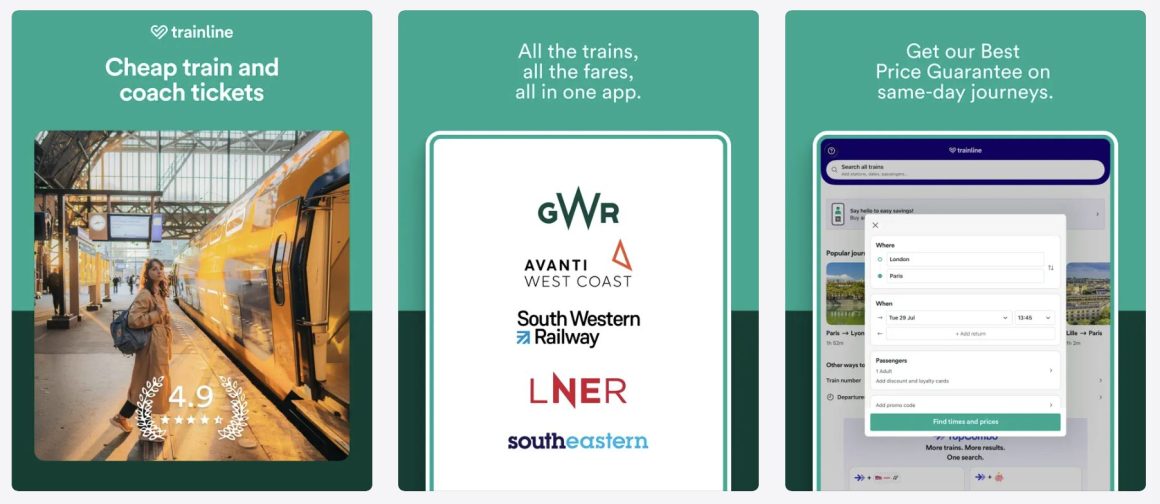
Open the mobile app, enter your departure station and destination, and pick whether you want a single, return, or open return. Add your travel date and time, the number of passengers, and any railcards you hold.
In the UK, railcards are worth knowing about before you even open the app. Each one costs around £35 a year (£80 for a three-year version) and saves a third off most fares. The main options are:
- 16-25 Railcard and 26-30 Railcard — One-third off for young adults and mature students
- Senior Railcard — One-third off for travelers aged 60+
- Two Together Railcard — One-third off for two named adults traveling together
- Family & Friends Railcard — One-third off for adults, 60% off for kids, when traveling with children
- 16-17 Saver — 50% off standard fares
- Disabled Persons Railcard — One-third off for the cardholder and one companion
Trainline submits your search and lists every train that fits, showing you the operator, number of changes, scheduled times, any reported delays, the platform (where available), total journey time, and the ticket price (booking fee added at checkout).
Pick your journey, pay with Apple Pay, Google Pay, PayPal, or card, and your ticket arrives as a QR code that lives in your phone’s wallet. No paper, no station kiosk, no queue. If you want to use Trainline data on the move — for tickets, maps, or anything else — pair it with our guide to the best portable WiFi hotspots for Europe to keep your connection stable on long train journeys.
Is Trainline Free? What the Booking Fee Actually Costs
Trainline is free to download and use online for searching and buying train tickets in Europe. You don’t need a subscription to view trains or book them. A booking fee may apply to your reservation, however, and that fee is one of the most-discussed features of the platform.
Per Trainline’s own help center, the fee depends on three factors: whether you book on the website or in the app (the app is generally cheaper), when you book relative to your travel date, and the value of your ticket. Trainline is also continually testing changes, so two users booking the same journey may see slightly different fees.
In practical terms, expect a modest fee on UK Advance tickets (typically less than the price of a coffee), no fee on day-of-travel UK online bookings, and variable fees on European bookings that depend on the carrier. The fee is shown clearly at checkout — there are no hidden surprises — but if you’re refunded for a ticket, the booking fee itself usually isn’t returned.
Important note for UK travelers: Trainline flagged refund rule changes for certain National Rail tickets from 1 April 2026 on its own help page. If you’re booking ahead of that date, it’s worth reading the latest terms.
A Step-by-Step Guide to Booking Train Tickets Online Guide
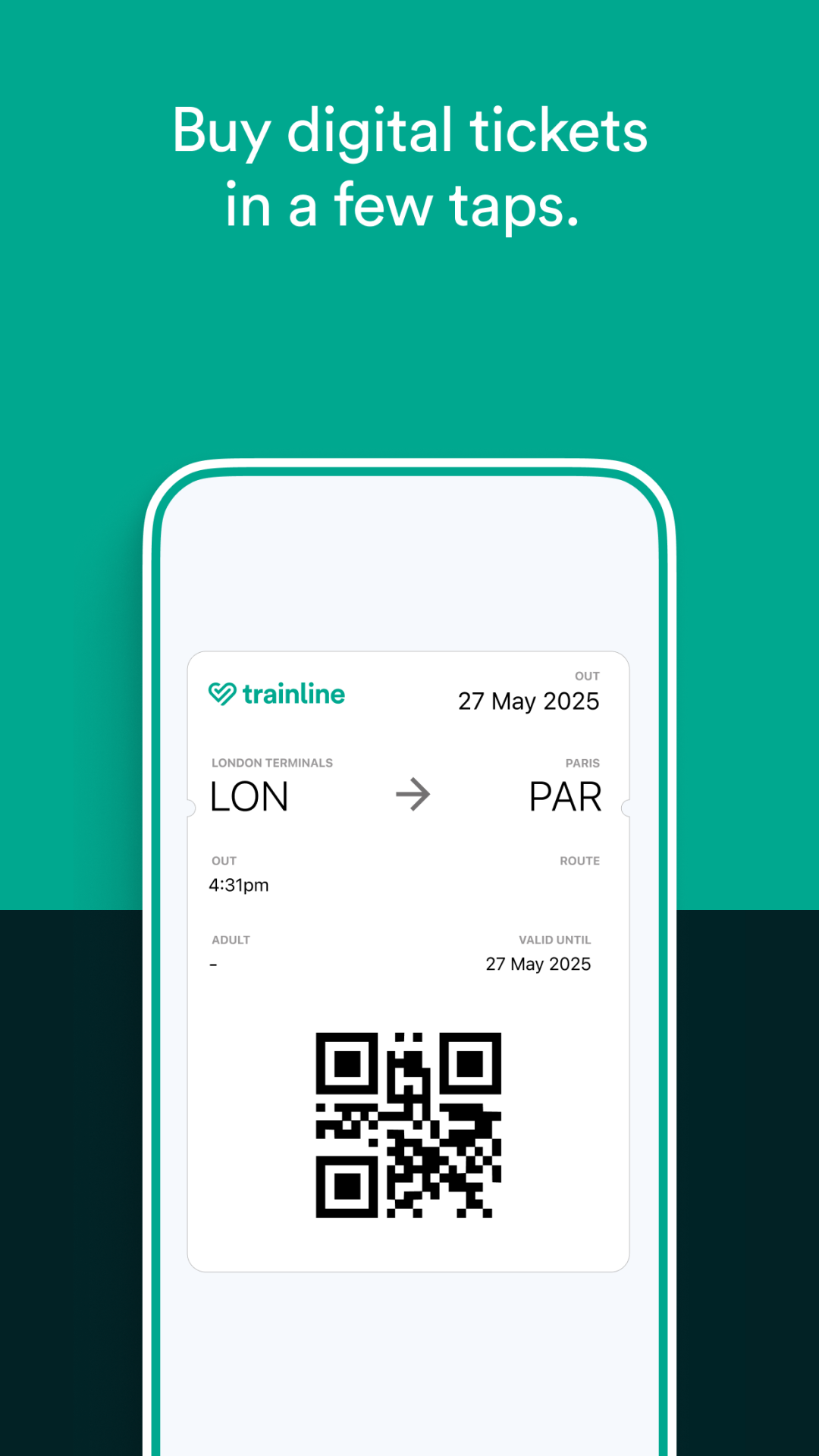
The whole journey from “I need to get to Paris” to “ticket in my Apple Wallet” takes about three minutes. Here’s the exact flow:
- Step 1: Download the app and create an account. Trainline is on iOS and Android, free to download. You can also book on the website without creating an account, but the app gets you cheaper booking fees on most journeys and stores all your tickets in one place.
- Step 2: Enter your route. Type your departure station and destination in the search bar — Trainline handles UK station codes, European city names, and most major airports. Pick single, return, or open return.
- Step 3: Add date, time, and passengers. Select your travel date and rough departure time. Add the number of adults and children, plus any railcards you hold (the app applies the discount automatically).
- Step 4: Review the results. Trainline shows every train that fits, with the operator, number of changes, scheduled departure and arrival times, total journey time, the platform (where available), any reported delays, and the ticket price excluding the booking fee. Look out for the SplitSave icon next to listings — that’s the split-ticketing tool that can cut UK fares by up to 61% on some routes.
- Step 5: Pick your fare type. Most UK routes offer Advance (cheapest, fixed train), Off-Peak (flexible within certain hours), and Anytime (most expensive, fully flexible). European routes vary by operator — Eurostar, SNCF, and Deutsche Bahn each have their own fare classes. You can book a second class or first class and pick the seat from the visual pop-up window. By the way, Frecciarossa in Italy introduced a nice and spacious Executive Class with free prosecco, free WiFi, and fresh and high-quality meals (try it Milan-Venice, for example).
- Step 6: Check out and pay. Add any promo code (the field is on the basket page, not the final payment page — easy to miss). Pay with Apple Pay, Google Pay, PayPal, or card. The booking fee, if any, is shown clearly here before you confirm.
- Step 7: Get your ticket. Tickets arrive instantly as QR codes that store in your phone’s wallet. For some European tickets you’ll also receive a PDF. No paper, no station kiosk, no queue.
- Step 8: At the station. Scan the QR code at the gate or show it to the conductor on board. For Eurostar and some European high-speed services, you’ll still need to clear security or check in, so allow an extra 30 minutes.
If you want to use Trainline data on the move, pair it with our guide to the best portable WiFi hotspots for Europe to keep your connection stable on long train journeys.
What Happens If Your Booking Fails? (We’ve Tested This)
A genuine concern with any booking platform is what happens when something goes wrong — and we hit this directly. On a recent attempt to book a Frankfurt to Paris Gare de l’Est journey on Trainline (€146.20), the booking failed at the carrier’s end. The Trainline experience that followed is worth flagging, because it’s where the company quietly earns trust.
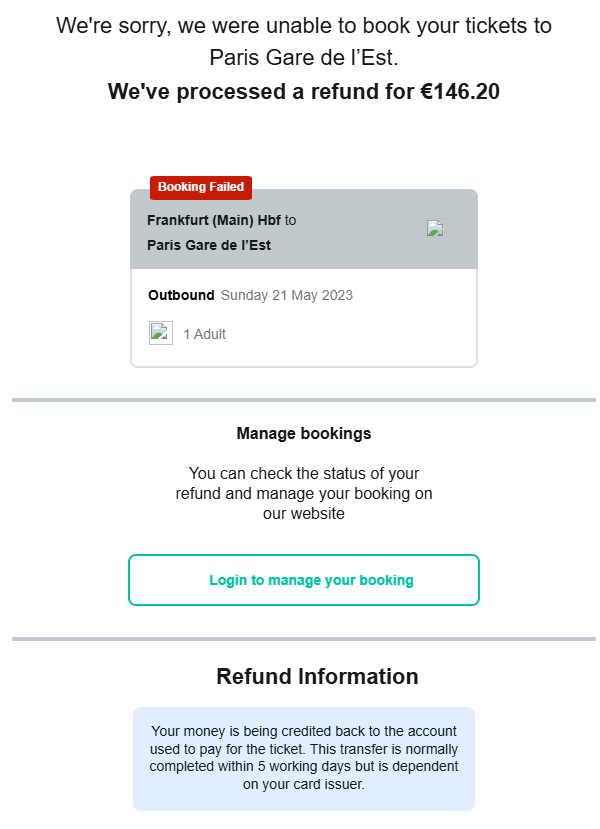
Within minutes, we received a clear email titled “Booking Failed” stating: “We’re sorry, we were unable to book your tickets to Paris Gare de l’Est.
We’ve processed a refund for €146.20.” The message confirmed the route, the date, the passenger count, and noted that the money would be credited back to the original payment method, normally within five working days but dependent on the card issuer. Actually, money arrived at Revolut in a few hours.
There was a direct “Manage Bookings” link to follow up, and no need to call customer service, fill in a refund form, or argue our case.
The refund landed inside the stated window. Zero friction, no chasing, no second email needed.
This matters because failed bookings at the operator end are surprisingly common in European rail — different operators have inventory mismatches, cross-border holds, or last-minute capacity changes — and the difference between a good booking platform and a bad one is almost entirely about how this moment is handled. Trainline handled it the way you’d want.
Insider tip: If a booking fails, don’t immediately rebook the same fare. Sometimes the original price has lapsed and the system needs a few minutes to refresh. Wait 5-10 minutes, search again, and you’ll usually find the same fare available or a cheaper alternative on a similar departure.
Trainline Discounts, Promo Codes & Savings
This is where the original guidance on Trainline is often out of date. The platform runs real, ongoing promotions and built-in features that can knock significant amounts off your fare. The most useful, all verified on Trainline’s own site:
- SplitSave — Trainline’s split-ticketing feature breaks a single long journey into multiple cheaper tickets (sometimes covering the same train, same seat) and packages them in one transaction. Trainline’s own marketing puts average savings as high as 61% on some UK routes. Look for the SplitSave icon in your search results.
- GroupSave — Groups of 3-9 adults traveling together on participating UK services get a 33% discount on standard fares. Available right in the booking flow.
- First-app-booking promo code ( use WELCOME10) — Trainline runs a recurring 10% off promo for first-time app users. Coupn codes change but the offer is consistent.
- First European booking promo — A 10% off code for your first European train booking (including Eurostar), typically capped around £15 or $15. Trainline often runs route-specific versions, such as a recent 20% off promo for Swiss domestic routes.
- Refer a Friend — Refer a new user and both of you get 10% off (up to $20). No cap on the number of referrals.
- Student discount via Student Beans — 10-15% off Railcards through Student Beans verification. Worth noting if you’re under 30 and don’t yet have one.
- Best Price Guarantee — If you find a lower fare on the same journey elsewhere, Trainline will refund the difference (terms apply).
Insider tip: Before you book a long UK journey, always check whether SplitSave is offering a cheaper option for the same train. The savings can be dramatic on routes between London and the north — and the experience is identical (same seat, same train, just two tickets instead of one stored in the app).
Trainline Reviews & Ratings: Is It Legit?
Trainline is highly rated across both major app stores:
- App Store: 4.9 / 5 (356,000+ ratings)
- Google Play: 4.7 / 5 (860,000+ reviews)
Reviewers consistently flag the booking fees, but most agree they’re modest enough and that Trainline is upfront about them. Several reviewers note that the convenience of having tickets from multiple European operators in one app saves more time and money than the fee costs — a fair summary of where the platform earns its keep.
One representative Google Play review from Michael Schackwitz sums up the value proposition: “This is a great app for buying rail tickets across multiple countries, and managing your tickets all in one place. I have never had trouble using my US credit cards to buy tickets. They do charge a small fee for the service, in my experience, from $1-10 depending on the cost of your tickets, but I think it’s worth it.”
The complaints that do surface tend to focus on refunds (slow, sometimes incomplete because the booking fee is retained) and the booking fee itself on smaller-value tickets, where £1-2 can feel like a real percentage hit.
If you’re planning to combine train travel with off-the-beaten-track exploring, our guide to lesser-known European islands covers dozens of spots reachable by a train-plus-ferry combo that Trainline can handle the first half of.
Trainline Alternatives? National Rail for the UK, Direct for Europe
If you want to skip the booking fee entirely and you’re traveling only in the UK, National Rail (or any individual operator’s own app — LNER, GWR, Avanti West Coast, etc.) sells the same tickets at the same prices, minus the Trainline fee. The user interface is similar, the inventory is identical, and for a frequent UK rail user, the savings add up.
The trade-off is that National Rail only sells UK tickets. If you’re interrailing or planning a multi-country European trip, you’ll need either Trainline or to book directly with each operator individually — which means juggling four to six accounts and remembering where your Brussels-to-Amsterdam ticket is stored.
A third option, especially for European travel: use Trainline to identify the operator and route, then book directly on the rail provider’s own website (SNCF, Deutsche Bahn, NS, Trenitalia, Renfe). Most don’t charge a reservation fee, though their interfaces are often less polished than Trainline’s and don’t always accept non-European credit cards smoothly.
For most travelers crossing borders, Trainline is the better all-rounder. For UK-only travel, the direct apps win on price.