




Outdoor recreation is having a moment. The 2025 Outdoor Industry Association report counted 181.1 million Americans aged 6 and older participating in outdoor activities in 2024 — 58.6% of the population, with 63.4 million of them hiking. Across Europe the numbers tell a similar story: more weekend trail walks, more multi-day bike trips, more “I want to spend a Saturday outside, not on my phone.” Route-planning apps are the quiet backbone of this shift, and Komoot has long been one of the most beloved.
It has also, in the past year, become one of the most controversial. Komoot was acquired by Italian tech firm Bending Spoons in March 2025, and the business model changed dramatically before the deal even closed. Below: how Komoot works today, what the new pricing actually means for new users (it’s significantly different from anything you’d have read about the app a year ago), and where its closest competitor now has a real opening.
What is Komoot?

Komoot was founded in 2010 in Potsdam, Germany, by a group of outdoor enthusiasts who wanted a navigation app built specifically for hikers, cyclists, and runners — not commuters. It’s the off-road counterpart to Google Maps, the app you reach for when the route you want involves dirt tracks, mountain passes, or forest paths that don’t show up in mainstream navigation tools.
For more than a decade Komoot operated as an independent, employee-led German company, growing to over 8 million users globally. That changed in March 2025, when Italian tech firm Bending Spoons acquired Komoot — the same company behind WeTransfer, Evernote, and Vimeo. According to BikeRadar reporting in September 2025, up to 85% of Komoot’s pre-acquisition staff of 150 were laid off in the months that followed, and the founding team (including CEO Markus Hallermann) is no longer involved with the company.
The current Komoot team is described as a blend of remaining pre-acquisition staff and new Bending Spoons hires. This matters because it directly explains what happened next.
The Big 2025 Pricing Change New Users Need to Know
Komoot used to operate on a much-loved model: free route planning, with one-off purchases for offline map regions ($3.99 for a single region, $8.99 for a bundle, $29.99 for the world pack). Buy once, own forever. No subscription required.
That model ended for new users on February 27, 2025, just weeks before the Bending Spoons acquisition was announced. Komoot quietly changed its policy: new users can no longer buy region packs. To sync routes to external devices — Garmin, Wahoo, Hammerhead bike computers, smart watches — new users must now subscribe to Komoot Premium.
The split is critical to understand:
- Legacy users (purchased anything from Komoot before end of February 2025) — Keep their existing access. Single region packs, bundles, and the World Pack continue to work as before. No subscription needed to sync routes to devices.
- New users (signed up from March 2025 onward) — Must subscribe to Komoot Premium to sync routes to external devices. Region packs are no longer available to purchase.
This is the single most important fact in any Komoot review written in 2026, and it’s the part most older articles don’t yet reflect. If you’re reading guides that mention $3.99 region packs and a $29.99 World Pack option, those are for legacy users only. A new account today cannot buy them.
How Does Komoot Work?
That caveat aside, the core product is still excellent. Komoot lets you plan routes for hiking, cycling, mountain biking, running, and other outdoor activities. You enter a starting point and destination, choose your activity type, and Komoot suggests a route optimized for that sport — taking elevation, surface type (paved, gravel, single-track), and difficulty into account.
Alternatively, you can browse community-uploaded routes through the Discover feature, which surfaces tours created by other Komoot users and the in-house team. Routes come with photos, user reviews, elevation profiles, and “highlights” (waypoints flagged for views, water stops, or points of interest). For unfamiliar terrain — a cycling tour in southern France, a weekend hike in the Italian Dolomites — this community layer is genuinely useful and remains free.
Once you’ve picked or built a route, you can follow it in-app on your phone. To sync that route to a Garmin or Wahoo bike computer, smartwatch, or other GPS device, you need either legacy access (bought before March 2025) or a current Premium subscription.
If you’re using Komoot to plan trips around Italy’s incredible outdoor regions, our guide to Italy’s best natural parks and nature activities covers Abruzzo, Gargano, the Dolomites, and other areas worth dedicating real time to.

Komoot Pricing: Free vs Premium
The current Komoot pricing structure as of May 2026, per Komoot’s own website and BikeRadar’s verified reporting:
- Free — Browse routes, plan trips, view community content, get one free regional map if you’re new
- Komoot Premium (weekly) — €4.99 / £4.99 / $4.99 (iOS and Android only)
- Komoot Premium (monthly) — €6.99 / £4.99 (web only)
- Komoot Premium (annual) — €59.99 / £59.99 / $59.99
Premium unlocks the feature set the region packs used to deliver, plus more:
- Sync to external devices — Send routes to Garmin, Wahoo, Hammerhead, smartwatches, etc.
- Multi-day trip planning — Build itineraries spanning multiple days
- Personal route collections — Group your favorite saved routes
- Live tracking — Share your real-time location with friends and family
- Weather along your route — Real-time conditions, not just destination forecasts
- Turn-by-turn voice navigation — In-ear directions on the trail
- 3D maps — For visualizing elevation and terrain
- Sport-specific mapping — Different map layers for mountain biking, road cycling, hiking, etc.
- Komoot maps on Garmin devices — Direct integration
The honest framing: at $59.99 a year, Premium is reasonably priced for a regular outdoor user, especially compared to AllTrails Peak ($79.99/year). But for someone who used to buy a $29.99 World Pack once and own it forever, the shift to a recurring subscription stings.
As DC Rainmaker put it in March 2025, the change effectively tells potential new customers to look elsewhere — which is exactly what makes HiiKER more interesting than it was a year ago (more below).
Komoot Bonuses, Perks & Discounts Worth Knowing
Komoot doesn’t run conventional promo codes, but there are still some legitimate ways to get value out of the platform:
- One free regional map for new users — Sign up and Komoot gives you one free single region to test the planning experience before deciding whether to subscribe
- Free 7-day Premium trial — Test the full Premium experience before committing to an annual subscription
- Weekly Premium for short trips — At €/$4.99 for a week, the weekly subscription is genuinely useful for a one-off cycling holiday or a multi-day hiking trip where you don’t want a year-long commitment. This is the most underused price point in the Komoot lineup.
- Free community content — Routes, photos, tips, and reviews from Komoot’s 8 million users remain free to browse and use as inspiration
- Brand partnerships — Komoot occasionally bundles Premium trials with brand promos (Garmin, Wahoo, certain bike retailers) — worth checking if you’ve recently bought outdoor gear
Insider tip: If you only need Komoot for a specific trip — a week of cycling in Tuscany, a long weekend hiking in Scotland — buy the weekly Premium subscription (€4.99) for that trip specifically and cancel afterward. Most users default to the annual plan without realizing the weekly option exists, and for occasional outdoor travelers it’s a much better fit than committing to a year-round subscription.
Komoot Hiking App Reviews & Ratings: Is It Better Than AllTrails?
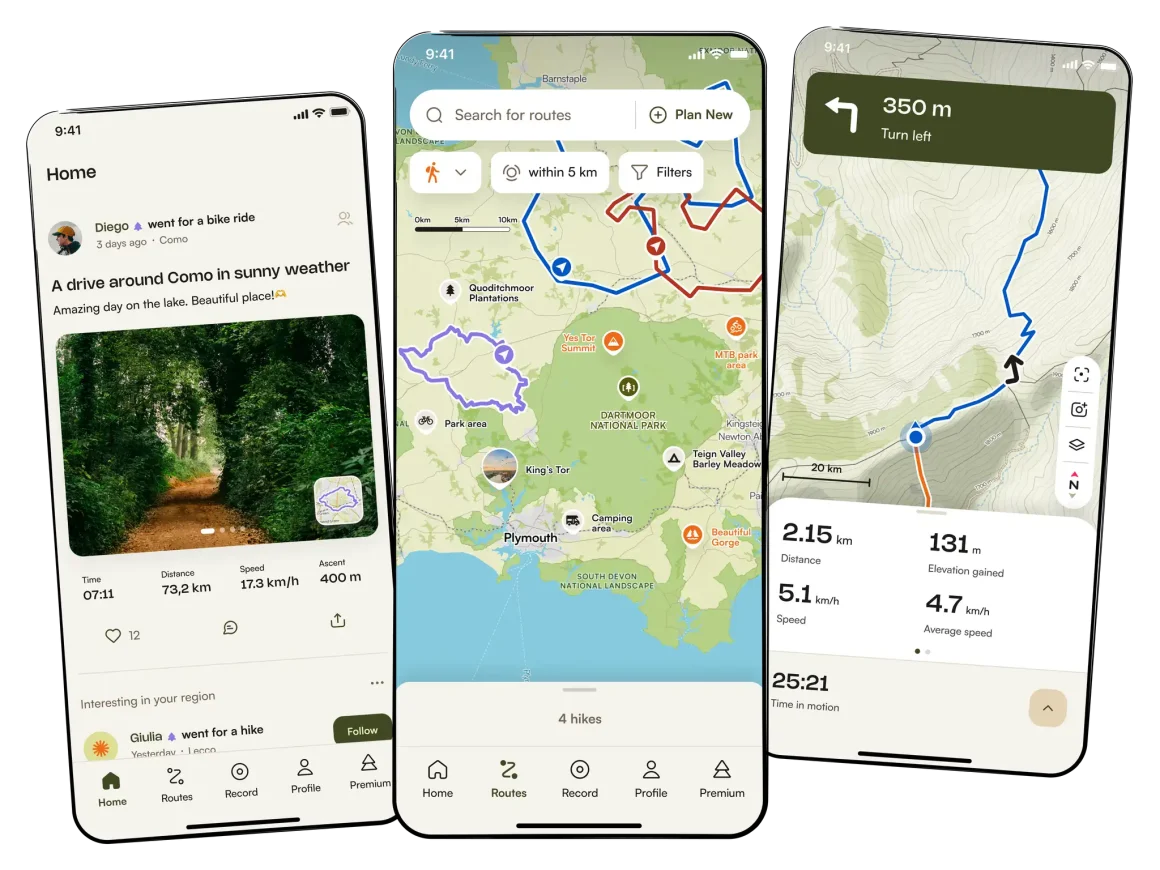
Komoot scores well on both major app stores, though the redesign in September 2025 has split opinions:
- App Store rating: 4.7 / 5 (7,600+ reviews)
- Google Play rating: 4.4 / 5 (379,000+ reviews)
For comparison, AllTrails sits at roughly 4.9 / 5 on the App Store and 4.5 / 5 on Google Play. The two apps are genuinely close on quality.
Reviewer sentiment toward Komoot has shifted noticeably since the acquisition. Long-time users praise the route quality, the community photos, the sport-specific routing logic, and the depth of trail data — particularly in Europe, where Komoot has historically led the market. The complaints, predictably, cluster around the new pricing model for sync-to-device functionality, the September 2025 redesign (which leans heavily into photo content and has divided power users), and the loss of the original German development team’s “family-like” culture.
One representative Google Play review from James Brennan, written before the pricing change, captures what the app does best: “Fantastic! I used Komoot to navigate my six-week cycling trip from Bristol, UK, to Nice, France, and it was brilliant. After I’d planned my route, I stuck an earbud in my left ear and let Komoot direct me, saving me the trouble of having to look at a map every five minutes.” The route-planning core that earned reviews like this is still there. The question is whether the new subscription pricing is worth it for your specific use case.
If you’re looking for a broader view of what’s available before committing, our roundup of the 10 best hiking apps compares Komoot directly against AllTrails, Gaia GPS, the NPS app, Outdoor Active, FarOut, and others — including pros and cons of each for hiking vs. cycling vs. backpacking.
Komoot Alternatives? HiiKER Looks Better Than It Used To

HiiKER is a route-planning app focused on hikers, ramblers, and walkers, and it has become significantly more interesting since Komoot’s pricing change. The app offers over 25,000 trail maps with free offline downloads — a feature that all of Komoot, AllTrails, Outdoor Active, and Gaia GPS now charge for. For new users, that’s a meaningful structural advantage.
The trade-off is real: HiiKER’s database is smaller than Komoot’s, and it’s tailored to hiking specifically, not cycling or mountain biking. If you’re a cyclist, Komoot is still the better app despite the new pricing. If you’re primarily a hiker, particularly one who values offline maps and doesn’t want a recurring subscription, HiiKER is now arguably the better starting point than it was 18 months ago.
The honest 2026 recommendation:
For legacy Komoot users (signed up before March 2025) — Don’t switch. Your one-time map purchases still work, and you’re getting a meaningfully better deal than any new user can get today
For cyclists, bikepackers, and multi-sport outdoor travelers — Komoot remains the best option. The Premium subscription is justified by the depth of cycling-specific routing
For hikers who want offline maps without a subscription — HiiKER is the new pragmatic choice
For US-focused hikers — AllTrails is still the largest database in the country (450,000+ trails), and our guide to top hiking routes across the US national parks, city trails, and iconic treks covers the routes worth planning a trip around regardless of which app you use