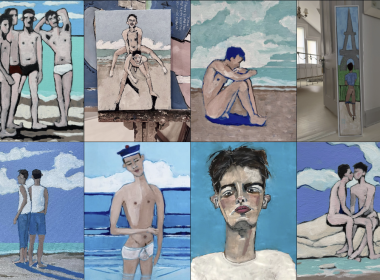

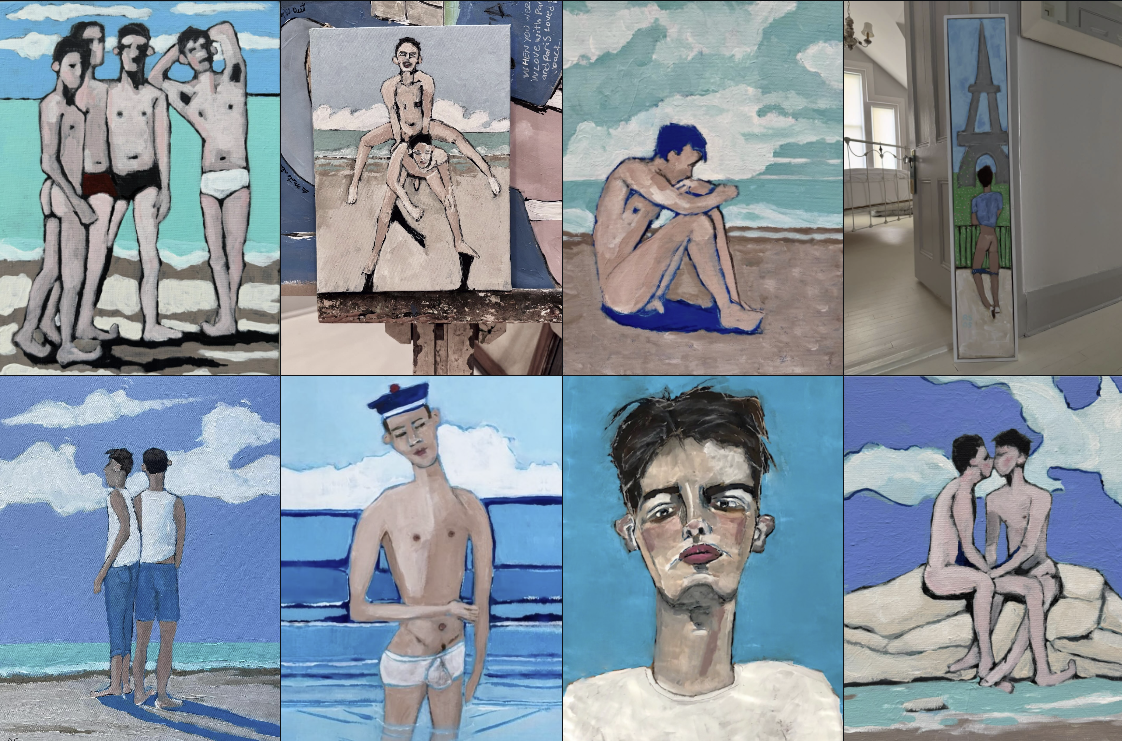
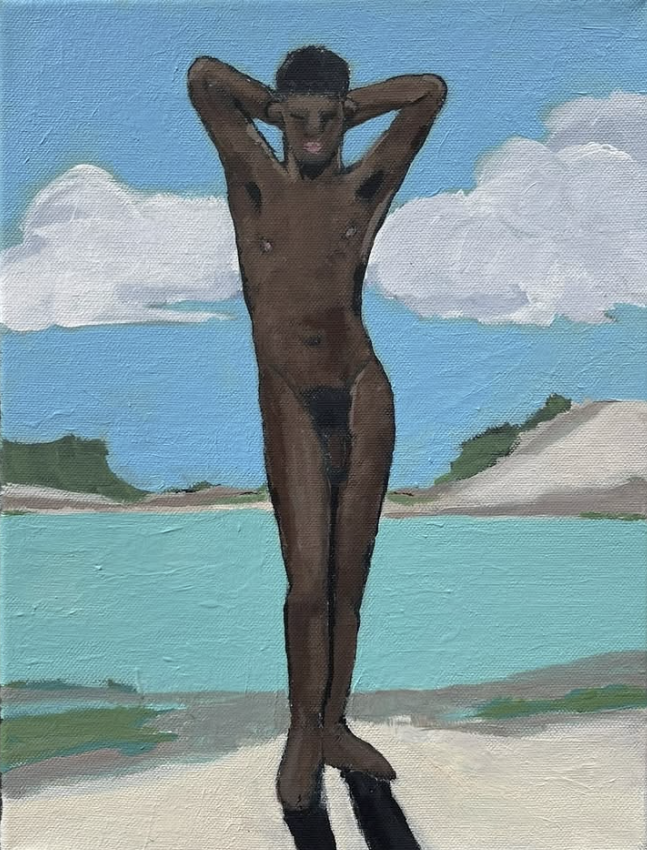
Richard Stabbert is an American painter, born in Red Bank, New Jersey in 1959 and entirely self-taught — no art school, no MFA. His small, intimate paintings of male nudes on the beach, rendered in a palette of blues, pinks and ochres, work as a diary of his summers on the New Jersey Shore and in Provincetown, Massachusetts, the town at the tip of Cape Cod that has been his artistic home for decades.
The Leslie-Lohman Museum of Art in New York holds his work in its permanent collection; he is one of the 100 Artists of the Male Figure; and his paintings have traveled from a Paris bookshop to a Dutch gallery. His book, Provincetown Memories: Paintings and Words, pairs his paintings with his own writing.
For Locals Insider, Richard wrote about learning to paint without a teacher, when the male figure became his subject, why he’s always searching for the right shade of blue, the artists and books that shaped him, the Chelsea opening night that changed everything — and a day in his personal Provincetown, from the stone wall outside Joe Coffee to a cold swim in the salt marsh.
His work is shown at ArtLove Gallery, Provincetown, and Galerie MooiMan in Groningen, the Netherlands. More at rstabbert.com and on Instagram at @rstabbert.
Documenting the People in My Life
Born in Red Bank, New Jersey, I am a self-taught painter. I document the people in my life, both past and present.
The timelessness of who we are as gay men, breaking down a façade and revealing ourselves. A chance to be vulnerable, an agelessness that resides in all of us. The beauty of men in all forms; that’s what I hope my work leaves the viewer with.
The themes of my paintings are semi-autobiographical images of male nudes on the beach which work as a diary of my summers on the New Jersey Shore and Provincetown, Massachusetts. My paintings are more emotionally than technically motivated expressing the constancy of love, nature and desire with themes of love, lost and found, playfulness and connection.
What Shaped Me Was Beauty
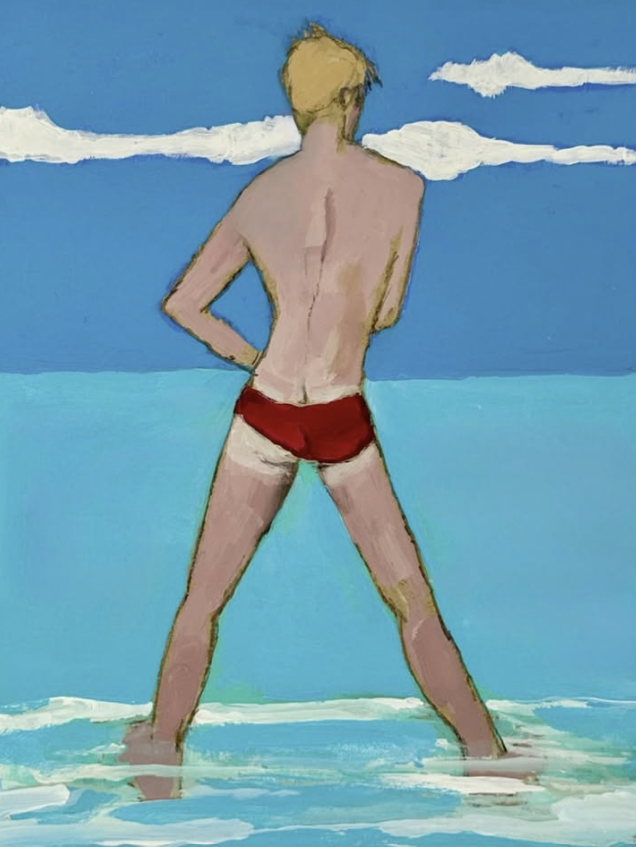
What shaped me was “beauty”. Perhaps being self-taught allowed me to arrive at my work from another direction. I didn’t learn the language of art. I had to figure it out, and I knew what I wanted to say. Constantly learning from the mistakes. Then there is life itself, desiring to possess a moment, a diary of sorts.
A day at Herring Cove, a summer’s day in Provincetown, something beautiful only glimpsed briefly, maybe remembered through my own hazy lens.
“I hope that color could create the emotion before the image even emerges.”
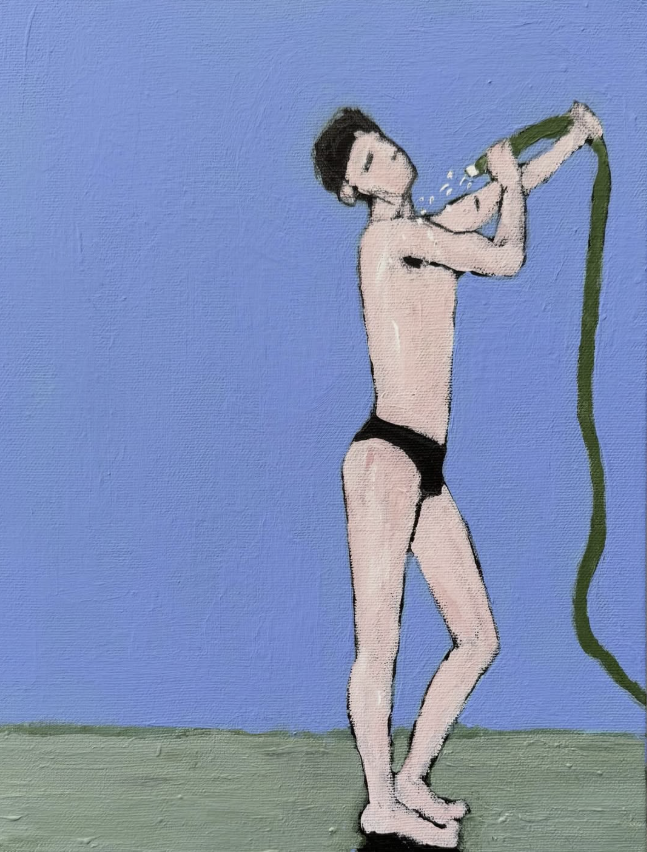
He Was Already There
I don’t remember making a conscious decision to paint the male figure. It was more of a realization that it had always been there.
As a teenager, and much to my mother’s dismay, I would draw male images.
For my adult life, I have been drawn to the male figure through painting, photography, literature and film long before I understood that it would become the central theme to my work.
It is only recently that I began to understand that. My paintings contain more for me; memory, beauty, vulnerability, desire, and the passage of time. My work is rarely portraiture in a conventional sense. The compositions are part memory, part invention, part someone I may have known or have wished to know. It is my way of revisiting a time and emotion that cannot actually be recovered.
Maybe it wasn’t a decision at all; at some point, he was already there in some form to be put on canvas.
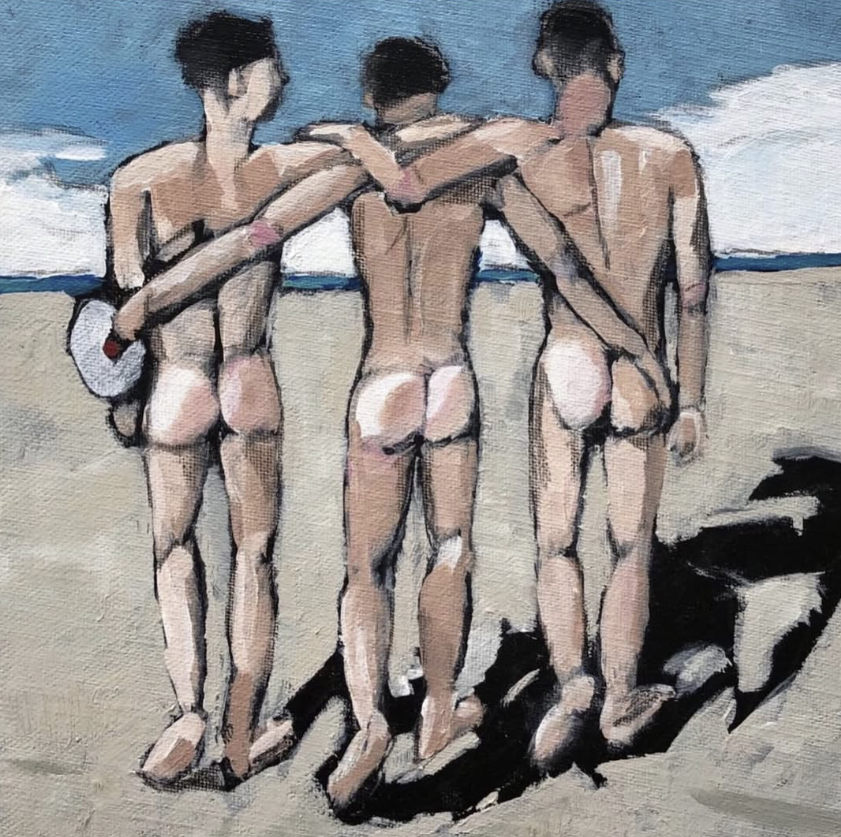
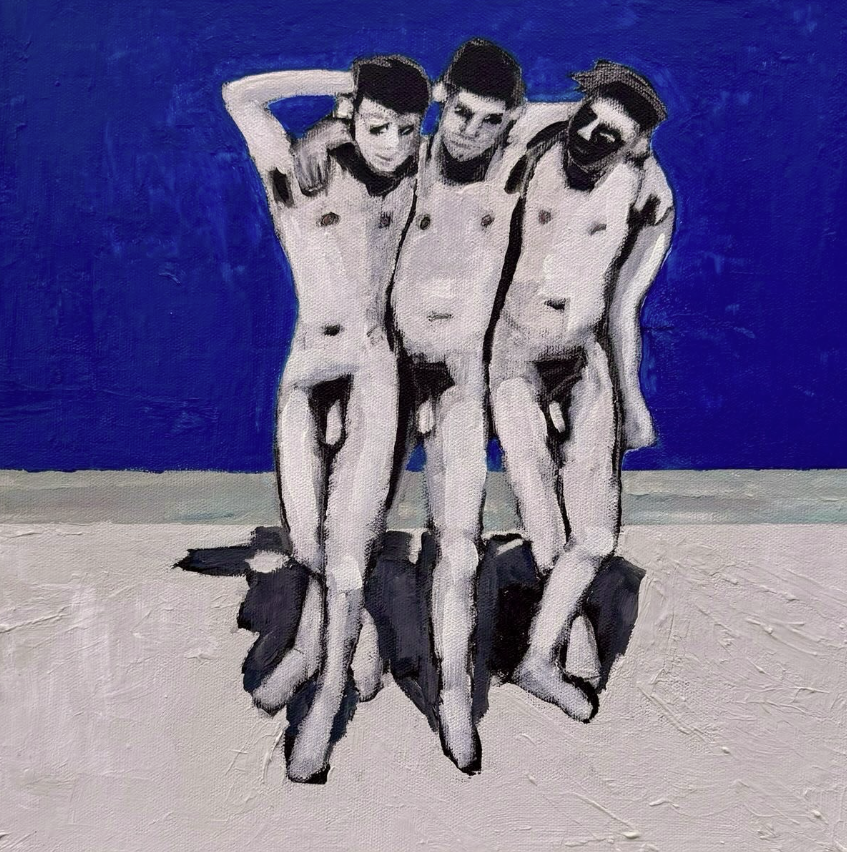
The Right Shade of Blue
Masculinity intrigues me most when it is not fixed. Strength and softness can exist in the same body. Men are most interesting to me when they let down their guard and reveal what is both sweet and vulnerable. My male figure can be sensual without being heroic, vulnerable without weakness, and feminine without becoming less masculine.
Perhaps the limited palette helps dissolve those boundaries. It becomes more of an emotion rather than a physical likeness.
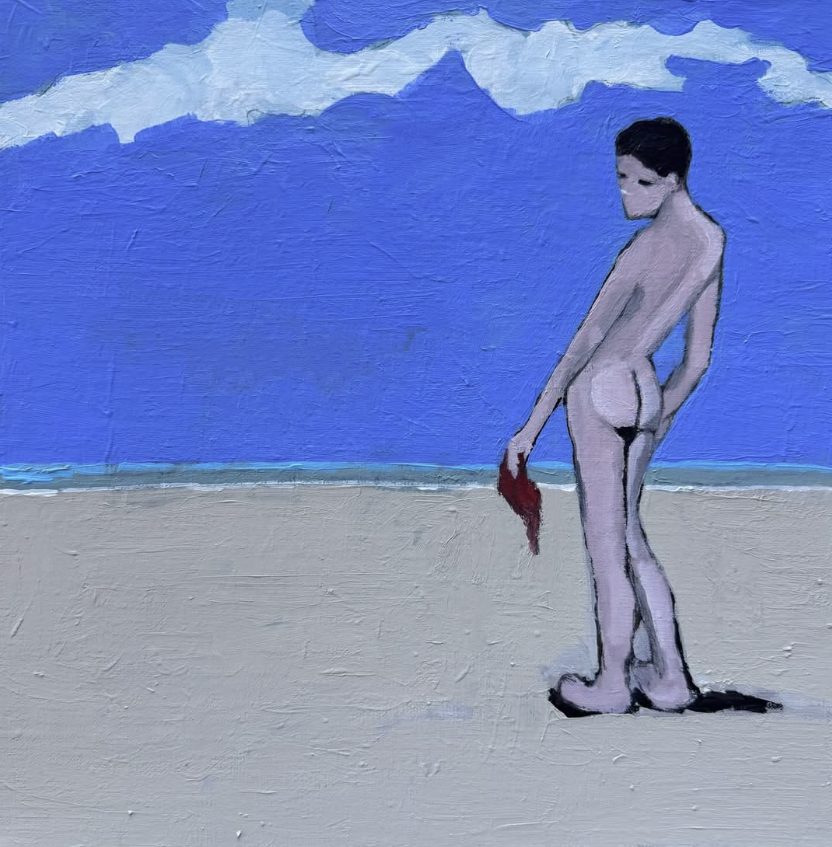
I don’t feel the need to prove that I can paint realistically. I am more interested in reducing to what remains essential: the curve of a calf or the placement of a hand, or the way a figure reaches to pick up a seashell, a gesture that becomes more than a physical detail.
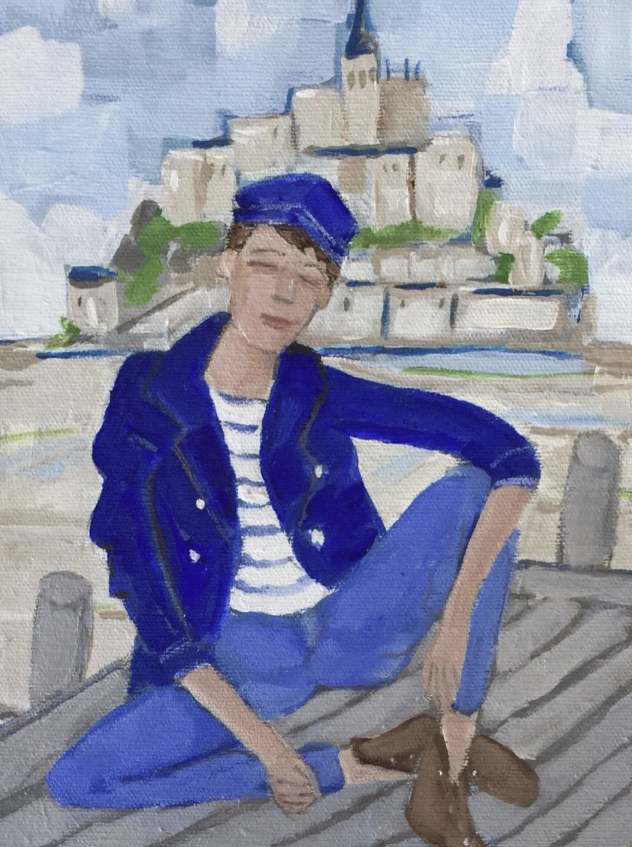
My palette is blues – I’m always searching for the right shade of blue – pinks and ochres. They are the colors of the sea, the sky, a blue forget-me-not, a Provincetown pink sunset. In a limited palette, the body stops being merely flesh.
The colors I choose can suggest vulnerability or tenderness; blue for me can suggest sensuality, solitude, yearning.
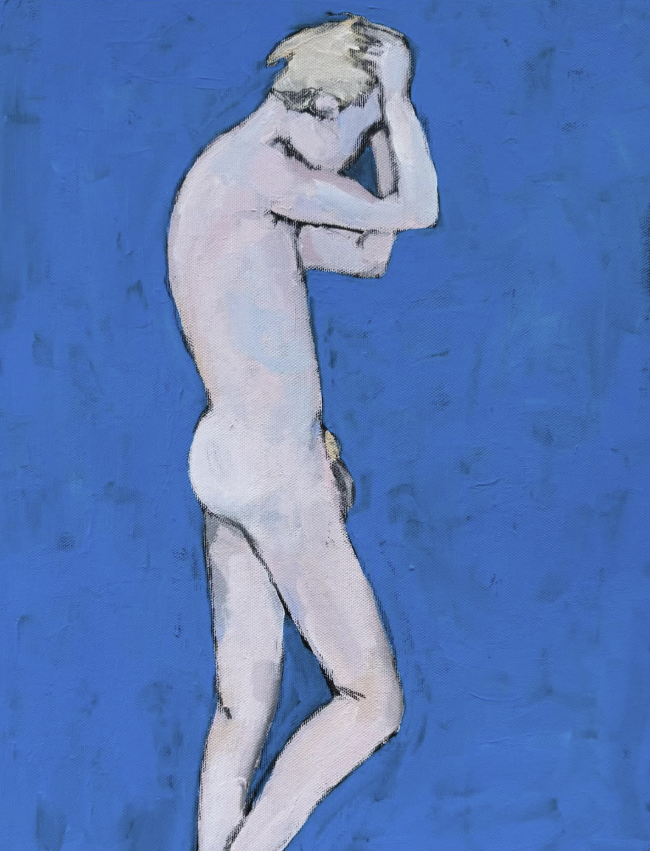
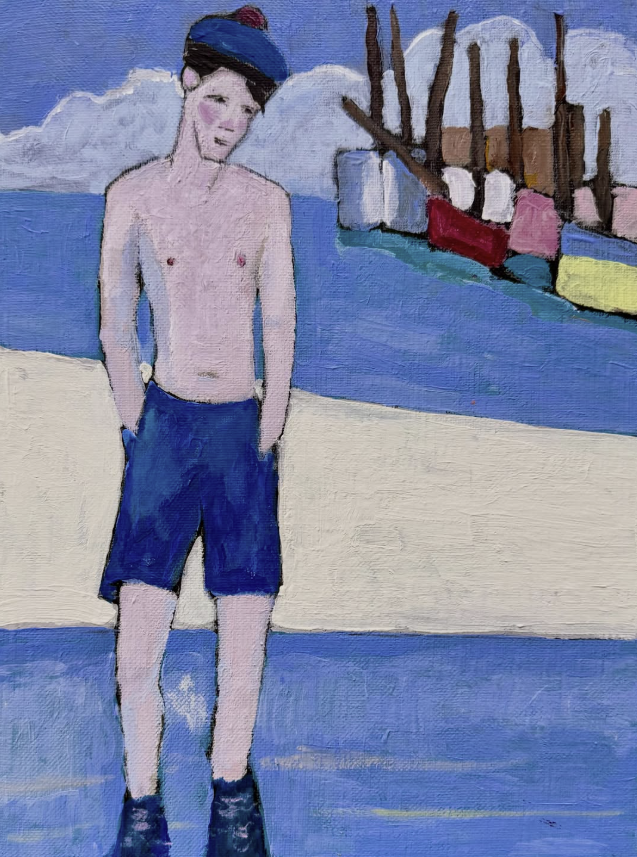
I certainly can understand the comparisons to naïve painters. My work has been called that from the beginning, and, yes, I have heard on more than one occasion the Matisse connection. But I don’t consciously set out to imitate any of it.
The paintings become stronger when I stop trying to explain everything, as the forms become simpler and I find the right combination of color. I am always adjusting and removing, but there are always certain codes within the paintings that work as a diary for me.
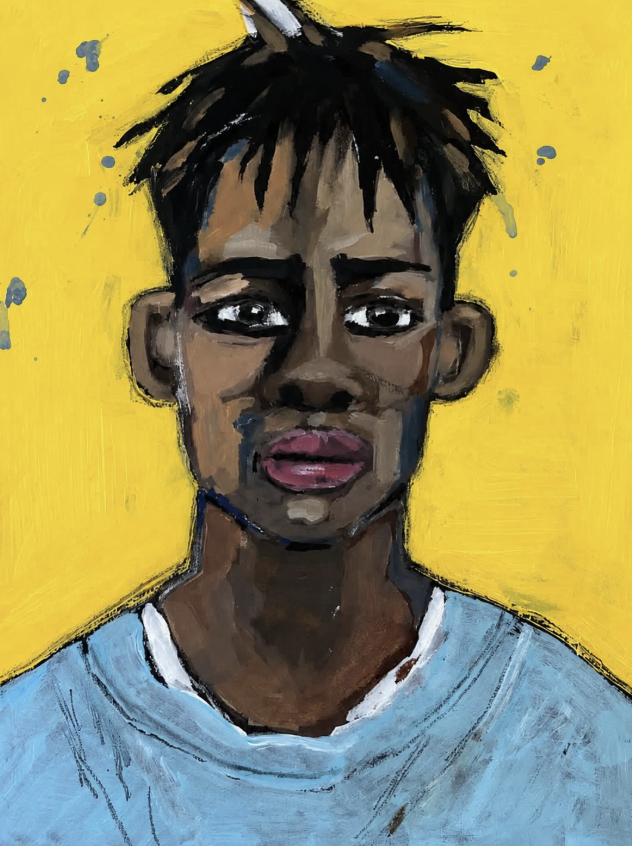
“In some way they are all self-portraits, although the figure is less literal and more open to interpretation.”
The Sum of So Many Inspirations
I am the sum of so many inspirations whether it is the complex simplicity of a Modigliani portrait or a Herbert List photograph of men, their sunlit bodies, bathing at the Baltic Sea. Or De Chirico and his “Mysterious Baths”, a fading into something more dreamlike.
Books that have remained with me as characters that I once knew in life,
At Swim: Two Boys by Jamie O’Neill; In the Absence of Men by Philippe Besson;
While England Sleeps by David Leavitt.
Intimacy is the reoccurring theme. It is what I hope my paintings can convey.
Jean Cocteau is a constant source of inspiration in his drawings and films, particularly the sailor illustrations and the film, “La Belle et la Bête.” There is also his White Book.
I am moved by the poetry of Cavafy that creates a sense of longing and desire.
I feel a sense of connection to Salman Toor’s work. When I first became aware of it, it spoke to me in a similar language but of a different experience; the essence of color to provoke a mood.
I make paintings from the accumulated visual and emotional memory of my life; art, literature, film, people I have known, men I have desired, places I remember.
From a Chelsea Opening Night to Paris
Each milestone has meant something different to me. The exhibition at Les Mots à la Bouche in Paris was deeply personal. To see my paintings presented there — inside a place so connected to gay literary and cultural life — felt like a moment of arriving, a dream come true.
I was honored to be included in 100 Artists of the Male Figure, and to be in this larger conversation about how artists have seen and interpreted the male body. I’m currently working towards Spring 2027, when I’ve been invited to do a solo exhibition at Bnude Art Gallery in Barcelona.
I never describe myself as an artist. I think of myself as a painter. I think that an artist is something ascribed by others. I merely continue to paint. Although creating has always been a part of my life, I didn’t begin painting in earnest until my late thirties.
One early moment stays with me. I was included in a group exhibition in Chelsea, New York City, and on opening night I was hesitant to attend, entering the New York art scene with my paintings having been described as they looked as if a sophisticated child had painted them. Then people began buying them. I was stunned — not simply by the sales, but by the realization that something I had made could speak to someone I had never met.
When the work began to gain some recognition, an invitation, a painting sold, or my name on a gallery wall, I was always amazed and I began to understand that I had stepped into a different place. What had begun quietly in the accumulation of hours alone with a canvas with no one expecting results was now vulnerable to different interpretations. And in that I have to return to a place that is honest to me.
Naked Men, Pink Sunsets & Words Beside the Paintings
It was actually the author and editor, an artist himself, Eric Gibbons who approached me to create a book of my paintings with various writers contributing stories inspired by the work.
I submitted a story, then two, then three, and Eric made the decision that I should fully take on the writing myself.
I saw it as both a challenge and an opportunity to take the words, fragments and disconnected sentences that float around my head and put them on paper in much the same way I put a brush to canvas.
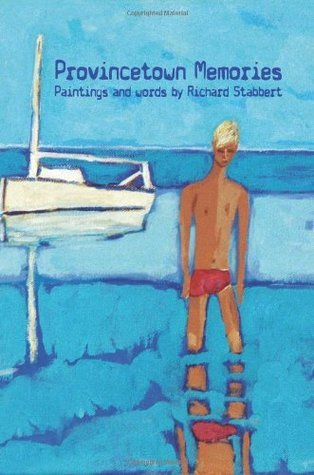
The words were not there to explain the paintings. I wanted them to exist beside them. The book, like the paintings, became a diary of sorts for me; a fiction that tells the truth of a season, a romance, a summer place. There is a conversation between the words and the art, but neither one is meant to finish the other’s sentence.
I didn’t have a specific reader in mind. It isn’t a memoir, short stories or a poem. If anything, I was trying to put something down before disappearing, or before changing over time.
Perhaps with my words, I hoped someone reading it might recognize something of their own life experience. We’ve all had people and places, things that seemed ordinary when they happened, but gained importance as time passes.
“Both my painting and writing are attempts to hold onto something that, by its nature, is ephemeral.”
A Painting Inspired by Provincetown Can Travel
I don’t paint specifically for a demand, but I’m now more aware that a painting inspired by Provincetown can travel and speak to someone in New York, Amsterdam, Paris, or for that matter anywhere. It has given me permission to trust the imagery more deeply and let the viewer create their own story.
I’m never quite satisfied that a canvas is finished. In time I can get a sense if I’ve chosen the right shade of blue, if I have put in all that is necessary and taken out all that is not.
I leave it to ArtLove Gallery and Galerie MooiMan to curate in a way that they feel best serves the presentation of my work. By the time it hangs in any gallery, it has moved from my hands into a completely different setting. That distance can make me see the painting anew.
My feeling is that European observers often seem immediately comfortable with the male figure as both an art-historical subject and an object of tenderness, beauty, and desire without needing the work to declare or defend its sexuality. I hope that both American and European viewers can understand the simplicity of the work and recognize something of themselves within them.
Perhaps the broader distinction would be that something rooted in my own particular place and memory could travel well. The paintings begin with me, with my recreation of masculinity, longing and recollection, but they remain open to the interpretation of others.
Art Is Life in Provincetown
It has become a cliché to say that the light in Provincetown is extraordinary, and yet that is so true. The bay and the ocean reflect the light in a way that is constantly changing – from brilliant sun to foggy haze.
Provincetown has a long history and is still a fishing village. Early on the village welcomed a diversity of artists, writers and other creative people. This allowed people to create lives that would have been difficult elsewhere. Provincetown has a long history of outsiders seeking self-expression and refuge.
“Art is life in Provincetown. It is not separate. You don’t just go to see art, you live in a culture of art, within both the natural and the human landscape.”
Not easy to get to, slightly remote, once you arrive, you feel like you left ordinary life to become part of a diverse and welcoming community that encourages and celebrates creativity. Allow yourself to get a little lost. Provincetown is best in the moments that are unplanned.
Whatever your vibe is, if you’re looking to live and let live, it’s right here in Provincetown. That being said, I suggest you avoid getting stuck behind the Mayflower Trolley as you ride your bike down the street. Have a great journey on your way to the beach, but by all means avoid the fragile dune grass. It can take the heat of summer, the frigid winter, but it won’t survive the patter of a thousand feet.
So, keep your toes in the sand. By the way, don’t walk in front of a pedi-cab. Those boys maybe beautiful, but they’re in a hurry.
As the urgency of summer wanes, the town begins to slow, the light fades earlier and the daytime is more golden. The streets are less crowded, you’ll find it easier to get into a favorite restaurant or wander through stores on Commercial Street.
For myself, with the days still warm, the leaves burning with color, and with its solitude, I like to wander through the old Winthrop Street Cemetery.
While summer has brought inspiration, the change of season encourages me to shift my focus back to painting.
My Provincetown: A Journey Through the Day
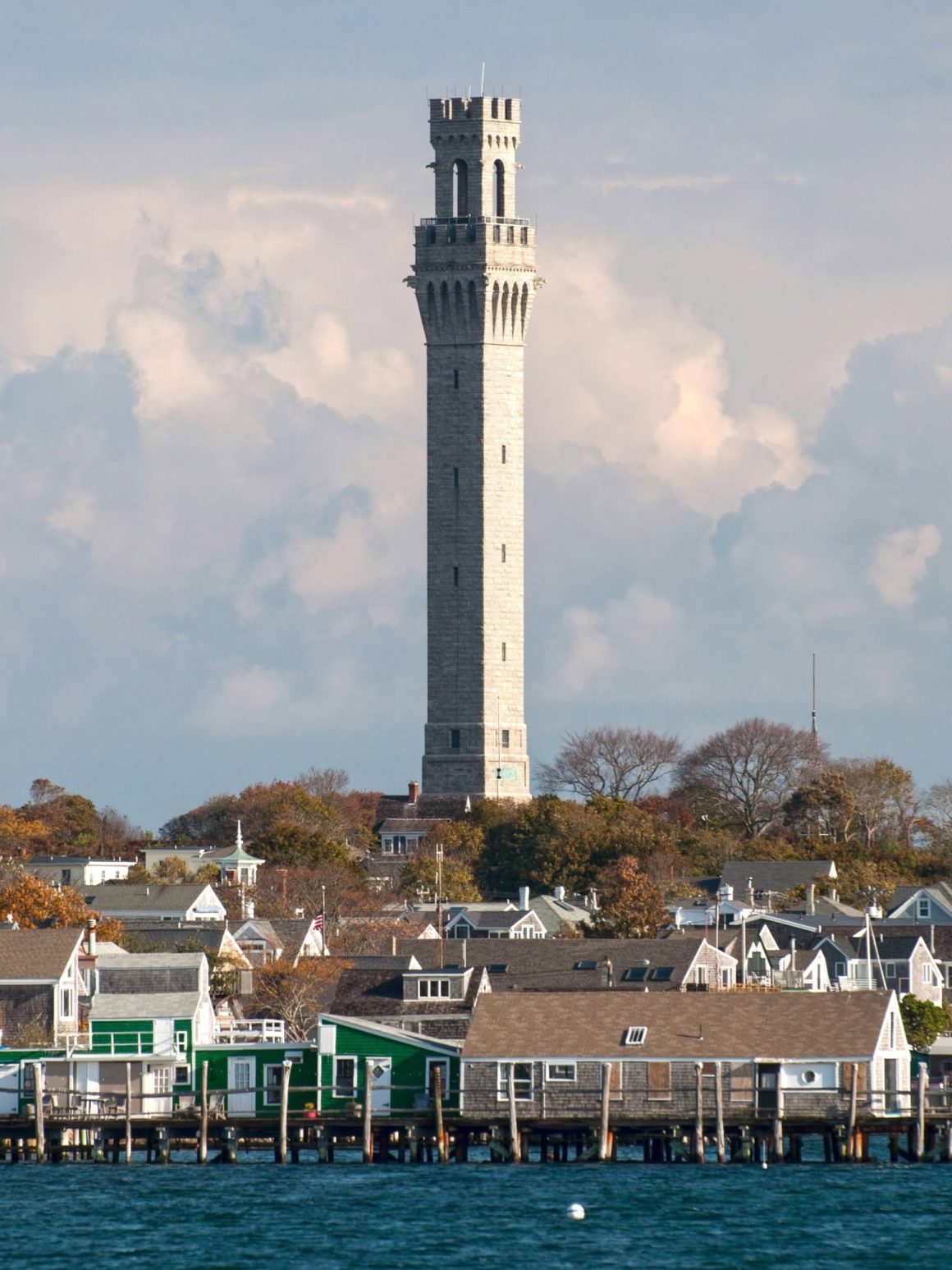
My personal Provincetown is less a list of destinations and more a journey through the day. It is a collection of rituals and small moments that I return to year after year.
My Provincetown is not over polished. I like to sit on the stone wall outside Joe Coffee and watch the theater of the street.
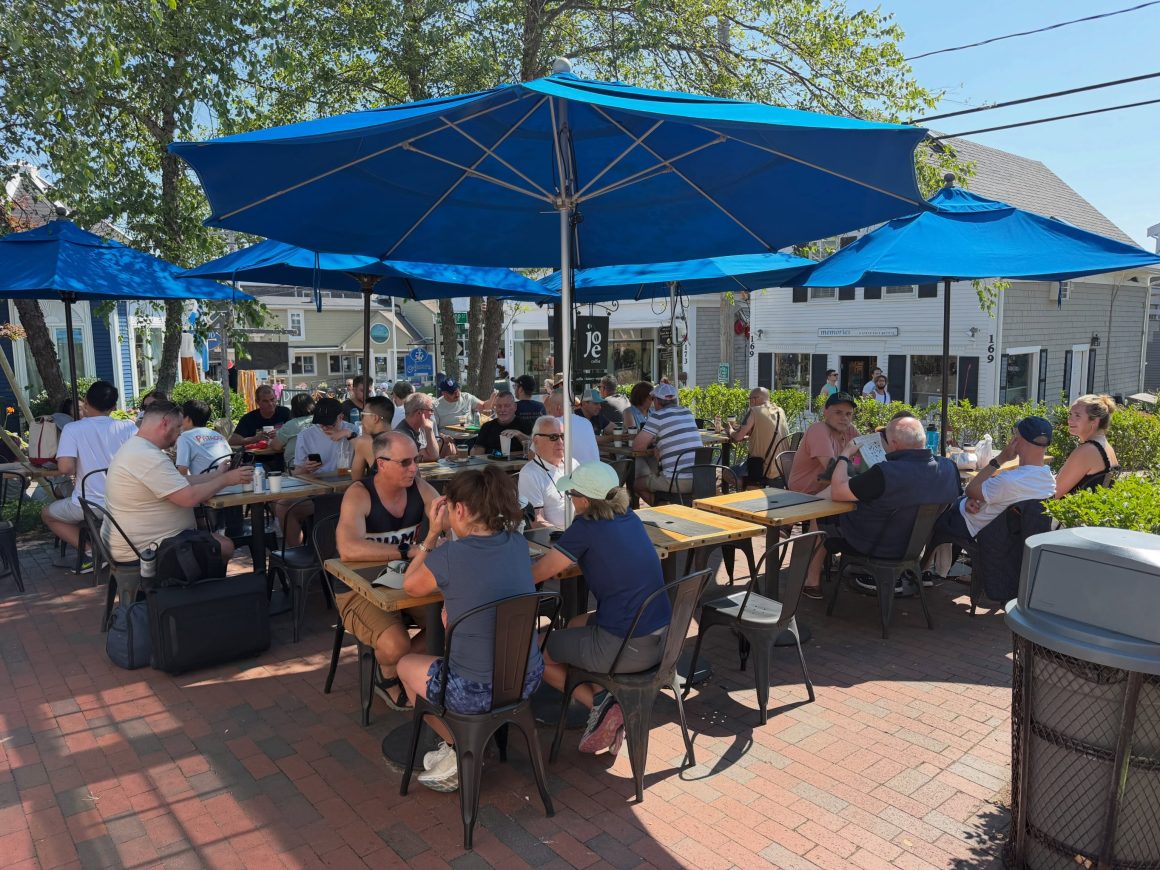
Together we would get on our bicycles dodging the crowd on Commercial Street, through the West End, pass the jetty, and to the salt marshes.
On the path to the beach, you will see the Wood End Light shining white in the distance.
We won’t be going that far today. We’ll find a quiet spot in the dunes. If you’re brave enough and the tide is up, we can go for a cold swim as the salt marsh is filling.
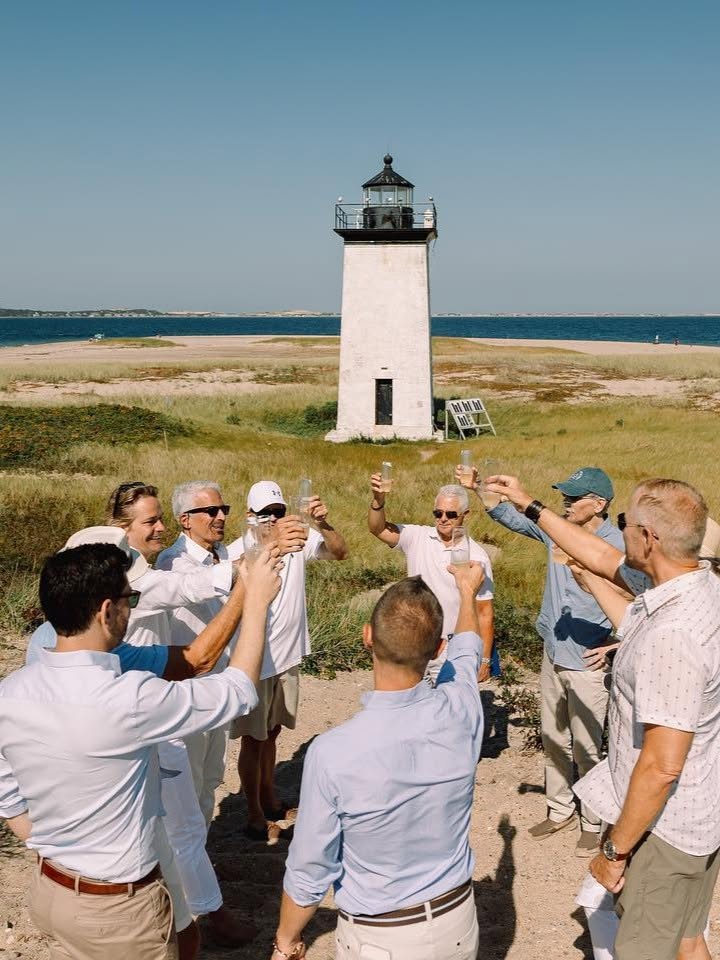
On the way home, in the later afternoon, we can stop into tea dance at the Boatslip.
And as the light begins to soften, we will head up to the Mayflower for dinner; unpretentious, familiar and a taste of old Provincetown. My choice would be the seafood casserole with Ritz cracker stuffing.
An East End Friday night gallery tour to see what’s going on in the art scene.
When the water retreats and lights go on in the cottages, and when the clouds turn pink and gray, we would walk along the bay, collecting shells that the tide has left behind.
There is magic in Provincetown, whatever it is you choose to do on this thin strip of ancient land, whether it is to party all night long, go see a show at the Provincetown Theater, eat an excellent meal with friends at the many restaurants, or take a romantic walk.
It is not merely a town that is shaped by the wind, the sand and the sea. It is shaped by the people who live here, work here, visit here that create the diversity and acceptance that makes Provincetown a place unlike anywhere else.
More artists on their cities, from Locals Insider:
Richard’s Provincetown is part of our series of first-person city guides by the people who make art there. In Paris, surrealist Marie Beltrami — Jean-Paul Goude’s chief stylist for twenty-five years — wrote about fifty years in the city, from the Palace era to the bars she still returns to.
Filmmaker Hadi Moussally wrote about Paris, Barcelona, cinema and finding where you belong — a natural companion read before Richard’s own Barcelona solo opens at Bnude Art Gallery in Spring 2027, and if that show is your excuse for a trip, our guide to boutique hotels in Barcelona away from the crowds covers where to stay.
In Sweden, The White Briefs founder Peter Simonsson shared his guide to Österlen, the coastal corner of Skåne where he lives and shoots his campaigns.
And in Paris again, performer Femi The Scorpion explained why the city became his biggest stage.