



Jet lag is one of those problems that gets less tolerable with age and more frequent with travel. Most “cures” you’ve read about — set your watch to local time, drink water, push through the first day — are folk wisdom dressed up as advice. The actual mechanism is biological: your circadian clock takes roughly one day per time zone crossed to reset, and nothing you do at the airport bar changes that math.
What does work is timing your light exposure, sleep, caffeine, and melatonin against your body’s internal clock with surgical precision. The problem is that figuring out those windows yourself is essentially impossible.
That’s what Timeshifter was built to do, and it’s the reason NASA astronauts, Formula 1 drivers, and Olympic athletes use it. Co-founded by Dr. Steven Lockley — a Harvard Medical School circadian rhythms specialist who has advised NASA on astronaut sleep since 2010 — the app has now processed over 360,000 verified post-flight surveys, with 96.4% of users who followed its advice reporting no severe jet lag. This Locals Insider review covers how it works, what the free tier delivers, current pricing, and whether Flykitt is a better fit for some travelers.
Introducing Timeshifter: The App That Resets Your Body Clock
Timeshifter launched in 2018 in New York, co-founded by Dr. Steven Lockley (Chief Scientist), Danish technology entrepreneur Mickey Beyer-Clausen (CEO), and award-winning UX designer Jacob Ravn. The combination matters: Lockley brings the science (he’s spent nearly 30 years on circadian rhythms research and was on the Harvard Medical School faculty for over two decades before joining Timeshifter full-time in 2024), while Beyer-Clausen and Ravn make sure the app doesn’t require a PhD to use.
The company has raised $5.3 million in funding to date, with investors including Formula 1 World Champion Nico Rosberg, Axiom Space Chief Astronaut Michael López-Alegría, and The Points Guy founder Brian Kelly — notably, the company says all of its investors are active Timeshifter users. The same algorithm now used to time astronaut sleep schedules around rocket launches and spacewalks is what runs on your phone before a long-haul flight.
How Timeshifter Works: Can You Really Reduce Jet Lag Symptoms & Headaches
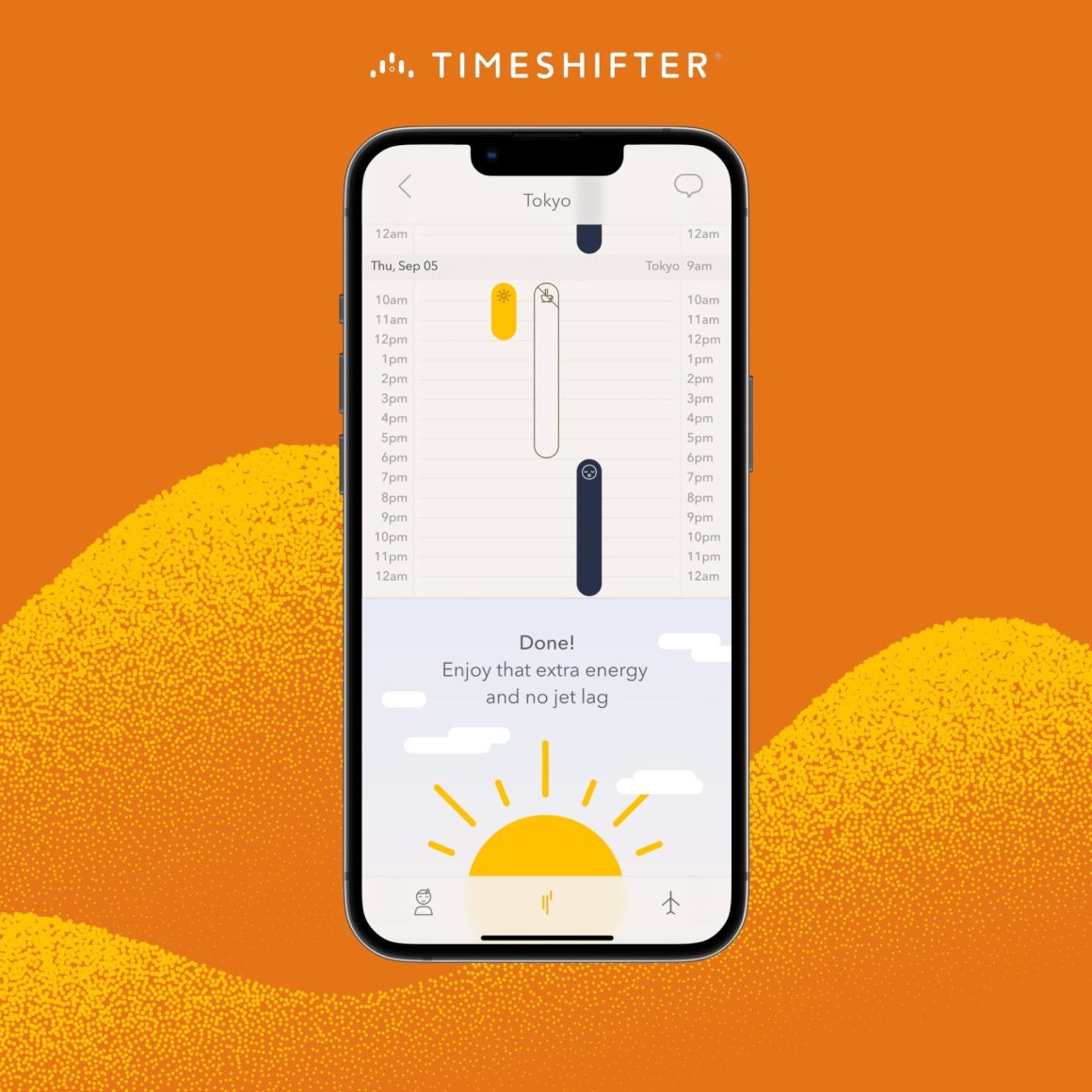
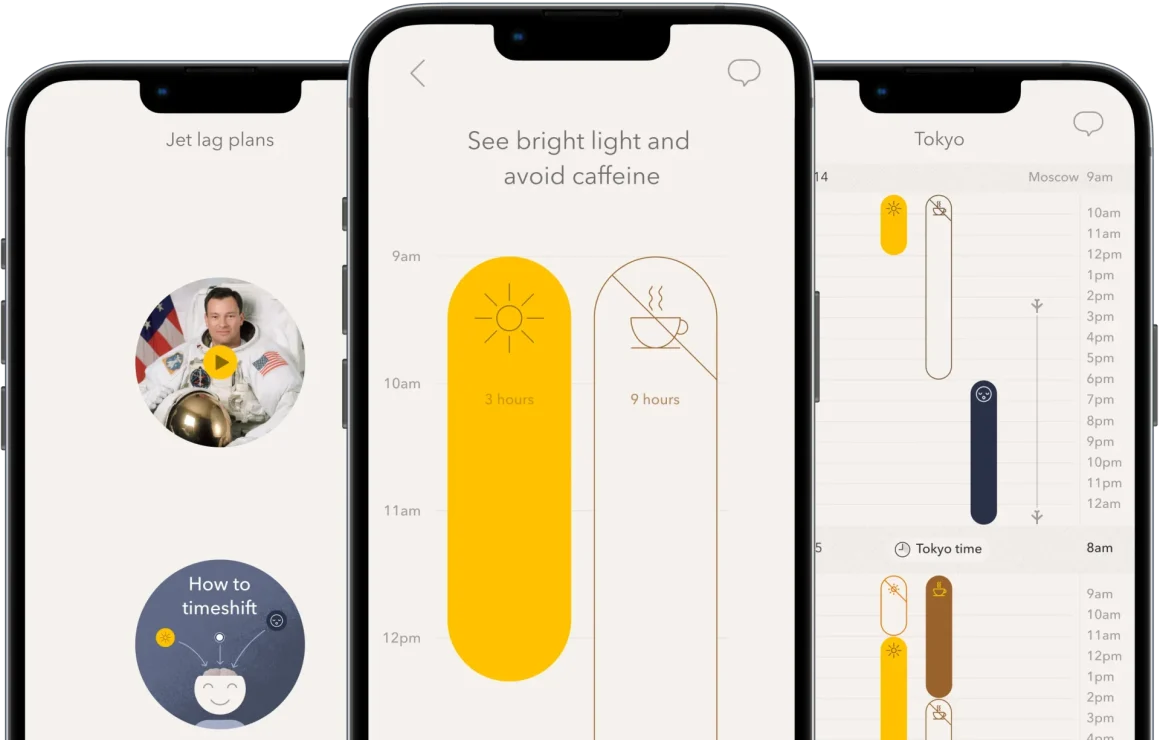
The science is genuinely complex. The execution isn’t. Timeshifter uses light exposure and avoidance to reset your circadian clock — the suprachiasmatic nucleus in your brain that runs your 24-hour sleep-wake cycle. The app tells you exactly when to seek light, when to avoid it, when to sleep, when to drink (or stop drinking) caffeine, and when to take melatonin if you use it.
Setting up a plan takes under a minute:
- Enter your origin and destination
- Add your flight details (including multi-leg flights and stopovers)
- Answer prompts about your chronotype (early bird or night owl) and sleep habits
- Receive your personalized plan with timing windows
You’ll get a fully customized jet lag plan with what Timeshifter calls a Practicality Filter — meaning advice that fits real life rather than recommending you sit in pitch darkness from 7 PM. The plan covers before, during, and after your flight, with push notifications so you don’t have to keep opening the app.
The headline result: according to Timeshifter’s analysis of 360,000+ post-flight surveys, users who followed the advice 80% or more reported no severe jet lag in 96.4% of cases. Travelers who didn’t follow the advice experienced a 6.2x increase in severe jet lag and a 14.1x increase in very severe jet lag.
Timeshifter Jet Lag Fighting App Pricing: How Much Does It Cost?
Timeshifter’s pricing model is genuinely friendly to first-timers:
- First jet lag plan: Free — no credit card required
- Single plans after that: $9.99 each (covers one-way or roundtrip with up to two short stopovers)
- Unlimited annual: $24.99/year — best value for anyone flying internationally more than three times a year
- Shift work app (separate product): $6.99/month or $69.99/year with a 30-day free trial
The unlimited annual plan is the obvious choice for frequent travelers — at $24.99/year, it works out to under $7 per month, and a single international trip with reduced jet lag is genuinely worth the cost.
Timeshifter also has partnerships with several airlines and hotels. United MileagePlus members (and Star Alliance partners Lufthansa, Brussels, Austrian, and Swiss) earn 500 miles for purchasing the unlimited annual plan. United Premier 1K members get Timeshifter free entirely. InterContinental and Six Senses hotels offer a complimentary jet lag plan with any direct booking.
Timeshifter Bonuses & Offers
Timeshifter doesn’t run flashy discount codes, but it has several legitimate routes to free or discounted access that frequent flyers should know:
- First plan free, no credit card required. This is the most generous “trial” in any travel app — a full, working plan for your first trip with zero commitment. Use it on an actual international flight to test the protocol against your real biology before paying for anything.
- United Premier 1K members get Timeshifter unlimited free. If you fly United enough to hit 1K status, register with your MileagePlus credentials for free permanent access.
- All United MileagePlus members earn 500 miles for purchasing the $24.99 unlimited annual plan — effectively reducing the net cost when you factor in the value of the miles. Same offer extends to Star Alliance partners Lufthansa, Brussels Airlines, Austrian Airlines, and Swiss.
- InterContinental and Six Senses hotel bookings include a complimentary single Timeshifter plan with any direct booking — useful for one-off trips where the unlimited plan doesn’t make sense.
- Shift work app 30-day free trial: If you’re a healthcare worker, pilot, or anyone with rotating shifts, the separate shift work app offers a full month free before billing kicks in — long enough to test it against several real shift rotations.
No coupon codes needed for any of the above — the airline and hotel partnership perks apply automatically when you register with your loyalty credentials or book through the partner.
Timeshifter Ratings & Reviews: Is It Legit?
Timeshifter holds strong ratings across both major app stores:
- App Store: 4.7/5.0 (2,500+ reviews)
- Google Play: 4.4/5.0 (1,770+ reviews)
Reviewers consistently call the app intuitive and easy to follow despite the complex science underneath. The combination of personalized timing windows and practical, real-world advice (rather than impossible-to-follow instructions) draws the most praise. Frequent flyers particularly recommend the unlimited annual plan, and shift workers — nurses, pilots, emergency responders — write strongly about the separate shift work app’s impact on their productivity between shifts.
The criticism is honest: the advice sometimes asks for things that are hard to execute in real life (bright light at 2 AM on a packed plane, sleeping during turbulence, avoiding caffeine when you’re already exhausted). The Practicality Filter mitigates this, but some compromise is unavoidable in any real travel scenario.
One Google Play reviewer, Amanda Preston, wrote: “This app is so good. My partner and I traveled from the UK to New Zealand and back – a 30-hour journey each way on opposite time zones – with no jet lag on the way there, and very little impact on the way back.”
Insider tip: Start your Timeshifter plan two to three days before you fly, not the morning of departure. The biggest jet lag wins come from gradually shifting your sleep and light exposure before you even leave home — by the time you land, your circadian clock is already most of the way to local time. Skipping the pre-travel phase is the single most common reason people say “the app didn’t work for me.”
Alternatives to Timeshifter: Try Flykitt
If Timeshifter’s app-only approach feels too disciplined, Flykitt by Fount is the strongest alternative — and a fundamentally different philosophy. Where Timeshifter relies on behavioral timing alone, Flykitt combines an AI-driven app with a physical kit: blue-light-blocking glasses, custom supplements (designed to reduce inflammation and support circadian reset), and a circadian-reset drink mix. The research base is also different — Flykitt was developed from work with Navy SEALs and fighter pilots, where rapid time-zone adjustment is operationally critical.
The catch is the cost. The Flykitt Core (round-trip kit) starts around $99 for the physical components, with subscription pricing available for frequent travelers. That’s significantly more than Timeshifter’s $24.99/year unlimited plan — but you’re paying for a more comprehensive product, not just an app.
Bottom line: Choose Timeshifter if you trust behavioral protocols and want an app-only solution at low cost. Choose Flykitt if you want supplements and glasses included, and don’t mind paying premium for a physical kit. Both have credible scientific backing — Timeshifter through Harvard and NASA, Flykitt through US military human-performance research.
For physical gear that pairs well with the Timeshifter protocol — eye masks, noise-canceling headphones, light-blocking accessories — our guide to the best travel accessories for long-haul flights covers what to pack alongside the app, and our roundup of the 12 best travel gadgets for your journeys covers the broader toolkit (power banks, water bottles, in-flight comfort gear) that makes long-haul flights more recoverable in the first place.