


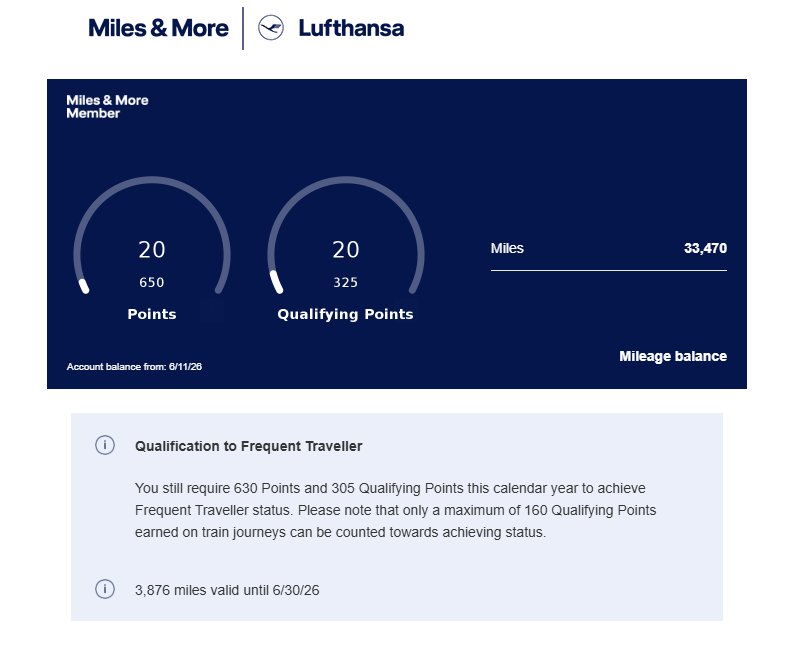
I opened my Miles & More app for the first time in months yesterday morning, just to check the damage. The dashboard tells a clean little story: 33,470 miles in the balance, 3,876 of them quietly counting down to expire on 30 June 2026 — about 19 days from now. The status meter at the top reads 20 out of 650 Points, and 20 out of 325 Qualifying Points. Which means that after more than a decade of Lufthansa, SWISS, and Brussels Airlines flights between Copenhagen, Malta, Paris, and Frankfurt, I’m somewhere around 3% of the way toward Frequent Traveller — the entry-level Star Alliance Silver tier, not even close to the genuinely useful Senator threshold above it.
That gap between “I’ve earned plenty of miles over the years” and “I have no usable status to show for it” is the bit nobody tells you about when you sign up for an airline loyalty program. The Miles & More app makes it easy to check the balance and the qualifying meter, but actually turning miles into something worthwhile — a flight, an upgrade, a hotel night, even a quiet lounge corner before a 7am departure — is consistently the hard part. That tension between “I should use them” and “I tried to book a Lufthansa flight to Bangkok in business class and the award seat doesn’t exist on any date that works” is the central reality of every major airline loyalty program in 2026.
Miles & More went through its biggest overhaul in years on 1 January 2024, when Lufthansa replaced the old miles-based status system with a Points and Qualifying Points structure. Status is now determined by your travel class and whether each flight is continental or intercontinental, rather than the old system that depended on fare-class multipliers and ticket price. A 2025 Marriott Bonvoy partnership added another way to earn Points without flying, and the partner network has been refined as airlines have joined and left the Star Alliance ecosystem — most notably SAS, which left Star Alliance and joined SkyTeam on 1 September 2024 and is no longer a Miles & More partner.
This Locals Insider review covers how Miles & More actually works in 2026, the post-2024 status system, where points deliver real value (and where they don’t), our honest experience with airline loyalty in general, and the alternatives worth comparing — using my own half-finished qualifying year as the running case study, because the actual numbers tell the story better than any marketing brochure ever could.
But First – What 20 Out of 650 Points Actually Means: A Mid-Year Reality Check
This is where the abstract numbers turn into a real worked example. My own account, checked while writing this piece, sits at 20 Points and 20 Qualifying Points against thresholds of 650 and 325 — roughly 3% of the way through the qualifying year, with about six and a half months left to make up the rest. The screenshot at the top of this section is the dashboard exactly as Miles & More shows it, and it’s worth using as a starting point for the same question every casual member faces around mid-year: is it still worth chasing status from here, and what would it actually take?
Miles & More publishes a useful set of practical tips for exactly this scenario. The honest answer is yes, the gap is closable — but only with specific intent rather than passive accumulation. Here’s how the math shakes out across the four earning paths.
Tip 1: Long-haul flights are the engine
An intercontinental flight in Premium Economy on a Lufthansa Group airline earns 80 Points and 80 Qualifying Points each way — 160 of each for a round-trip. Book a Green Fare ticket (the eco-conscious fare with built-in carbon offsetting) and you get a 10% Points uplift; layer on a CO₂-saving package with SAF (sustainable aviation fuel) and that can rise to as much as +80% on top. A single Premium Economy round-trip with both bonuses applied can deliver up to 288 Points and 288 Qualifying Points — which on its own takes my balance from 20 QP nearly to the 325 threshold in one trip.
There’s also a summer Premium Economy promotion running on Lufthansa Group flights between early June and late August, adding another 50% Points on top of the standard earning rate. If I were going to chase status this year, this is the obvious window — a single transatlantic Premium Economy return in July or August, ideally on a Green Fare, would land me at or above the qualifying line by itself.
Tip 2: Rail transfers count toward status
If you book a Lufthansa Group flight with a connecting rail leg via Austrian AIRail, Lufthansa Express Rail, or SWISS Air Rail, the train journey earns Points the same way a comparable feeder flight would. A Hamburg-to-Frankfurt return earns 40 Points and 40 Qualifying Points. The catch is in the small print: only the first 160 Qualifying Points from rail journeys count toward status each calendar year — so trains can supplement long-haul flying but can’t replace it.
Tip 3: Marriott Bonvoy stays
The 2025 partnership now lets you earn 40 Points per qualifying Marriott stay of at least one night, capped at three stays (120 Points) annually. The important footnote: these are Points only — zero Qualifying Points — so Marriott stays help you toward the 650 P target but contribute nothing to the 325 QP requirement that’s currently my real bottleneck. Useful supplement, not a primary path to status.
Tip 4: Credit card miles conversion (Germany only)
If you hold a German-market Miles & More Gold Credit Card, you can exchange up to 25,000 credit-card-earned miles for 100 Points and 100 Qualifying Points per year, at a fixed rate of 5,000 miles for 20 of each. Geography- and card-specific, but worth knowing if you qualify. Outside Germany this option doesn’t apply, so most international members are back to the flying-and-staying paths above.
Miles & More went through its biggest overhaul in years on 1 January 2024, when Lufthansa replaced the old miles-based status system with a Points and Qualifying Points structure. Status is now determined by your travel class and whether each flight is continental or intercontinental, rather than the old system that depended on fare-class multipliers and ticket price.
A 2025 Marriott Bonvoy partnership added another way to earn Points without flying, and the partner network has been refined as airlines have joined and left the Star Alliance ecosystem — most notably SAS, which left Star Alliance and joined SkyTeam on 1 September 2024 and is no longer a Miles & More partner.
This Locals Insider review covers how Miles & More actually works in 2026, the post-2024 status system, where points deliver real value (and where they don’t), our honest experience with airline loyalty in general, and the alternatives worth comparing.
What is Miles & More
Miles & More is the Lufthansa Group’s loyalty program, launched in 1993 and now the largest frequent flyer program in Europe with around 36 million members. You earn miles and points by flying with Lufthansa, SWISS, Austrian, Brussels Airlines, Discover Airlines, ITA Airways, LOT Polish Airlines, Air Dolomiti, Eurowings, Luxair, plus the broader Star Alliance network and a handful of non-alliance partners.
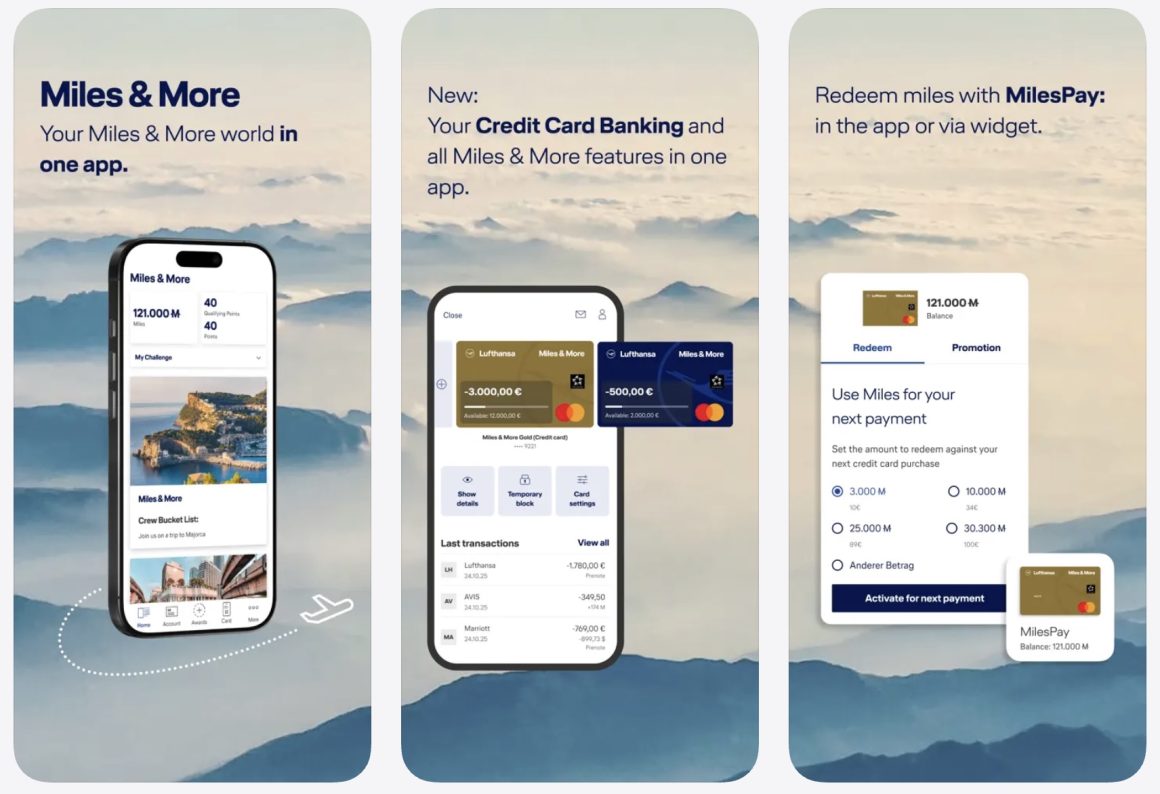
You can also earn through hotel stays (now including Marriott Bonvoy as of the 2025 partnership), car rentals, the Worldshop, and Miles & More co-branded credit cards.

The easiest way to track your account is through the Miles & More app, which is free to download on the App Store and Google Play Store.
There are also several Miles & More credit cards depending on your region. In the United States, Barclays issues the Miles & More World Elite Mastercard, with welcome bonuses up to 70,000 miles plus the option to convert spending miles into Points and Qualifying Points (which is how some US-based members reach status without flying as much).
In Europe, Deutsche Bank’s Miles & More credit cards are the most widely used, with Lufthansa-themed variants offering bonus miles on Lufthansa Group airline purchases.
How Does Miles & More Rewards Work?
The program operates on three parallel currencies, which can be confusing at first but make sense once you understand the structure.
Award Miles are what you redeem for flights, upgrades, hotel nights, and merchandise. These are earned on flights, credit card spending, hotel stays, partner shopping, and Marriott Bonvoy stays. Award miles expire after 36 months unless you have status or hold an active Miles & More credit card.
Points are what determine your status (Frequent Traveler, Senator, HON Circle). These are earned only on flights with airlines that participate in the program — which means all Star Alliance carriers plus integrated Miles & More partners.
Qualifying Points are a subset of Points earned only on Lufthansa Group airlines and fully integrated Miles & More partners (Lufthansa, SWISS, Austrian, Brussels Airlines, Discover Airlines, ITA Airways, LOT Polish Airlines, Air Dolomiti, Eurowings, Luxair). To achieve any status, you need both a minimum number of Points and a minimum number of Qualifying Points within a calendar year.
The number of Points earned per flight depends on travel class and whether the flight is continental or intercontinental:
| Flight Type | Economy | Premium Economy | Business | First |
|---|---|---|---|---|
| Continental | 20 | 20 | 40 | 40 |
| Intercontinental | 60 | 80 | 200 | 400 |
You earn the same number of Points, Qualifying Points, and HON Circle Points per eligible flight segment, though some flights don’t qualify for all three categories.
How to Use Miles & More
Here’s how a typical flow plays out — booking a Lufthansa flight and claiming the miles after travel:
- Before booking, sign in to your Miles & More account via the app or website so your member number is attached to the reservation automatically. If you book through a travel agent or third-party site, enter your Miles & More number manually in the passenger details.
- Take the flight. If you forget to attach your number, you can submit a retroactive miles claim within 6 months by uploading your boarding pass and ticket receipt in the app under “Mileage credit.” Most claims are processed within 4-8 weeks.
- Check your balance in the app after the flight. Miles typically post within 7-14 days. The app shows your award miles, Points, Qualifying Points, and HON Circle Points separately.
- To redeem, tap “Use miles” in the app and choose your category — award flight, upgrade, hotel stay, car rental, or Worldshop merchandise. For flights, the Lufthansa booking engine shows real-time award availability across partner airlines. For upgrades, you can request an upgrade at the time of booking or close to departure if there’s availability.
- Confirm the redemption. The miles are deducted instantly and you receive a booking confirmation. Some redemptions (like hotel stays through partners) take longer to process.
The whole flow works smoothly when award availability exists. The challenge — covered honestly below — is that for popular destinations and dates, the award seats often don’t.
Status Tiers: Frequent Traveler, Senator, HON Circle
Status determines benefits like extra baggage allowance, lounge access, priority boarding, fast-track security, and bonus miles on every flight. The current thresholds (as of the January 2024 overhaul) are:
Frequent Traveller (Star Alliance Silver): 650 Points + 325 Qualifying Points per calendar year. Benefits include 50% bonus award miles on flights, priority check-in, extra baggage allowance, and lounge access on Lufthansa Group flights with a paid Business Class ticket.
Senator (Star Alliance Gold): 2,000 Points + 1,000 Qualifying Points per calendar year. All Frequent Traveller benefits plus Senator and Star Alliance Gold lounge access worldwide, priority boarding on all Star Alliance carriers, additional baggage allowance, and upgrade vouchers.
HON Circle Member: 6,000 HON Circle Points per calendar year. The exclusive top tier, earned through business and first-class travel on Lufthansa Group airlines. Benefits include private limousine transfers, dedicated HON Circle Lounges, guaranteed seat availability on full flights, and personal travel concierge service.
A notable change in 2024: status is now valid for a minimum of one year plus the period until the end of February in the year after next. If you qualify in May 2024, your status is valid until end of February 2026 — significantly more generous than the old strict-calendar-year system. If you don’t requalify, you drop one tier (Senator becomes Frequent Traveller, for example).
The Marriott Bonvoy partnership added in 2025 lets linked-account members earn up to 120 Points per year toward elite status by staying at qualifying Marriott properties (40 Points per qualifying 1-night stay, capped at 3 stays annually).
Partner Airlines

Miles & More currently has around 35 airline partners, plus dozens of additional partners across hotels, car rentals, shopping, dining, and finance — bringing the total to approximately 67 partner brands. The airlines you can earn and redeem with include:
Aegean, Air Astana, Air Canada, Air China, Air Dolomiti, Air India, Air New Zealand, All Nippon Airways, Asiana Airlines, Austrian Airlines, Avianca, Brussels Airlines, Cathay Pacific, Copa Airlines, Croatia Airlines, Discover Airlines, EgyptAir, Ethiopian Airlines, Eurowings, EVA Air, ITA Airways, LATAM Airlines, LOT Polish Airlines, Lufthansa, Luxair, Olympic Airlines, Shenzhen Airlines, Singapore Airlines, South African Airways, SWISS, TAP Portugal, Thai Airways, Turkish Airlines, United.
Notable absence in 2026: SAS (Scandinavian Airlines) left Star Alliance and joined SkyTeam on 1 September 2024. If you previously earned Miles & More points on SAS flights, those flights no longer qualify. SAS now uses its own EuroBonus program, which is part of the SkyTeam network alongside Air France, KLM, Delta, and Korean Air.
This shift is worth knowing about because many travelers in Scandinavia, Northern Europe, and beyond have moved their primary loyalty from Miles & More to either EuroBonus or Flying Blue depending on their typical routes.
What is the Value of Miles & More Points?

The value of Miles & More points depends entirely on how you redeem them. Different redemption categories deliver very different value per mile:
Merchandise (Worldshop) and lifestyle redemptions typically offer the lowest value — roughly $5-10 per 1,000 miles. This is where many casual members end up using their miles by default, but it’s the worst use of them.
Economy award flights on short and medium-haul routes sit at the lower-middle end — around $10-15 per 1,000 miles. Useful for off-peak travel where the cash fare is moderate, but rarely a great deal.
Business class on intercontinental routes is where Miles & More miles genuinely shine — sometimes $30-50 per 1,000 miles in equivalent cash value. A Frankfurt to Singapore business class redemption that would cost €4,000-6,000 in cash might be available for 105,000 miles plus taxes — strong value if you can find the award seat.
First class redemptions on Lufthansa or partner airlines can deliver the highest theoretical value — sometimes $80-100 per 1,000 miles — but availability is famously scarce and most first-class award seats only open up within a few weeks of departure.
Miles & More provides a points calculator on its website to estimate redemption value for specific destinations and travel classes, but the honest reality is that real-world award availability is often the limiting factor, not the points balance itself.
Reviews & Our Personal Take
The Miles & More app itself is well-rated:
- App Store rating: 4.5/5.0 (around 1,700 reviews)
- Google Play Store rating: 3.2/5.0 (around 19,100 reviews)
The disparity between iOS and Android ratings is unusual but consistent across many travel apps — Android user bases tend to be more critical of bugs and update issues. The most common positive feedback praises the integrated credit card management (Deutsche Bank or Barclays cards can be added to the same app), real-time mile tracking, and a streamlined Worldshop interface.
A representative Google Play Store review reads: “Easy and user-friendly. It’s perfect if you compare this app to the old one. Now you have the Miles & More shop and your credit card in one app — no more switching between apps” — John Adams-Bryan.
Common complaints across both stores include occasional sync issues between flight bookings and mileage credits, the difficulty of finding business and first-class award availability on popular routes, and the booking interface not always showing partner airline awards clearly.
The honest take on my own points gap
For the 305 Qualifying Points I’d still need, the cleanest realistic route is a single intercontinental round-trip in Premium Economy on Lufthansa or SWISS — which would cover roughly half the gap (160 QP) at base rate, or comfortably the whole thing (240–288 QP) with the Green Fare and summer promotion stacked. A Business Class long-haul return delivers 400 Qualifying Points by itself and locks in the status with room to spare, but the cash outlay for that is rarely justified by the status benefits alone unless you’d be travelling that way anyway.
Whether it’s worth chasing depends on what Frequent Traveller actually buys you in practice. For me, the answer is honest and slightly deflating: the meaningful perks (priority boarding, extra baggage, occasional lounge access on Business Class tickets I’d often have anyway) are pleasant but not transformative. The real value-per-flight uplift starts higher up at Senator level, which sits roughly four times further away.
So my own half-finished qualifying year is probably going to stay half-finished — and that’s a useful answer to have rather than an embarrassing one. The miles will keep accumulating passively whenever I fly the Lufthansa Group, and one day they’ll either feed into a status push during a year I’m flying more, or they’ll quietly fund an upgrade somewhere along the way.
Before any of that, though, there’s the 3,876 miles expiring on 30 June 2026 to deal with. Those don’t extend automatically. They need to be either redeemed (smallest useful options: a Worldshop purchase, or an upgrade fee co-pay on an existing booking) or activated through any qualifying account activity to push the expiry window forward.
A single posted flight or even a small partner shopping credit before the 30th resets the clock. The lesson from this small piece of urgency is the broader lesson of every airline loyalty program: the points only work if you treat them as something to actively manage, not a passive savings account that quietly grows in the background.
Locals Insider tip: If you fly Lufthansa Group airlines regularly, attach your Miles & More number to every booking anyway — the miles accumulate passively and cost nothing extra. Where the program genuinely earns its keep is in airport lounge access (Senator and HON Circle members), priority boarding, and extra baggage on long-haul trips. The real value of mid and high-tier status isn’t in eventually redeeming a business class ticket — it’s in making every flight you pay for noticeably more comfortable.
Miles & More’s Pros and Cons
The strengths: the largest frequent flyer program in Europe with 35+ airline partners across Star Alliance, simplified Points-based status system since January 2024, valid status period extended to roughly 1.5 years (significantly more generous than before), Marriott Bonvoy partnership now adds non-flying paths to status, Worldshop and credit card consolidation in the app, strong lounge network for Senator and HON Circle members, miles don’t expire if you hold status or an active Miles & More credit card.
The trade-offs: award seat availability for popular routes and dates is consistently scarce, business and first-class redemptions hardest to find for the routes that matter most, the points system is more complex than competitors (three currencies to track), Worldshop redemptions deliver poor value, lower-tier Frequent Traveller status benefits are modest compared to Senator, no easy transfer partners for buying miles efficiently (unlike Avios via Amex Membership Rewards), and the Android app rating reflects ongoing technical issues that the higher iOS rating obscures.
Alternatives to Miles & More? Consider Avios
Avios is the best-known alternative to Miles & More and remains a strong rewards program if you frequently fly with British Airways, Aer Lingus, Iberia, Vueling, Finnair, Qatar Airways, or Loganair. The Avios currency is owned and operated by IAG Loyalty (a subsidiary of International Airlines Group), not by British Airways directly.
Originally founded as Air Miles in 1988 and rebranded Avios in 2011, the program now has around 70 million members worldwide. The Avios airline network is narrower than Miles & More, but the redemption flexibility within that network is often better — Avios works particularly well for short-haul European routes where it can offer good value per point.
For travelers based in Scandinavia, the UK, or anyone flying SAS regularly, EuroBonus has become the more relevant program since SAS left Star Alliance for SkyTeam in September 2024. EuroBonus points can now be earned and redeemed across the SkyTeam network including Air France, KLM, Delta, and Korean Air, alongside SAS itself. The redemption options include SAS in-flight WiFi from just 1,000 points, the EuroBonus Shop, hotel stays through 250,000+ partner properties, and flight upgrades.
The right choice depends on which airlines you actually fly. If your typical routes are on Lufthansa, SWISS, Austrian, Brussels Airlines, or Star Alliance carriers like United, Air Canada, ANA, or Singapore Airlines, Miles & More is the natural fit. Avios makes more sense for travelers who mainly fly British Airways, Iberia, or other OneWorld airlines. Meanwhile, EuroBonus is the obvious choice for those based in the Nordic region or flying SAS regularly.
Many frequent travelers eventually maintain accounts in multiple programs and credit each flight to whichever program offers the best value for that specific airline.
For more on getting the most out of travel, you might find our best travel apps roundup, our guide to the travel accessories for long-haul flights, and our 12 cool travel gadgets list useful starting points.